


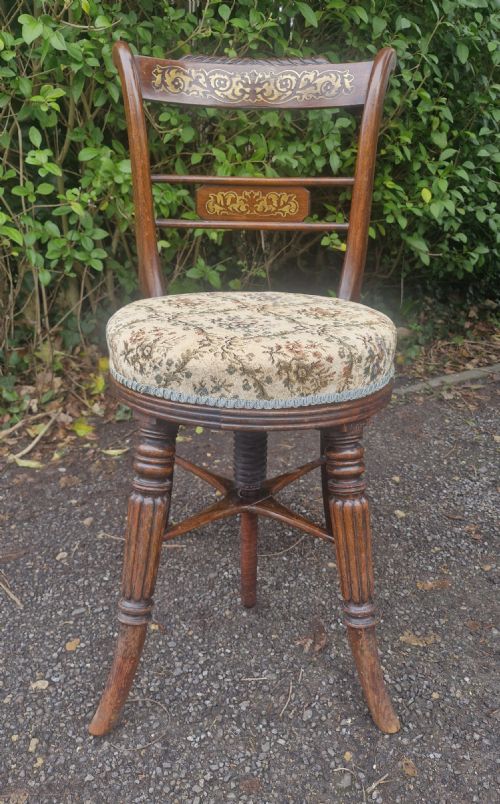
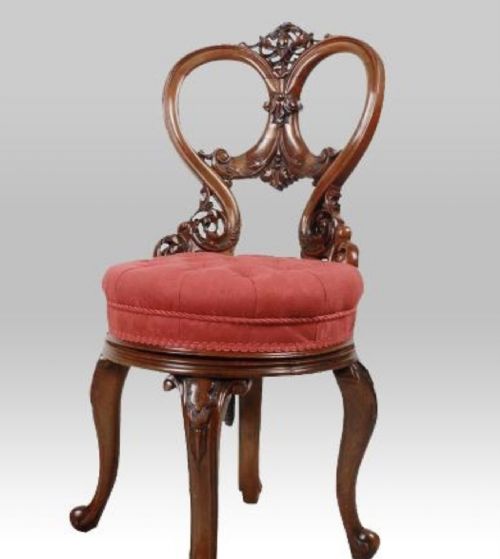


Rosewood Revolving Stool
A rosewood revolving stool offers the precise seat adjustment demanded at the keyboard, combining dark figured timber with a clever mechanism.
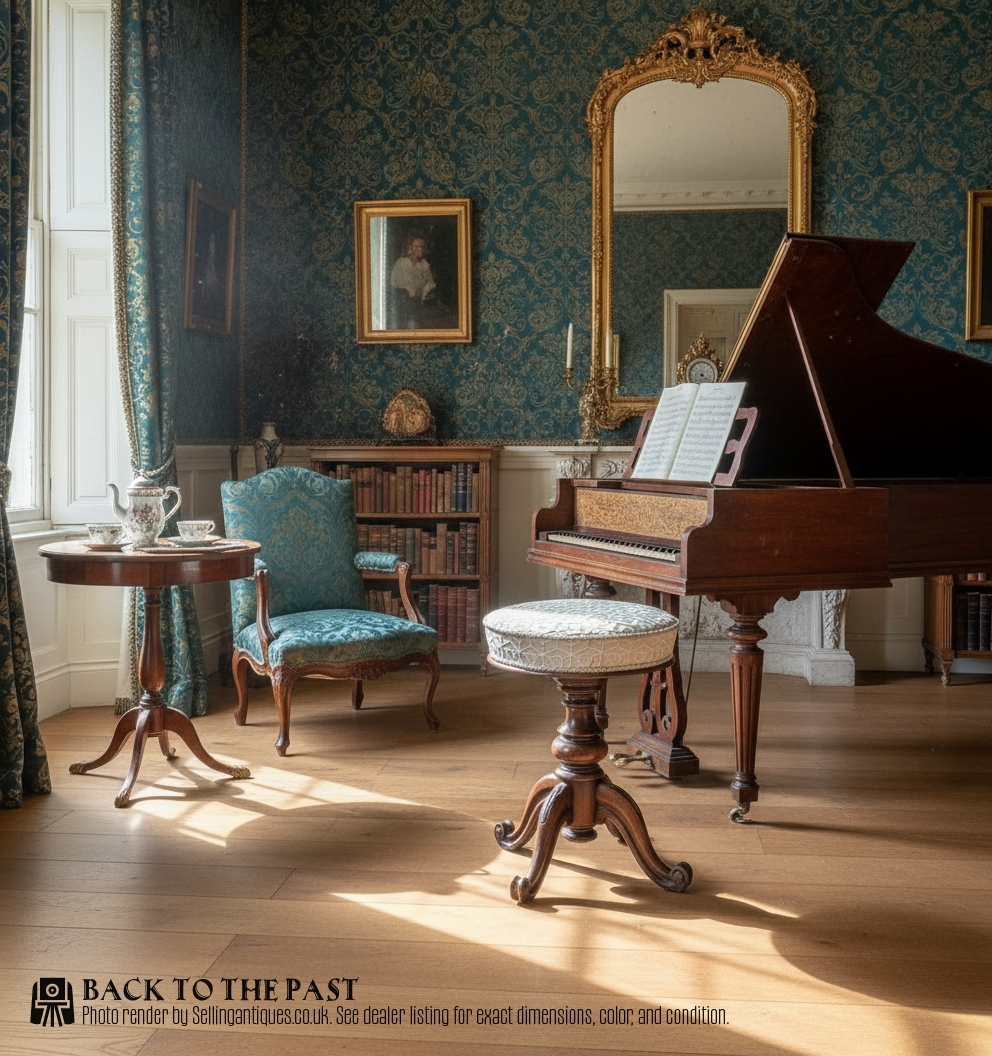
Rosewood Revolving Stool
A rosewood revolving stool is primarily encountered as a piano stool, music chair, or dressing table seat dating from the Regency, William IV, and Victorian periods. These pieces serve both domestic utility and decorative refinement, frequently appearing in forms that rise and fall through a central screw mechanism.
The selection ranges from early Georgian and Regency examples to late Victorian and Arts and Crafts iterations. Buyers will find piano stools and music chairs designed with revolving tops or adjustable rising seats to suit musicians and performers.
Forms extend from straightforward circular revolving tops to elaborate harpist chairs with backs and brass inlaid frames. Whether configured for the piano, organ, or dressing table, each piece displays the distinctive dark grain of rosewood timber.
How they were made
Cabinetmakers utilised dense rosewood, occasionally enhanced with boxwood inlay, gilt decoration, or simulated rosewood finishes over alternative timbers. The structural frames often incorporate carved elements and solid turnings to support the weight of the mechanism.
Musicians historically required these revolving seats because enthusiastic piano practice demanded constant, millimetric height adjustments without leaving the keyboard.
What varies in quality
The distinction between ordinary and superior pieces lies in the crispness of the timber carving, the execution of boxwood inlay, and the finesse of the gilt decoration. Higher grade items exhibit dense, well-figured rosewood and robust mechanical engineering in the revolving screw action.
Maker attribution elevates certain examples, particularly those bearing the hallmarks of established workshops like Gillows or patented mechanisms such as Brooks Patent. The integration of quality secondary woods and the original condition of the upholstery ensemble further distinguish the finer pieces.
Gillows·Brooks Patent
The Rosewood Revolving Stool Glossary
- Rosewood
- A heavy, durable tropical timber prized for its dark purple-brown colour and contrasting black grain figures. It accepts a high polish and forms the primary carcass material for these stools.
- Revolving mechanism
- The internal screw thread or pivot assembly allowing the seat top to turn through three hundred and sixty degrees. This engineering enables the user to alter their seating height.
- Simulated rosewood
- A painted or stained finish applied to a lighter domestic timber to mimic the distinctive grain pattern of genuine rosewood. This technique appeared on furniture produced during the Regency era.
- Boxwood inlay
- Contrasting pale wood sections inserted flush into the darker rosewood surface to create geometric or floral patterns. This decorative technique highlights the borders and friezes of better pieces.
- Harpist chair
- A specialised music seat featuring a low or partial back designed to accommodate the player's arms and instrument. These chairs frequently incorporate revolving and adjustable rising functions.
Rosewood Revolving Stool: Frequently Asked Questions
How do I adjust the height on a rosewood revolving stool?
Most models operate via a central wooden or metal screw thread concealed beneath the upholstered top. Turning the seat clockwise or anticlockwise raises or lowers the platform to the desired playing position.
Some examples utilise a rise and fall mechanism secured by a side lever or thumbscrew. Care must be taken not to unscrew the top beyond its intended stopping point.
Were these stools only used for playing the piano?
While primarily designed as piano stools and music chairs for keyboard players and harpists, their utility extended across the Victorian home. They frequently served at dressing tables and organs where adjustable seating proved necessary.
The compact footprint and decorative rosewood frames made them versatile occasional seats in drawing rooms and parlours.
How can I tell a Regency stool from a Victorian one?
Regency and William IV pieces often display classical restraint, featuring brass inlay, simulated rosewood finishes, and sabre legs influenced by ancient Greek and Roman forms. The timber grain tends to be crisp and the proportions architectural.
Victorian examples generally show heavier proportions, more robust carving, and increasingly complex mechanical adjustments. Late Victorian and Arts and Crafts versions introduce simpler forms with honest structural joinery.
What is a harpist chair and how does it differ?
A harpist chair is a specific form of music seat constructed with a modified or absent backrest to allow the musician clearance for the instrument. These chairs share the revolving and adjustable properties of standard piano stools.
Their frames are shaped to accommodate the physical posture required when performing on the harp rather than sitting squarely at a keyboard.
How should I care for the rosewood and fabric upholstery?
Rosewood benefits from occasional treatment with appropriate furniture wax to nourish the timber and maintain its deep lustre. Avoid placing the stool near direct heat sources or strong sunlight which can fade the dark grain.
Upholstery in velvet, tapestry, or textile requires gentle brushing or professional cleaning suited to antique fabric. The mechanical screw should be kept lightly lubricated to ensure smooth operation.