


Rosewood Magazine Holder
A rosewood magazine holder is a practical piece of library or drawing room furniture, most frequently seen here as a nineteenth-century Canterbury.
Rosewood Magazine Holder
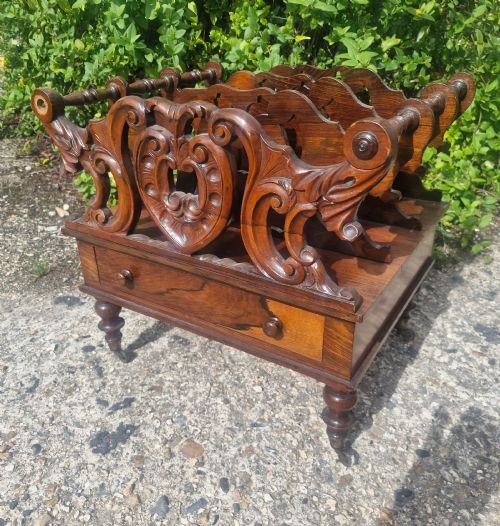
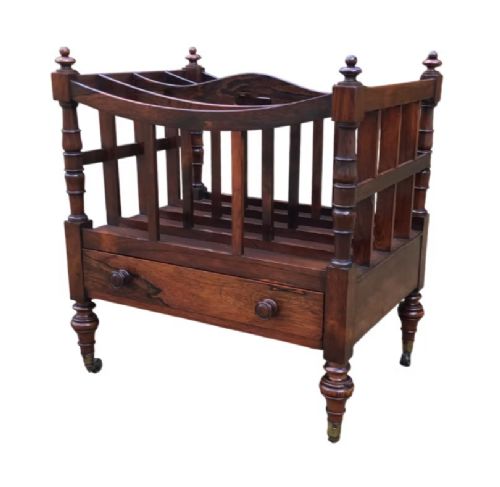
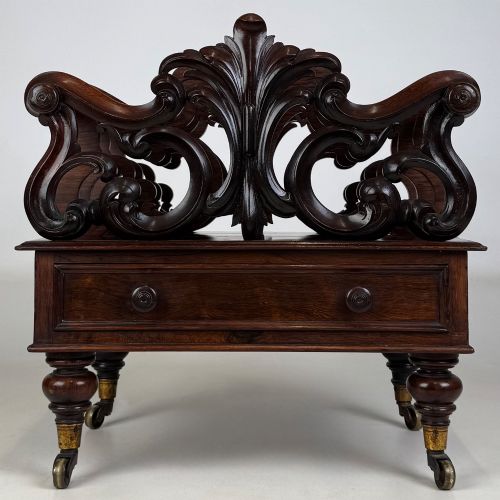
When you search for a rosewood magazine holder, you are looking at nineteenth-century storage pieces designed to hold sheets of music, newspapers, and periodicals close to hand. The most common form on this page is the Canterbury, a compartmented stand raised on castors that often includes a low drawer in the base.
The evidence shows origins spanning the Regency, Victorian, William IV, and Georgian periods, with styles ranging from plain country house items to finely carved French and English designs. You will find pieces featuring turned columns, brass inlay, and cut-out slats, alongside larger folio stands and occasional tables adapted for the same purpose.
Materials and construction
Cabinet makers built these pieces using dense tropical rosewood, valued for its deep grain and dark purple-brown colour. Many examples incorporate contrasting brass castors, handles, and delicate inlay to accent the timber.
Structural elements frequently include mahogany for secondary framing and internal drawer linings. Carved details such as foliate motifs or the Prince of Wales feathers appear directly on the solid rosewood uprights and divisions.
Judging the work
Quality in a rosewood magazine holder rests on the crispness of the joinery and the selection of the timber. Better examples display carefully matched grain patterns across the divisions and drawer fronts, rather than haphazardly joined boards.
The sophistication of the turning and carving distinguishes standard production from superior pieces. Workshops influenced by designers like Loudon or makers such as Gillows achieved cleaner lines in the slatted divisions and sturdier joints in the underframe.
Gillows·J C Loudon
The Rosewood Magazine Holder Glossary
- Folio stand
- A larger piece designed to hold oversized prints, drawings, or bound sheets rather than loose periodicals. These often share the structural layout of a Canterbury.
- Whatnot
- A set of open shelves for displaying ornaments or holding books, occasionally combined with a Canterbury base unit in nineteenth-century designs.
- Regency
- An English design period spanning the early nineteenth century, characterised by classical restraint, elegant proportions, and classical revival motifs.
- William IV
- A transitional stylistic period bridging the Regency and early Victorian eras, noted for robust proportions and heavier carved ornamentation.
Rosewood Magazine Holder: Frequently Asked Questions
How do I distinguish Regency pieces from Victorian ones?
Regency pieces dating from the early nineteenth century tend to show clean architectural lines, brass stringing, and restrained classical details. They often reflect the influence of designers like Loudon.
Victorian examples from the mid to late nineteenth century frequently display heavier carving, such as foliate motifs or pierced woodwork. The timber grain on Victorian pieces can also vary from the dense dark rosewood typical of earlier decades.
Where were these pieces used in the home?
These stands sat beside the piano, near the fireplace in the drawing room, or within a country house library. They kept daily newspapers, sheet music, and current reading material neatly sorted and portable.
The inclusion of carrying handles allowed servants or family members to move the stand easily between rooms as social habits shifted throughout the day.
How should I care for rosewood furniture?
Rosewood benefits from being kept away from direct sunlight and steady heat sources to prevent the dense timber from drying out. A light application of appropriate wax polish maintains the lustre of the grain.
Avoid using modern liquid sprays containing silicone, which can build up on the historic polish and dull the natural appearance of the wood over time.