




Georgian Rosewood Canterbury
A Georgian rosewood canterbury is a compartmentalised stand for sheet music, newspapers and magazines, prized for its timber figure and utility.
Georgian Rosewood Canterbury
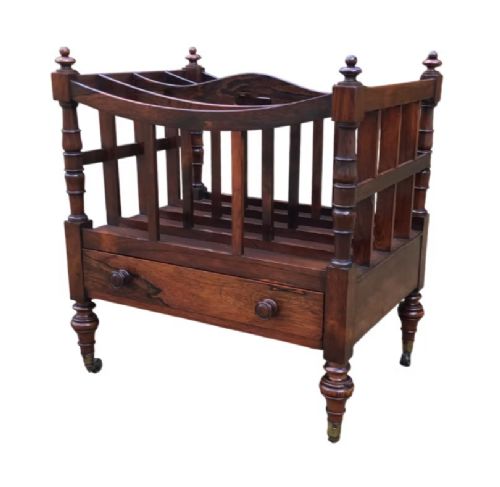
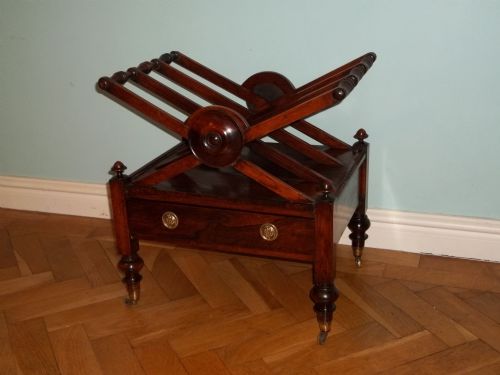
A georgian rosewood canterbury is a specialised stand designed to hold sheet music, newspapers, magazines, and folios within divided partitions above a low drawer or plinth base. These pieces span the Georgian, Regency, George III, George IV, and William IV periods, alongside broader nineteenth-century examples.
The version most commonly encountered on this page is the Regency rosewood canterbury, frequently featuring four or three divisions, sometimes incorporating a carrying handle or carved details such as Prince of Wales feathers.
Makers and designers like J. C. Loudon and Gillows influenced the architectural and aesthetic trajectory of these stands, ranging from standard country house proportions to oversized folio stands.
How they were made
Makers utilised dense rosewood veneers applied to solid framing timbers, often selected for rich grain patterns and dark figuring across the divisions and base drawers.
Brass castors support the feet of many examples, whilst turned or carved uprights divide the compartments and sometimes incorporate carrying handles for portability.
Georgian Rosewood Canterbury Retail Price Guide 2026
Typical asking prices for georgian rosewood canterbury among the pieces listed under this phrase on Sellingantiques today, from the lower quarter to the upper quarter. They describe what is for sale here now, not the wider market.
Carried from room to room by a central handle, the canterbury was essentially the eighteenth-century equivalent of a mobile coffee table magazine basket.
What varies in quality
The distinction between standard examples and the finest pieces rests upon the crispness of carved details, such as Prince of Wales feathers, and the richness of the rosewood timber figure.
Proportion and structural restraint define superior work, where architectural division uprights integrate harmoniously with the lower drawer and leg assemblies rather than appearing heavy.
Gillows·J C Loudon
The Georgian Rosewood Canterbury Glossary
- Canterbury
- A low stand with divided partitions used originally for sheet music and later for newspapers and magazines. It often includes a single drawer beneath the divisions.
- Folio stand
- A larger variant of the canterbury designed to store oversized prints, drawings, and bound volumes rather than loose sheets of music.
- Division
- One of the vertical partitions that separates the upper section of a canterbury into individual compartments for papers.
- Prince of Wales feathers
- A carved decorative motif of three ostrich feathers bound by a coronet, occasionally found on the uprights of Regency pieces.
Georgian Rosewood Canterbury: Frequently Asked Questions
What were canterburys originally used for?
These pieces were designed to hold loose sheet music and scores near a piano or music stand in the drawing room.
Over the nineteenth century, their purpose expanded to include newspapers, periodicals, and general reading materials.
How do I tell Regency from William IV pieces?
Regency examples typically display restrained classical lines, lighter proportions, and refined turnings influenced by antique designs.
William IV pieces often lean towards heavier proportions, bolder rosewood figuring, and more robust structural elements.
Where should I place a canterbury at home?
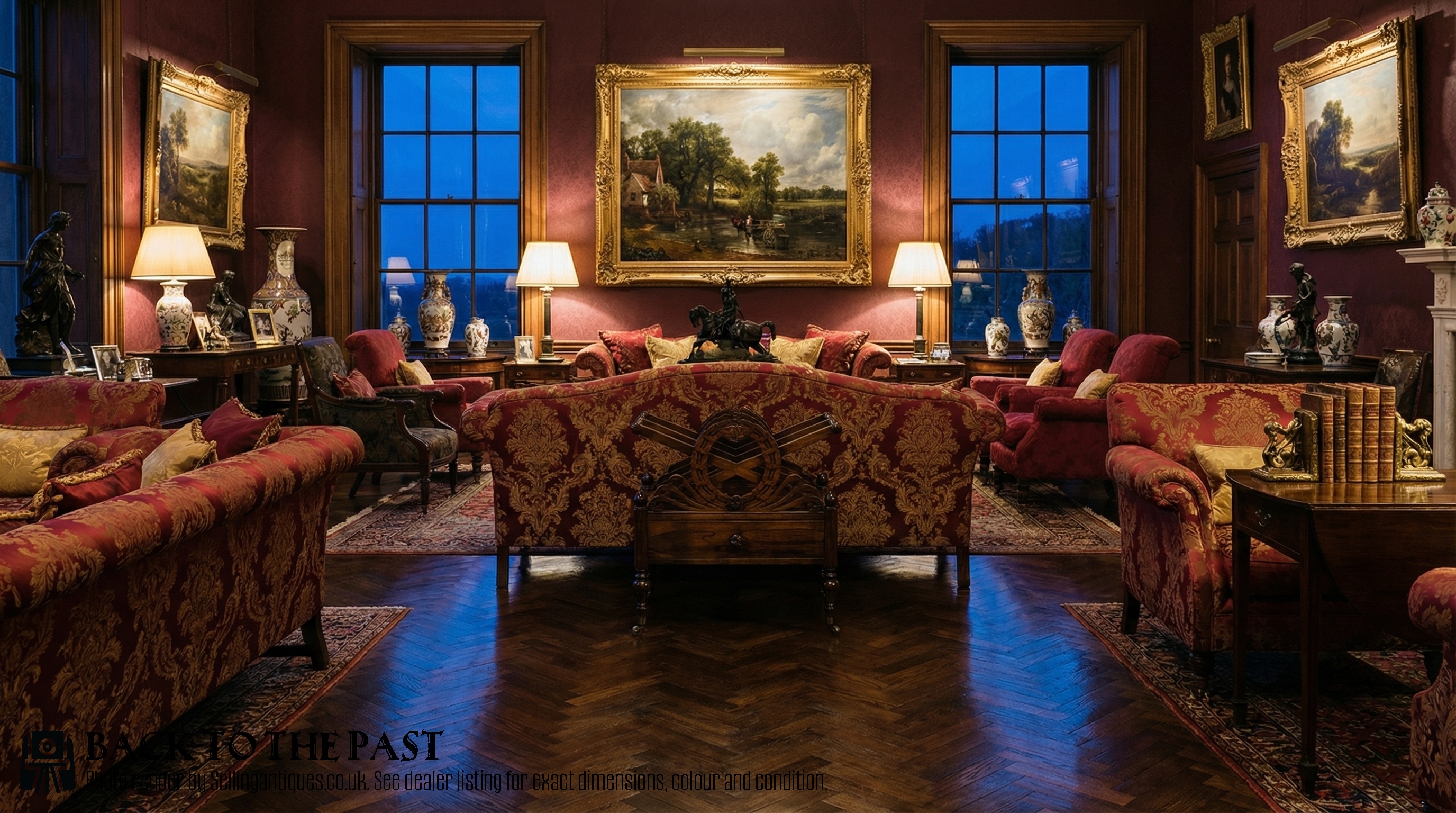
These stands suit sitting rooms and studies, positioned beside a sofa, armchair, or desk to keep reading material accessible.
Freestanding models look best when viewed from all sides, especially those finished uniformly around the base and divisions.
Did all canterburys include a drawer?
Many examples feature a single shallow drawer beneath the partitions for smaller items like strings, reeds, or writing accessories.
Simpler or earlier forms omit the drawer entirely, resting on open legs or a low plinth with castors for movement.