
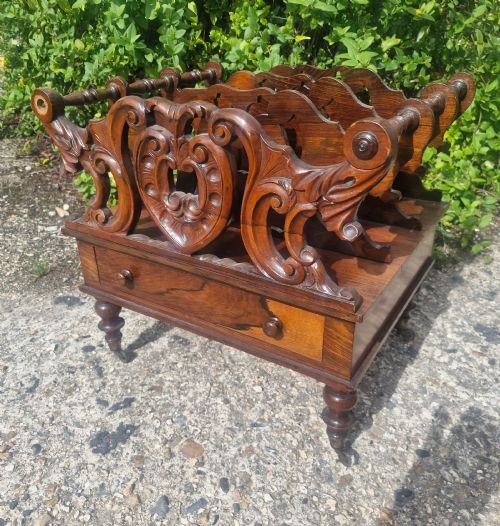
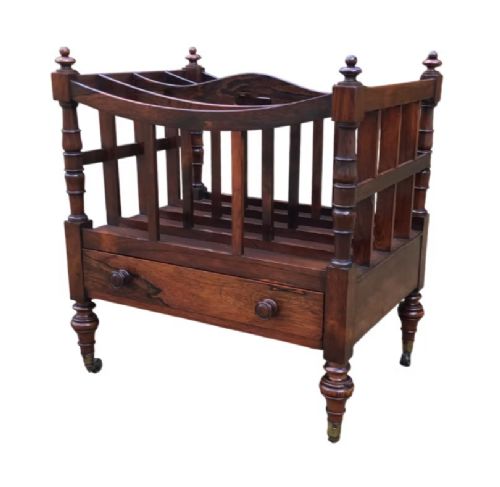
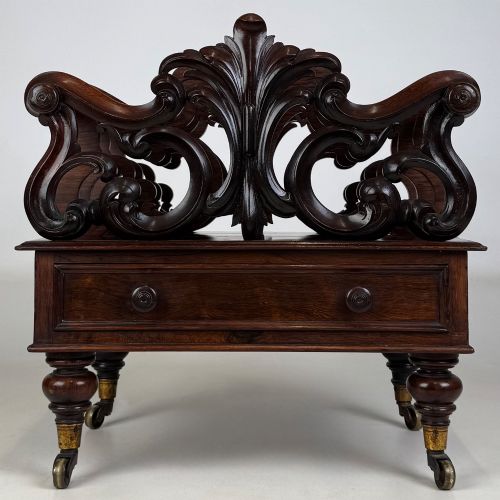


Rosewood Canterbury Rack
A rosewood canterbury rack brings refined compartmentalised storage for papers and folios into a room, combining practical division with decorative timber grain.
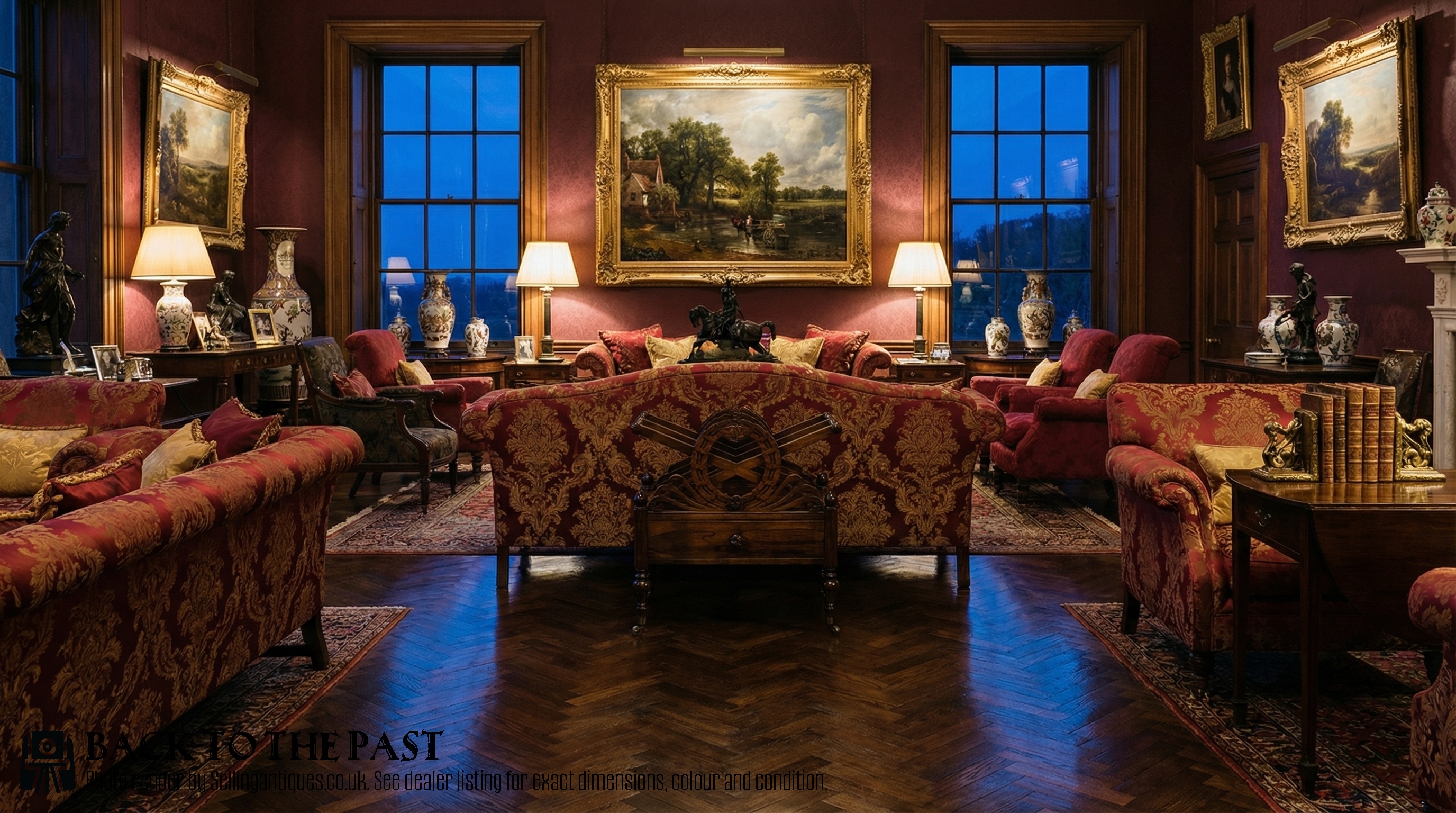
Rosewood Canterbury Rack
A rosewood canterbury rack is a traditional stand designed to hold sheet music, newspapers, magazines, and folios, typically constructed with slatted vertical divisions above a low base. These pieces originated around the Georgian period and continued through the Regency, William IV, and Victorian eras, frequently taking the form of low open stands or multi-tiered whatnots.
The pieces on this page span the 19th century, featuring distinct regional interpretations and design influences such as Gothic Revival, French styling, and country house proportions. Many examples incorporate a single drawer beneath the divisions, while others double as folio stands or music racks suited for drawing rooms and libraries.
Materials and Construction
Makers utilised rich rosewood veneers and solid timbers, often selecting stock with strong grain patterns to catch the light on the upright divisions and legs. Brass castors frequently support the feet, allowing the stand to be moved easily across carpets and floorboards.
Structural integrity relied on sturdy joinery for the slatted partitions, alongside turned or carved columns. Detail work included fretwork, inlay, and carved motifs such as Prince of Wales feathers or foliate designs.
Design influences recorded in the inventory range from Gothic Revival and French nineteenth-century styles to documented patterns by Loudon.
Judging Quality
Quality rests in the crispness of the carving, the selection of the rosewood timber, and the harmony of the proportions. Finer examples display meticulous attention to the fretwork and joinery of the vertical divisions rather than relying on plain construction.
Gillows
The Rosewood Canterbury Rack Glossary
- Canterbury
- A low stand with vertical divisions used originally for sheet music and later for newspapers and magazines. It often includes a small drawer at the base.
- Whatnot
- A piece of furniture consisting of several open shelves or tiers for displaying or storing small items. In this context, it combines shelving with the traditional rack divisions.
- Folio Stand
- A large rack designed to hold oversized paper sheets, prints, or maps. These share a similar construction to larger canterburys.
- Fretwork
- Ornamental work consisting of interlaced or perforated patterns cut from wood. It adds decorative lightness to the sides or divisions of the rack.
- Castors
- Small wheel attachments fitted to the bottom of the legs. They permit smooth mobility across the floor.
Rosewood Canterbury Rack: Frequently Asked Questions
What was a canterbury used for originally?
These stands were created to hold musical scores near piano stools in fashionable drawing rooms.
Over the nineteenth century, their utility expanded to accommodate newspapers, unbound books, and weekly periodicals.
How do I identify a Regency period piece?
Regency examples often display clean classical lines, boat-shaped partitions, and elegant turned uprights.
Makers working in this period favoured rich rosewood grains and understated brass detailing over heavy ornamentation.
Can I use these for modern magazines?
The vertical divisions easily accommodate contemporary periodicals, broadsheet newspapers, and art folios.
Their compact footprint allows them to sit beside sofas or armchairs as practical side storage.
What is the difference between a rack and a whatnot?
A standard canterbury consists solely of partitioned slots above a base or drawer.
A whatnot version incorporates stacked open shelves above or beside the rack for display purposes.