




Rosewood Paper Rack
A rosewood paper rack brings structured elegance to a desk or floor, holding journals, correspondence, and sheets in rich timber.
Rosewood Paper Rack
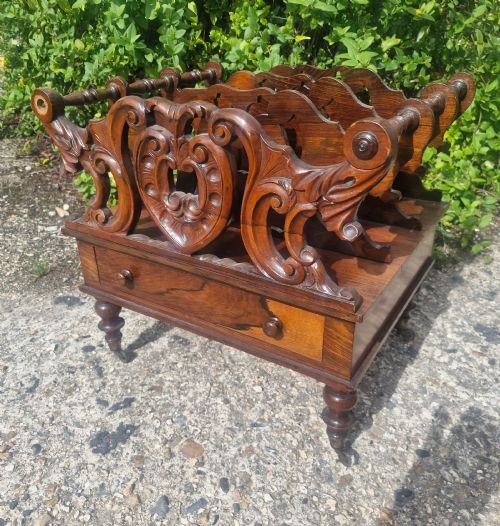
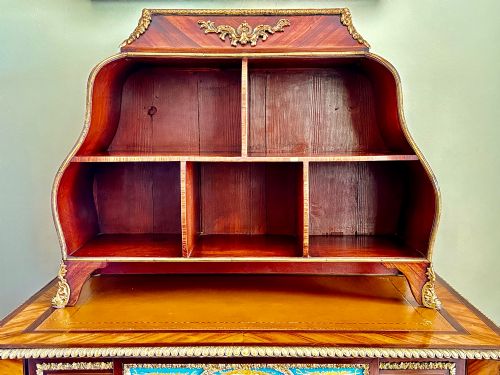
When you search for a rosewood paper rack, you encounter sophisticated nineteenth-century furnishings designed to keep journals, newspapers, and sheet music orderly. The pieces appearing here span the Regency, William IV, and Victorian eras, often taking the form of a freestanding canterbury or a desktop cartonnier.
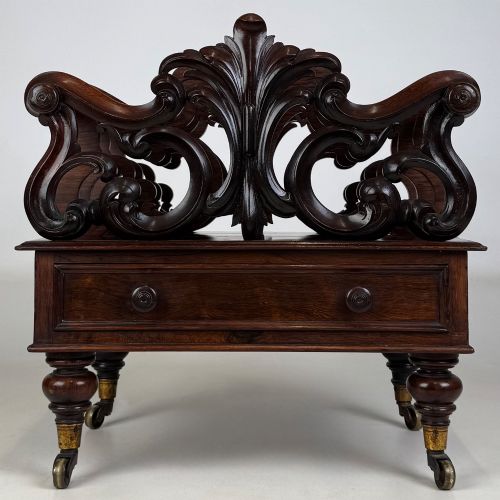
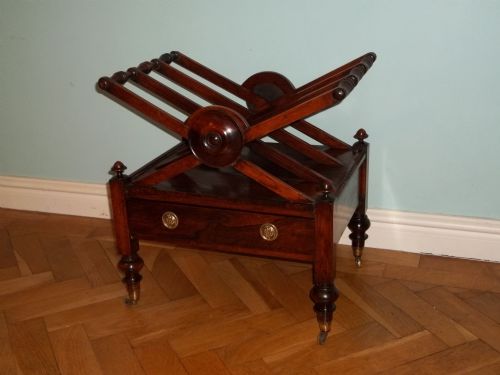
Most examples you will meet function as multi-tiered storage stands with slatted dividers for upright papers, frequently featuring a low drawer beneath the main compartment. Origins range from English country houses to French workshops, reflecting diverse aesthetic movements from George III influences to Louis XV revivals.
Materials and construction
Cabinetmakers utilised dense, richly figured rosewood as the primary timber, often framing compartments with finely turned spindles and upright divisions. Structural joinery accommodated freestanding use, while smaller desktop containers incorporated specialised paper compartments.
Metal accents provided structural reinforcement and visual contrast. Makers applied brass castors, metal fittings, and cast or gilt ormolu mounts to enhance the decorative finish of Regency and Victorian iterations.
Early nineteenth-century makers occasionally carved delicate Prince of Wales feathers into the upright timber supports of sheet music stands.
Judging quality
Distinctions in quality rest upon the crispness of carved details, such as foliate motifs or Prince of Wales feathers, and the depth of timber grain. Superior specimens exhibit harmonious proportions and robust spindle construction that withstands everyday handling.
The integration of secondary elements like fitted drawers or intricate brass and ormolu mounts elevates an example above standard production. The coherence of the revival style or period design dictates the overall standing of the piece.
The Rosewood Paper Rack Glossary
- Cartonnier
- A desktop cabinet or rack fitted with upright compartments or pigeonholes for sorting papers and correspondence. These desktop containers often display ornate mounts in ormolu or brass.
- Ormolu
- Gilt bronze ornamentation applied to furniture and decorative objects during the eighteenth and nineteenth centuries. This technique imparts a bright metallic contrast against dark rosewood surfaces.
- Regency
- A British design period spanning the early nineteenth century defined by classical restraint and archaeological revival styles. Pieces from this era often feature clean lines alongside rich timber veneers.
- William IV
- A transitional nineteenth-century style bridging Regency and early Victorian aesthetics. Furniture from this period frequently showcases heavier proportions and bolder carved decoration.
Rosewood Paper Rack: Frequently Asked Questions
What is a canterbury?
A canterbury is a partitioned stand originally built for organising loose papers, folios, and sheet music. These pieces typically rest on castors for easy movement across a room.
Most versions feature upright wooden slats dividing the upper section into distinct bays. Many examples also include a shallow drawer positioned beneath the main rack.
How were desktop cartonniers used?
Desktop cartonniers served as organised receptacles for incoming correspondence, official documents, and writing paper. They kept active paperwork within arm reach on library tables and writing desks.
These compact containers relied on vertical filing partitions to separate different categories of papers. Their refined materials suited prominent display in private studies and formal drawing rooms.
How do I identify a Regency piece?
Regency items display neoclassical restraint, architectural proportions, and crisp turning on spindles and legs. They lean upon classical antiquity for decorative inspiration rather than heavy ornamentation.
Makers working in this idiom prioritised the natural figuring of rosewood over excessive carving. Brass elements remain refined and purposeful rather than ostentatious.
Where should I place a paper rack?
These racks suit studies, libraries, and sitting rooms where periodicals and journals accumulate. Freestanding canterburys sit neatly beside armchairs or reading desks for accessible storage.
Desktop cartonniers belong on top of writing tables or sideboards where paper sorting occurs. Their finished backs and polished timber allow them to occupy prominent positions in a room.