
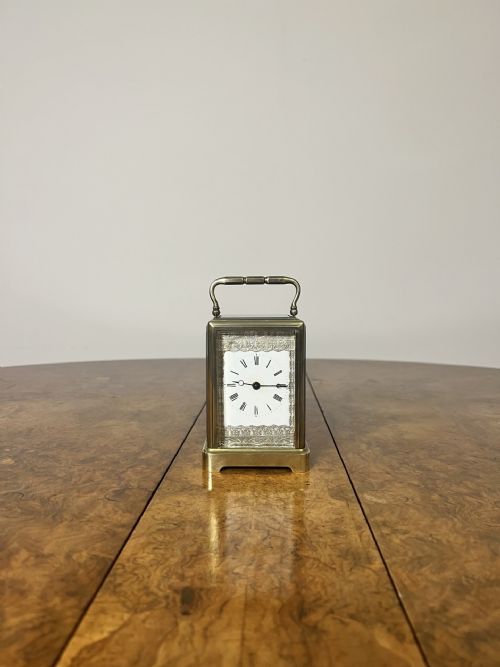


Roman Numeral Carriage Clock
A roman numeral carriage clock brings portable mechanical timekeeping into the room with clear dial markings and brass casing.

Roman Numeral Carriage Clock
A roman numeral carriage clock is a portable timepiece housed in a metal and glass frame, designed originally for travel by coach or rail. The pieces seen here span the nineteenth century, the Edwardian era, and the mid-twentieth century.
The versions most commonly met on this page range from miniature brass cases to giant timepiece carriage clocks, alongside striking models and mantel clock variations. Styles cover Victorian, Edwardian, traditional English, and mid-century designs.
Origins include English and nineteenth-century French workshops, reflecting the widespread production of these mechanical timepieces across different European centres.
How they were made
These clocks combine heavy metal casting with glazed panels, using brass, gilt brass, and solid silver cases to enclose the mechanical movement. Enamel and silvered metal provide the contrasting surfaces for the white roman numeral dials.
Makers integrated glass windows into the brass and gilt frames to display the escapement and internal gear train while protecting the mechanism from dust and damage.
Roman Numeral Carriage Clock Retail Price Guide 2026
Typical asking prices for roman numeral carriage clock among the pieces listed under this phrase on Sellingantiques today, from the lower quarter to the upper quarter. They describe what is for sale here now, not the wider market.
Some models are large enough to be called giant timepieces, while others are small enough to sit in the palm of a hand.
What varies in quality
The standard of materials and case finishing defines the distinction between standard production clocks and finer examples. Heavy cast brass, substantial gilt work, and the inclusion of materials such as lapis lazuli indicate higher workmanship.
The presence of specialised functions, such as bell striking or repeating mechanisms, separates simple timepieces from more complex mechanical configurations.
Luxor·Garrard and Co·Henry Marc
The Roman Numeral Carriage Clock Glossary
- Carriage clock
- A portable spring-driven clock developed for travel in the nineteenth century. These clocks typically feature a rectangular brass case with glass panels and a swing handle.
- Escapement
- The mechanical linkage that controls the release of power in a clock movement. It regulates the motion of the gear train to ensure accurate timekeeping.
- Striking
- A mechanism that sounds the hours or quarters on a bell or gong. Many carriage clocks include this feature alongside standard timekeeping.
- Repeating
- A complication that allows the clock to repeat the last struck hour or quarter upon pressing a button or lever. This function was particularly useful during the night before electric lighting.
Roman Numeral Carriage Clock: Frequently Asked Questions
How do I wind a carriage clock?
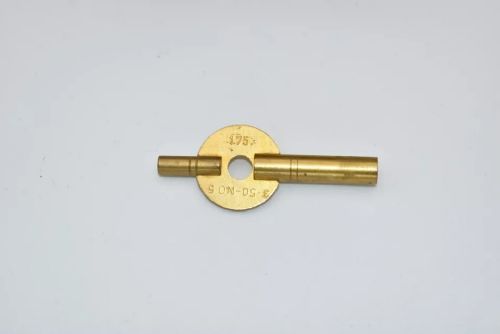
Most carriage clocks use a key inserted into the back plate to tension the springs for timekeeping and striking.
Care should be taken not to overwind the mechanism, stopping as soon as resistance is felt.
Can I travel with a carriage clock?
While originally built for travel, antique mechanical movements require careful handling.
Modern transit can disturb the delicate balance wheel and escapement, so stationary placement in the home is usually preferred.
What is the difference between a timepiece and a striking clock?
A timepiece simply measures and displays the hours and minutes without sounding any notes.
A striking clock contains an additional gear train and hammer to sound the hours on a bell or gong.
How do I identify the period of a carriage clock?
Stylistic details in the brass casting, handle shape, and dial typography help determine the era.
Nineteenth-century models often feature heavier frames, while Edwardian and mid-century examples show lighter proportions or different metal finishes.