
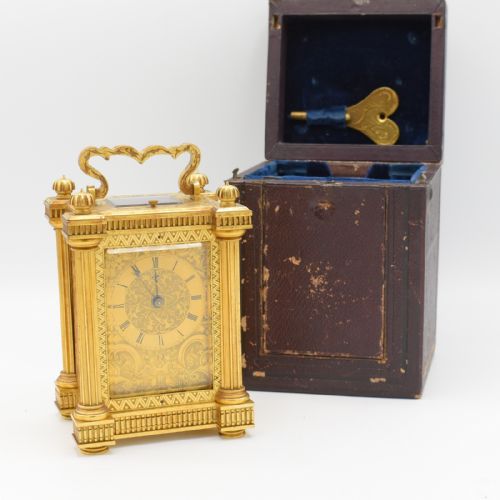
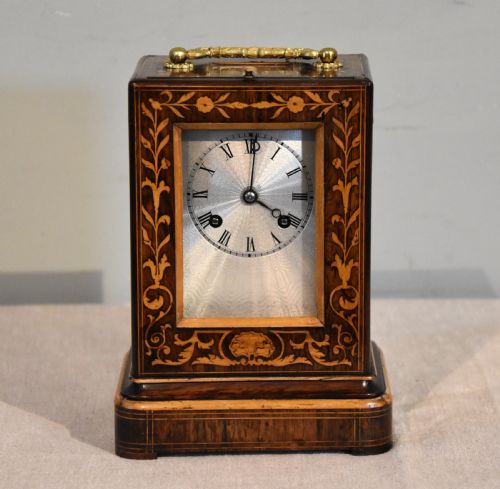

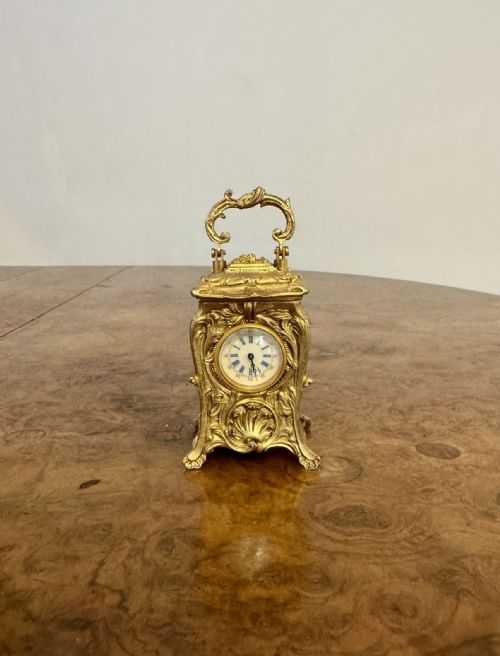

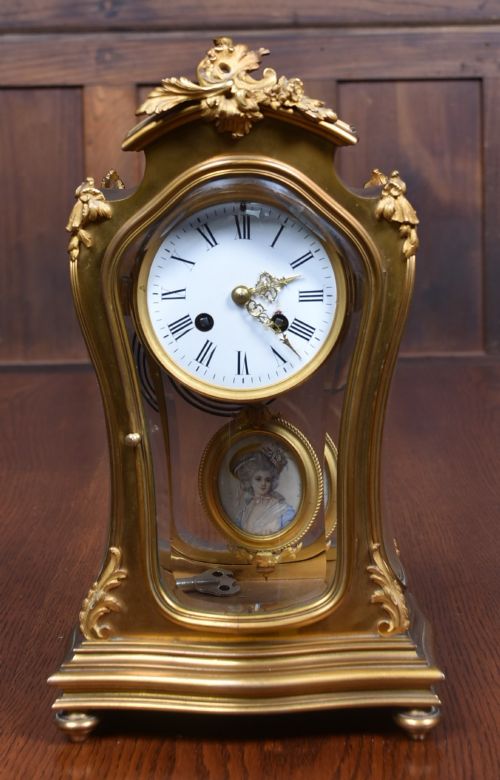

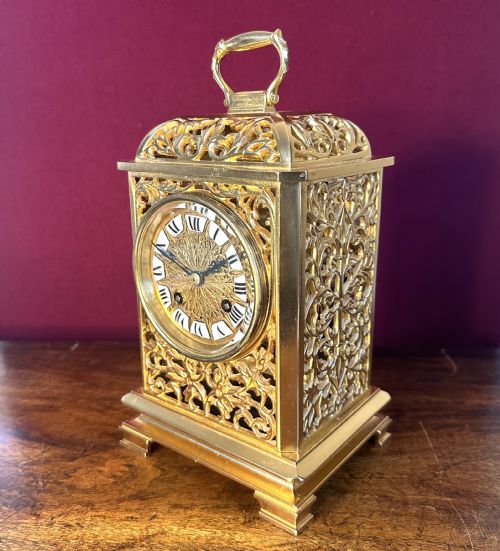


French Style Carriage Clock
A french style carriage clock offers portable precision, bringing brass frames and bevelled glass panels from the nineteenth century into modern rooms.

French Style Carriage Clock
A french style carriage clock brings together portable timekeeping and refined metalwork, predominantly appearing in nineteenth-century brass cases with glass viewing panels. These pieces span the Victorian era, the Edwardian period, and extend into mid-twentieth-century examples, incorporating varied decorative movements.
The selection ranges from compact miniature brass carriage clocks to heavy repeating models and four-glass mantel variants. Makers and retailers such as Howell & James, Pickford, L Epee, Tiffany, Dent, and Drocourt appear alongside traditional Capucine and gorge case styles.
Buyers encounter everything from simple brass timepieces to ornate gilded bronze, ormolu, and elaborately engraved cases equipped with alarms. These domestic instruments reflect diverse historical revivals, including Rococo, Gothic, and French Empire aesthetics.

Markers of quality
Quality reveals itself in the weight and thickness of the cast metal case, the crispness of the engraving, and the integration of repeater mechanisms or alarms. Finer examples display meticulous finishing on internal components and robust escapements housed within heavy, well-fitted glass frames.
The presence of signature work by recognised makers or retailers, alongside specialised complications like striking trains, elevates a piece above standard domestic production. The clarity of enamel dials and the preservation of original gilding further distinguish superior items.
French Style Carriage Clock Retail Price Guide 2026
Typical asking prices for french style carriage clock among the pieces listed under this phrase on Sellingantiques today, from the lower quarter to the upper quarter. They describe what is for sale here now, not the wider market.
Object variations include standard carriage clocks, miniature models, four-glass mantel clocks, and desk comps.
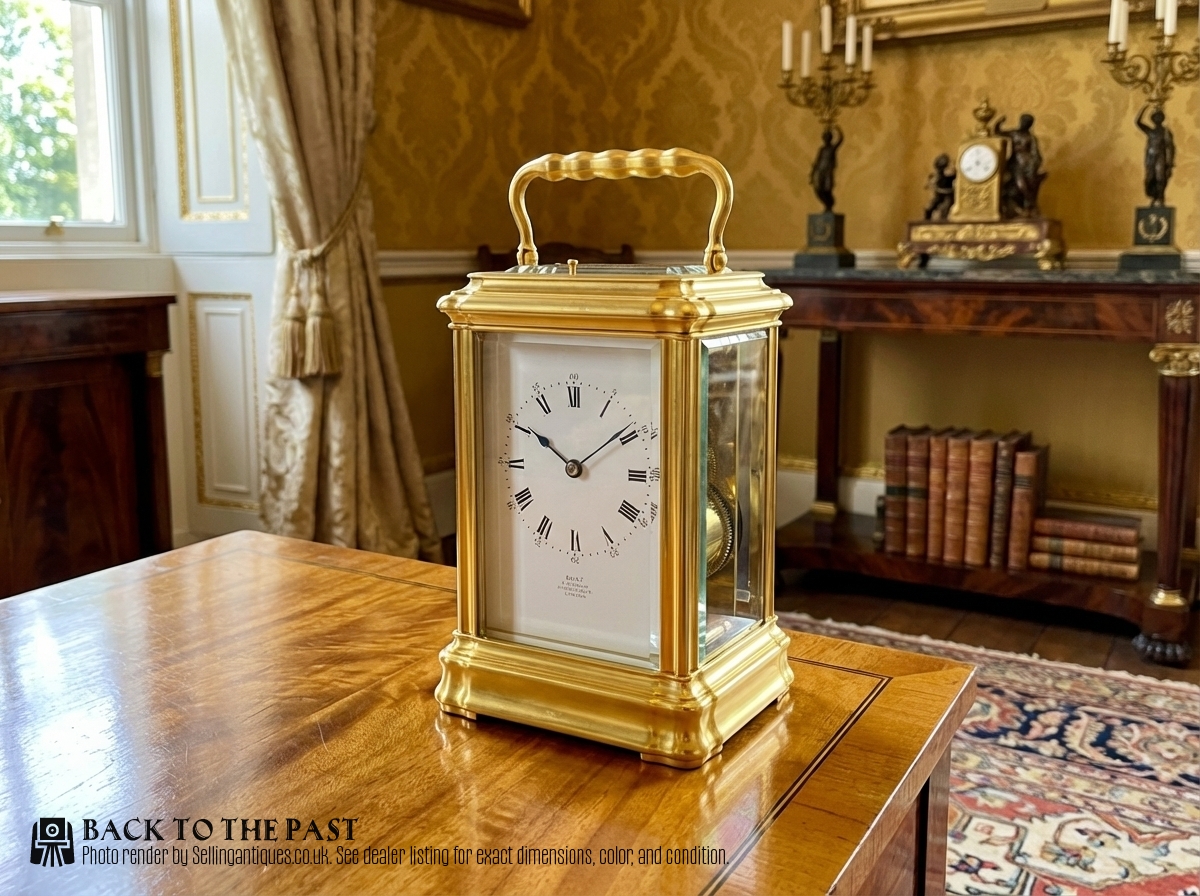
Howell & James London·Pickford of London·L Epee·Tiffany·J C Vickery London·Dent·Garrard & Co·Malecot of Paris·Pons·Drocourt
The French Style Carriage Clock Glossary
- Carriage clock
- A small, spring-driven portable clock originally designed for travellers in the nineteenth century. These clocks typically feature a rectangular brass case with glass panels and a handle on top.
- Repeater
- A mechanism that chimes the hours and quarters upon demand when a lever or button is pressed. This complication was particularly useful for telling time in the dark.
- Gorge case
- A distinct style of carriage clock housing characterised by a stepped, multi-ribbed moulding at the top and bottom of the frame. It represents a classic French design from the Victorian period.
- Ormolu
- Gilded bronze produced by applying a finely ground high-carat gold-mercury amalgam to a bronze object. The technique creates a rich, durable golden surface seen on high-end nineteenth-century decorative pieces.
- Capucine
- An early type of French portable alarm clock featuring a striking train and prominent bell mounted on top. This form predates the standard nineteenth-century carriage clock.
French Style Carriage Clock: Frequently Asked Questions
How do I wind a carriage clock?
Most carriage clocks use a key inserted into the winding squares on the backplate to tension the mainspring. Care must be taken not to overwind the mechanism.
Some models feature separate arbors for the timekeeping train and the striking or alarm trains, each requiring individual attention.
What is a gorge case?
A gorge case refers to a specific rectangular brass frame style with stepped or moulded cornices at the top and bottom. It is a hallmark of traditional French manufacturing.
These cases often house high-grade movements and provide a sturdy housing for bevelled glass panels.
How do I tell if a carriage clock is antique?
Examine the construction methods, materials, and internal movement characteristics such as platform escapements versus older cylinder or lever setups. Nineteenth-century examples often feature hand-cut serial numbers and makers' stamps on the backplate.
The presence of mercury gilding, traditional escapement types, and period-specific retailer signatures further help determine age.
Where should I place a carriage clock at home?
Place the clock on a stable, level surface away from direct sunlight, drafts, and excessive moisture to protect the delicate metalwork and lubricants. Mantelpieces, desks, and bedside tables are traditional locations.
Because these clocks were built for portability, their compact footprints allow them to sit securely on narrow ledges.