

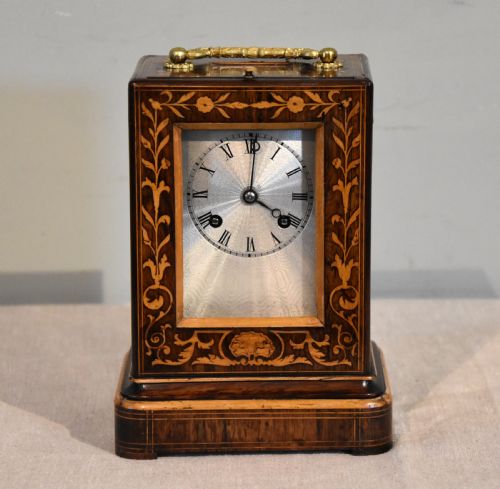
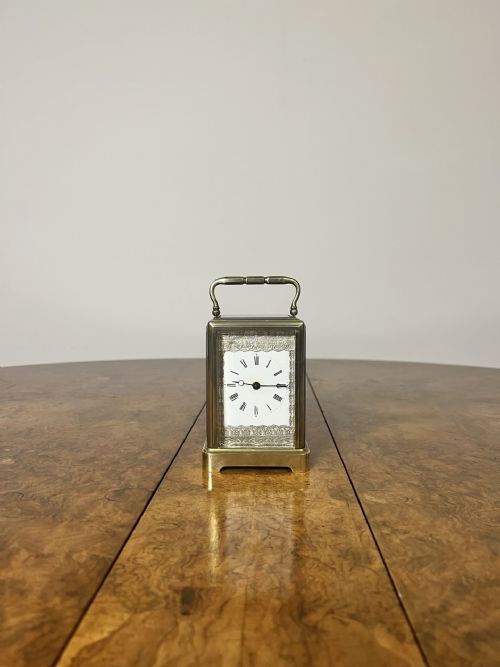


Silvered Dial Carriage Clock
A silvered dial carriage clock offers the traveller's precision of the nineteenth and early twentieth centuries, housed in brass or sterling silver.
Silvered Dial Carriage Clock
When you search for a silvered dial carriage clock, you encounter portable timepieces produced across the nineteenth century and the Edwardian era. These pieces encompass miniature designs alongside larger repeating models built for travel and domestic display. French makers dominate the record, though English makers and retailers appear among the surviving examples.
The objects combine brass, gilt brass, and silver cases with glass panels that reveal the escapement and movement within. Victorian and Edwardian periods contribute most of the pieces you meet on this page, spanning dates from eighteen-fifty to nineteen-hundred. Forms range from simple timepieces to complex quarter striking clocks with date work.
Materials and construction
Cases utilise cast and polished brass, gilt brass, and solid silver or sterling silver, often paired with bevelled glass viewing panels. Enamel frequently appears on subsidiary dials or chapter rings, contrasting with the brushed or engraved silvered metal of the main dial.
Mechanisms rely on steel components driven by spring barrels, sometimes featuring single fusee movements or repeating trains. Workshops such as those of Paul Garnier and Thomas Cole integrated these complex gear trains into compact housings designed for portability.
Silvered Dial Carriage Clock Retail Price Guide 2026
Typical asking prices for silvered dial carriage clock among the pieces listed under this phrase on Sellingantiques today, from the lower quarter to the upper quarter. They describe what is for sale here now, not the wider market.
Listings feature brass, gilt brass, and sterling silver cases enclosing silvered metal dials across Victorian and Edwardian periods.
Assessing quality and execution
The standard of execution reveals itself in the crispness of the silvered dial engraving and the precision of the brass or silver casing. Finer examples display chased ornamentation across the exterior metalwork and incorporate complicated movements like quarter striking or repeating mechanisms.
Signatures on the dial or movement elevate a piece, connecting it to recognised makers and retailers of the period. The presence of original fitted cases and fully restored movements distinguishes the highest grade of surviving clocks.
Thomas Cole and James Cole·Hunt And Roskell·Paul Garnier·Clerke Royal Exchange London·A Delépine·Le Roy et Fils à Paris·Henry Matthews
The Silvered Dial Carriage Clock Glossary
- Carriage clock
- A portable spring-driven timepiece originally designed for travellers during the nineteenth century. These clocks typically feature a rectangular brass or silver case with glass panels.
- Fusee
- A conical pulley used in clock movements to maintain an even force on the gear train as the mainspring unwinds. It represents a higher level of horological construction.
- Repeating movement
- A mechanism that chimes the hours and quarters upon demand when a lever or button is pressed. This complication requires intricate internal gear work.
- Escapement
- The mechanism within the clock that controls the release of power from the gear train to the balance wheel. It translates the unwinding spring into measured ticks.
Silvered Dial Carriage Clock: Frequently Asked Questions
What is a carriage clock?
A carriage clock is a portable mechanical timepiece developed in the nineteenth century for use while travelling. They were built with sturdy metal frames and glass panels to protect the delicate movement inside.
Most examples sit on small feet and feature a folding handle on top. They rely on mainsprings rather than hanging weights, allowing them to function reliably away from a fixed wall mount.
How do I date these clocks?
Dating relies on stylistic markers, case materials, and signatures stamped on the back plate or dial. Victorian and Edwardian pieces often exhibit distinct proportions and engraving styles typical of their decade.
Makers' marks and retailer signatures provide a direct link to operational periods. Comparing the complexity of the escapement and dial layout also helps narrow down the era of production.
Where should I place it?
Choose a stable, level surface away from direct sunlight, moisture, and extreme temperature fluctuations. Mantelpieces, desks, and sturdy cabinets provide suitable display locations.
Because these clocks rely on a precise balance wheel to regulate time, placing them on an uneven or vibrating shelf will interrupt the beat. Ensure the clock stands plumb so the escapement operates evenly.