


Traditional Carriage Clock
A traditional carriage clock offers portable mechanical precision encased in bevelled glass and heavy brass, built for travel and mantelpiece alike.

Traditional Carriage Clock
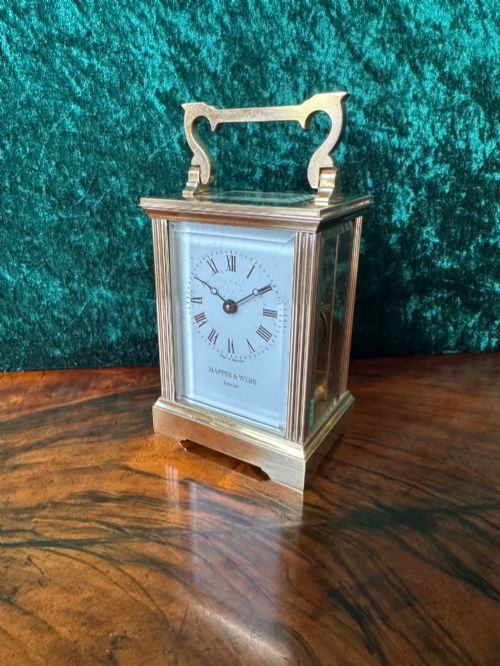
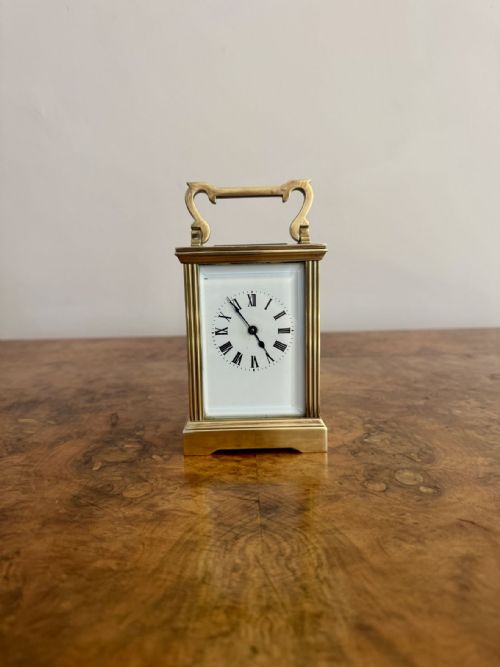
A traditional carriage clock is a portable timepiece designed originally for travel, housing a mechanical movement within a protective metal and glass case. You encounter pieces spanning the nineteenth century up through the mid twentieth century, predominantly originating from French workshops or English makers.
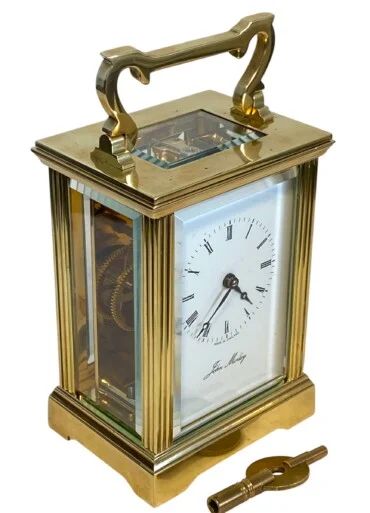
The prevalent form is the brass-framed clock with bevelled glass panels that reveal the escapement and gear train inside. Examples range from simple timepiece movements to striking mechanisms and repeater complications housed in standard gorge cases or serpentine shapes.
How they were made
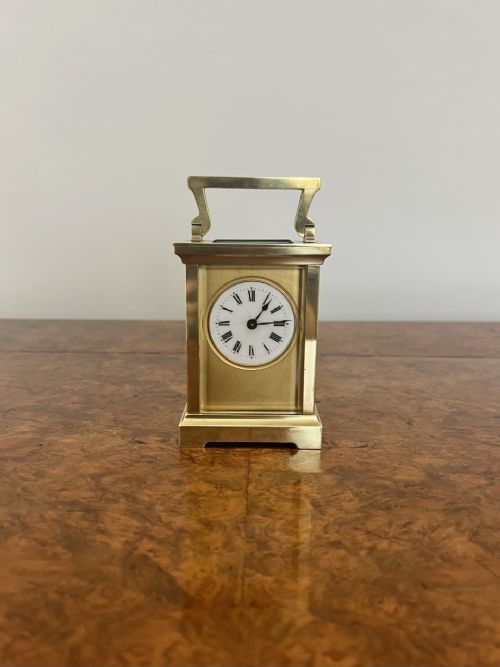
These clocks are constructed primarily from brass and gilt brass, cast and finished to form the structural frames and bezels. Bevelled glass panels are fitted tightly into the metal housing to protect the delicate internal brass gears and steel components.
Dial faces are frequently executed in white enamel with painted Roman or Arabic numerals, sometimes complemented by subsidiary dials for alarm or calendar functions. Casing variations include leather travelling outer cases as well as wood elements like mahogany with marquetry inlay.
Recorded periods span from eighteen eighty through the nineteen sixties, encompassing Victorian, Edwardian, and Neoclassical revival styles.
What varies in quality
Subtleties in finishing, weight of the metal housing, and complexity of the movement separate standard pieces from superior examples. Heavier brass castings and robust platforms dictate durability and mechanical longevity.
The inclusion of complications such as striking mechanisms, repeaters, moon phases, or calendar displays elevates the calibre of the clock. Finer workmanship is also evident in the crispness of enamel dials and the precise fit of glass panels within the brass frame.
Mappin and Web·John Morley·Henry Jacob·L Epee·Tiffany·James Grohe·Garrard and Co·Malecot of Paris·Penlington and Batty
The Traditional Carriage Clock Glossary
- Carriage clock
- A small, portable spring-driven clock with a handle, originally designed for travellers in the nineteenth century.
- Gorge case
- A stepped rectangular brass case style commonly used to house traditional carriage clock movements.
- Repeater
- A mechanism that chimes the hours and quarters on demand when a lever or button is pressed.
- Escapement
- The internal mechanism that controls the release of power to regulate the timekeeping of the clock.
- Four glass clock
- A mantel clock featuring glass panels on all four sides to expose the entire movement to view.
Traditional Carriage Clock: Frequently Asked Questions
How do I wind a traditional carriage clock?
Use the matching key on the winding arbors located on the backplate of the movement. Turn gently until resistance is felt, avoiding over-tightening the mainspring.
Ensure you support the clock properly on a flat surface while performing this maintenance to protect the delicate escapement.
Why does my carriage clock stop running?
Stopages often occur if the clock is resting on an uneven surface that disrupts the balance wheel. Adjusting the small regulation lever inside can help restore correct beat.
Accumulated dust in the brass gear train or dried oil can also halt the movement, requiring professional servicing.
Were these clocks really used for travel?
Originating in the nineteenth century, they were built sturdy enough for officers and travellers on horse-drawn carriages or early trains. Many survived journeys inside fitted leather outer travelling cases designed to absorb shock.
Over time, their decorative appeal led them to become stationary mantelpiece ornaments in domestic drawing rooms.
How do I tell an English carriage clock apart from a French one?
English examples often feature robust fusee movements with chain drive systems and distinct signatures on the backplates. French pieces predominantly utilise platform escapements with rack striking and spring barrels.
Examining the internal layout and signature stamps usually clarifies the origin of the workshop.