

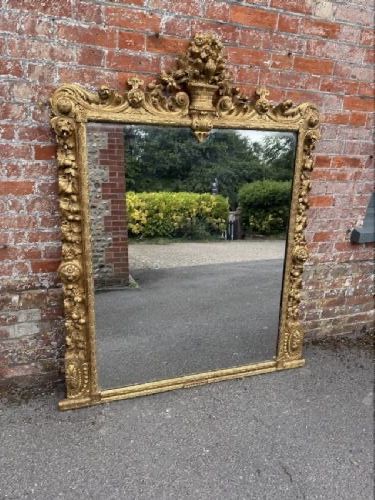


Rococo Revival Mantel Mirror
These rococo revival mantel mirror examples bring sweeping, asymmetrical curves and gilded grandeur directly to period interiors.
Rococo Revival Mantel Mirror
A rococo revival mantel mirror brings nineteenth-century theatricality to a room through ornate scrolling frames and prominent crests. When searching for a rococo revival mantel mirror, buyers encounter overmantel mirrors and wall mirrors spanning the Victorian era and early twentieth century. Most pieces present large formats designed to sit above a fireplace, frequently executed in giltwood, carved wood, and gesso.
The selection on this page demonstrates various interpretations of the French rococo taste, stretching from mid-nineteenth-century English workshops to continental examples. Forms range from archtop designs featuring central cartouches to mahogany frames and painted finishes. Victorian iterations often incorporate cast brass elements or mask crests alongside traditional gilding.
Assessing quality
Depth and crispness of the carved ornament separate standard production from superior examples. The vitality of the gesso work and the complexity of the crest, such as a carved central cartouche or mask, indicate the ambition of the original maker.
The integrity of the original gilt surface and the presence of period mirror glass contribute significantly to a piece's visual impact. Greater sculptural confidence in the asymmetrical scrolls marks out the finest frames.
Rococo Revival Mantel Mirror Retail Price Guide 2026
Typical asking prices for rococo revival mantel mirror among the pieces listed under this phrase on Sellingantiques today, from the lower quarter to the upper quarter. They describe what is for sale here now, not the wider market.
Several pieces incorporate unexpected mask crests, watching silently over the Victorian mantelpiece.
The Rococo Revival Mantel Mirror Glossary
- Giltwood
- Wood that has been covered with a thin layer of gold leaf. This finish defines many formal period mirrors.
- Gesso
- A plaster-like mixture applied to wood frames to create a smooth surface for carving and gilding. It allows for sharp, intricate decorative relief.
- Overmantel mirror
- A large mirror specifically proportioned to hang above a mantelpiece or fireplace. These pieces dominated nineteenth-century drawing rooms.
- Cartouche
- An ornamental tablet or oval frame, often resembling scrolled paper or leather, placed centrally on the mirror crest.
- Foxing
- Small dark spots or brownish age marks within the silvering of antique mirror glass. It results from chemical reactions over long periods.
Rococo Revival Mantel Mirror: Frequently Asked Questions
How do I hang a heavy overmantel mirror?
These substantial frames require professional wall fixing directly into masonry or secured wall studs using heavy-duty brackets. Weight distribution must be calculated carefully before mounting.
Many period pieces retain original iron strap hangers on the reverse, though modern load-bearing hardware provides greater security for daily living.
Can these mirrors be placed in modern interiors?
The dramatic scale and ornate frames create an immediate focal point when rested upon a modern fireplace or hung on a plain wall. They contrast effectively against minimalist backgrounds.
Positioning the glass opposite a window maximises natural light distribution throughout the living space.
How do I clean an antique giltwood frame?
Dusting requires only a very soft, dry artist brush to remove particles from deep carved recesses without disturbing fragile gesso or leaf. Water and chemical cleaners damage historic gilding instantly.
Professional conservation is necessary if the gesso surface shows active flaking or separation from the wood base.
What defines the Rococo Revival style?
The style revives the eighteenth-century French rococo movement, favouring asymmetry, natural forms like shells and foliage, and elaborate scrollwork. It rejects rigid symmetry in favour of dynamic movement.
Victorian makers reinterpreted these motifs with heavier proportions and often integrated them with domestic mantel furniture.