


Regency Silver Bottle Stands
Regency silver bottle stands are elegant table accessories designed to hold wine bottles and decanters securely while protecting dining surfaces.
Regency Silver Bottle Stands
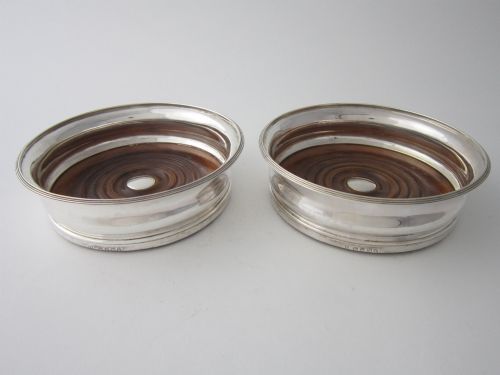
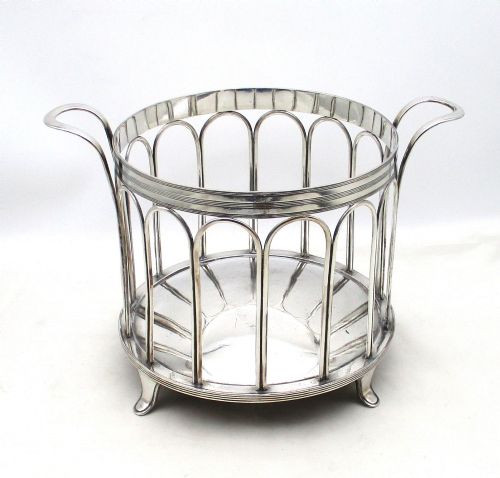
When you search for regency silver bottle stands, you encounter a selection of wine coasters, decanter coasters, and cruet sets dating from the Georgian and nineteenth-century periods. These items encompass single stands, pairs, sets of three or four, and larger multi-bottle cruet frames.
The objects originate from the nineteenth century, 1800, 1890, and the Regency, Grand Regency, and William IV styles. Forms include simple circular bottle coasters as well as complex stands housing multiple cut glass bottles.
Materials and construction
The pieces on this page are constructed from sterling silver, silver plate, and Old Sheffield plate, frequently incorporating wooden bases such as mahogany alongside cut glass and copper components. Makers utilised fused plating techniques characteristic of Sheffield plate alongside traditional hallmarked sterling silver fabrication.
Makers integrated turned wooden bases within metal rims to support the bottles and protect the table surface from condensation and heat.
Materials across these listings include sterling silver, silver plate, Old Sheffield plate, copper, mahogany, and cut glass.
Evaluating quality and craftsmanship
Quality separates through the crispness of armorial engraving, the weight and gauge of the silver or Old Sheffield plate, and the harmony of matched pairs or sets. Superior pieces display refined chased or pierced borders and securely fitted wooden bases.
The inclusion of original cut glass bottles that match the exact configuration of the cruet stand elevates the integrity of the piece compared to later replacements.
Charles Thomas Fox·Matthew Boulton·John & Thomas Settle
The Regency Silver Bottle Stands Glossary
- Old Sheffield Plate
- A composite material made by fusing a thin sheet of silver to a thicker copper base. This technique preceded modern electroplating and produces a rich, deep lustre.
- Cruet Set
- A fitted stand holding multiple bottles or cruets for condiments, oil, vinegar, or wine. These frames often feature a central carrying ring.
- Wine Coaster
- A small, portable stand designed to hold a wine bottle while passing it around the dining table. They frequently feature protective baize-lined wooden inserts.
- Armorial
- A heraldic design or coat of arms engraved onto silver or metal surfaces. Such engravings often denote the original family ownership of the piece.
Regency Silver Bottle Stands: Frequently Asked Questions
What is the difference between a bottle stand and a cruet set?
A bottle stand or coaster typically holds a single wine bottle or decanter, moving independently across the dining table.
A cruet set incorporates a fixed frame or stand designed to hold multiple bottles containing condiments, sauces, or wine together in one unit.
How do I care for Old Sheffield plate bottle stands?
Old Sheffield plate requires gentle cleaning with a soft cloth and a non-abrasive silver polish to preserve the thin layer of silver fused to the copper base.
Avoid submerging wooden-bottomed coasters in water, as moisture can warp the mahogany and damage the baize lining.
Were these stands used exclusively for wine?
While the single and paired coasters primarily served wine bottles and decanters during formal dining, multi-bottle stands accommodated various table liquors and condiments.
The stands protected polished mahogany dining tables from rings left by wet bottles.
How can I tell a Regency piece from an 1890 piece?
Dating relies on stylistic markers associated with the Regency, George III, and William IV periods, alongside maker marks and assay office hallmarks.
Later nineteenth-century pieces often reflect revival styles or different plating methods compared to early 1800s sterling silver and Old Sheffield plate.