
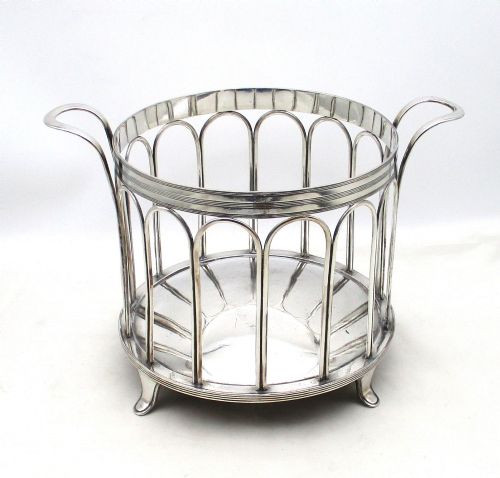
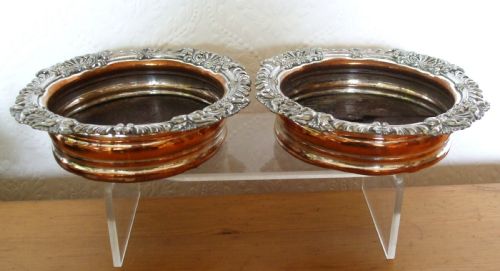


Old Sheffield Plate Coasters
Old sheffield plate coasters are historic table accessories designed to protect dining surfaces while holding wine bottles and decanters.
Old Sheffield Plate Coasters
Old sheffield plate coasters emerge primarily from the Georgian, Regency, and Victorian periods, taking forms such as single wine coasters, matched pairs, and sets of three or four. Collectors encounter various shapes, from simple circular rings to deep bottle holders and wheeled wine trolleys.
The objects serve the practical function of carrying decanters smoothly across the dining table during post-dinner port and wine circulation. Most pieces appear as circular frames designed to hold standard wine bottles securely.
Materials and Construction
The material relies on fused layers of silver and copper, an early plating technique that sandwich a copper core between thin sheets of sterling silver. Makers often incorporated turned wood bases, frequently using mahogany, alongside silver-plated wirework and pierced gallery edges.
Makers finished the rims with applied decorative borders, sometimes utilising solid silver mounts or intricate motifs such as grape vines. The base inserts frequently sat upon green baize or felt to protect the polished wood of dining tables.
Listings feature items spanning the Georgian, Regency, and Victorian periods, constructed from fused silver plate, copper, and turned mahogany.
Judging Quality
Quality rests upon the preservation of the silver layer over the underlying copper, where excessive polishing reveals the reddish metal beneath. The crispness of chased or embossed decorative motifs and the stability of the turned wooden base dictate the standing of a piece.
Weight and structural integrity separate standard utility items from finer examples, particularly in the construction of wirework frames and multi-bottle trolleys. Original matching pairs and larger sets command greater attention than assembled groups.
Matthew Boulton·T & J Creswick·Padley, Parkin and Co·James Dixon and Son
The Old Sheffield Plate Coasters Glossary
- Old Sheffield Plate
- A composite material made by fusing a sheet of silver to a copper ingot before rolling them into thin sheets together. This technique predates modern electroplating.
- Wine Trolley
- A wheeled coaster or carriage designed to transport decanters along the dining table during dessert. They often run on small silver or metal wheels.
- Wirework
- An open lattice construction formed from thin silver-plated wires, seen on lighter coaster frames. This delicate openwork style appears frequently in late eighteenth-century examples.
- Turned Wood
- Wood shaped on a lathe to form the flat or slightly concave base insert of a coaster. Mahogany is the predominant wood used for this purpose.
- Decanter Coaster
- A circular receptacle sized specifically to hold spirit or wine decanters. These items protect polished mahogany dining tables from condensation rings and spills.
Old Sheffield Plate Coasters: Frequently Asked Questions
What are old sheffield plate coasters?
These pieces are historic table accessories created by fusing silver and copper together. They protect dining surfaces and hold wine bottles.
Craftsmen shaped the composite metal into circular galleries, often adding turned mahogany bases and decorative borders.
How do you clean them?
Cleaning requires gentle silver polish and a soft cloth to avoid wearing through the thin silver layer. Harsh abrasives will expose the copper underneath.
Keeping the wooden bases dry during maintenance preserves the integrity of the antique assembly.
How do you spot copper showing through?
Look along raised edges and high points where regular polishing wears away the outer silver skin. A faint yellowish or reddish tint indicates the base metal.
This telegraphs the history of use rather than a structural failure in the piece.
What is a wine trolley?
A wine trolley is a specialised coaster fitted with small wheels designed to roll across the dining table. They allowed guests to pass bottles easily.
Single carriages and double wagon formats both exist within the historical record.