
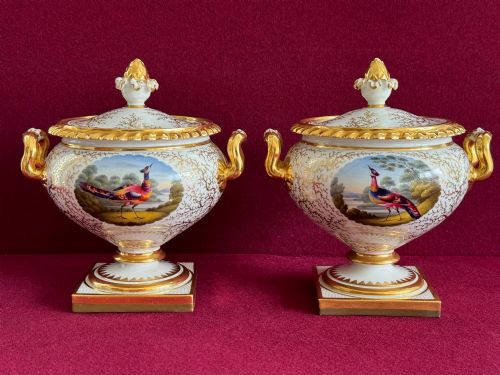
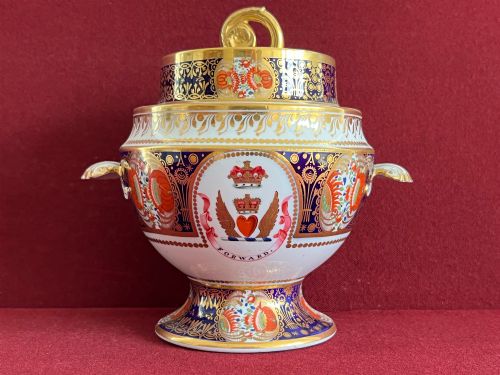
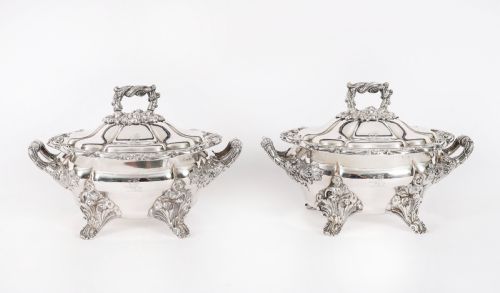
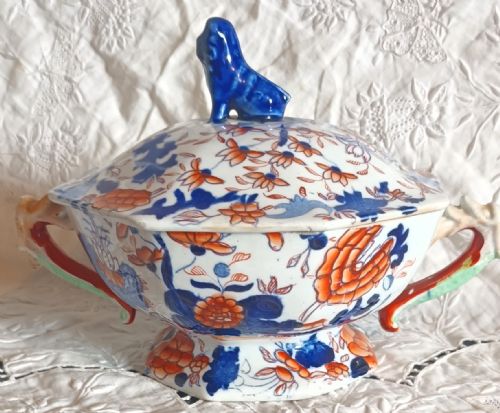
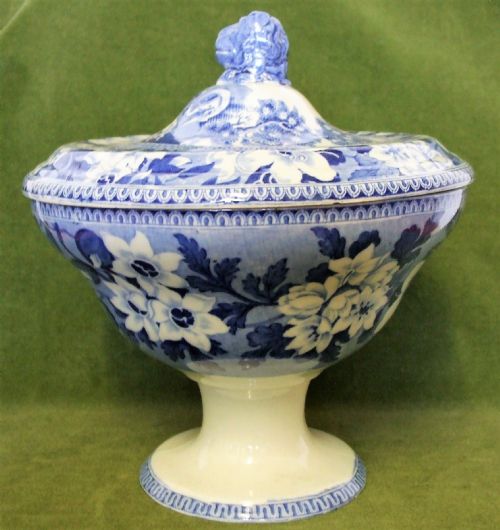
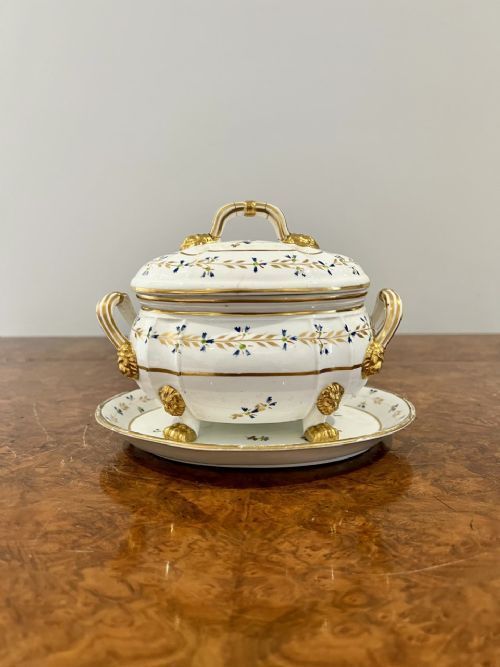


Regency Sauce Tureen
These regency sauce tureen examples bring formal dining elegance to the table, combining neoclassical form with refined porcelain and silver-plated copper.
Regency Sauce Tureen
A regency sauce tureen is a covered vessel designed for serving gravies and sauces during formal nineteenth-century dining, usually accompanied by its own matching base dish.
The examples found here span the late Georgian and Regency periods, encompassing crisp white porcelain, robust ironstone, and gleaming Old Sheffield plate.
Buyers will encounter both individual tureens and scarce matched pairs, often bearing armorial crests or hand-painted botanical and oriental motifs.
How they were made
Potters shaped fine porcelain and dense ironstone on the wheel or in moulds before applying intricate transfer prints and hand-painted enamels, sometimes enriched with gold leaf.
Metal versions utilise Old Sheffield plate, fusing a thin layer of silver onto a copper core to achieve the lustre of solid silver without the extreme weight.
Craftsmen applied gilt handles, moulded lion heads, and detailed finials to both ceramic bodies and plated metal vessels to complete the neoclassical silhouette.
Listings feature porcelain, ironstone, and Old Sheffield plate spanning the nineteenth century, with prominent examples from the Regency period.
What varies in quality
The crispness of the transfer printing and the precision of the hand-applied gilding separate standard vessels from superior factory output.
Proportion and modelling define the best pieces, where handles, covers, and bases form a cohesive design rather than a mismatched assembly.
The survival of original gilding and the integrity of the silver plating on copper substrates dictate the overall visual preservation of the metalware.
John Rogers and Son·Flight Barr and Barr·Mason's Ironstone·Chamberlain Worcester
The Regency Sauce Tureen Glossary
- Old Sheffield plate
- An early form of plated metal produced by fusing silver to a copper ingot before rolling them into sheets. This technique leaves a thin line of copper visible at the cut edges.
- Ironstone
- A dense, durable type of earthenware patented in the early nineteenth century to rival imported Chinese porcelain. It takes heavy enamel colours and transfer printing particularly well.
- Transfer printing
- A method of applying complex decorative patterns to ceramics by engraving a copper plate and transferring the ink via tissue paper. It allowed factories to produce intricate designs consistently.
- Imari
- A decorative style inspired by Japanese export porcelain, featuring a distinctive palette of underglaze cobalt blue, iron red, and gilt highlights. English factories widely adopted this aesthetic during the Regency era.
- Finial
- The decorative knob or sculptural element situated on top of a tureen cover. It serves as a practical grip while completing the symmetry of the vessel.
Regency Sauce Tureen: Frequently Asked Questions
How were sauce tureens used at the dining table?
These vessels sat on the dining table to hold warm gravies, melted butter, or seasoned sauces during multi-course meals. Servants lifted the covers to ladle the contents directly onto guests' plates.
Pairs of tureens were often placed at opposite ends of the table to balance the table setting and ensure guests had easy access to condiments.
Can I use an antique sauce tureen for serving food?
Most ceramic and plated metal tureens remain stable enough for serving dry foods or modern sauces. However, thermal shock from boiling liquids can stress fragile nineteenth-century glazes.
Hand washing is essential for preserving delicate enamel decorations, transfer prints, and thin layers of gold leaf or silver plating.
How do I distinguish porcelain from ironstone?
Porcelain is typically thin and possesses a translucent quality when held to a strong light. It often feels lighter in the hand and rings slightly when tapped.
Ironstone is opaque, significantly heavier, and designed to withstand robust daily use while maintaining a smooth glazed surface.
Why do some tureens include matching underplates?
Underplates caught stray drips of sauce and protected polished mahogany or linen tablecloths from heat damage. They complete the formal ensemble of the service.
Finding a tureen with its original matching base plate significantly enhances the historical completeness of the piece.
What defines the Regency style in tableware?
Regency design draws heavily on classical Greek and Roman motifs, favouring clean lines, urn shapes, and restrained ornamentation over earlier rococo curves. Details like paw feet, classical handles, and bright white porcelain typify the period.