

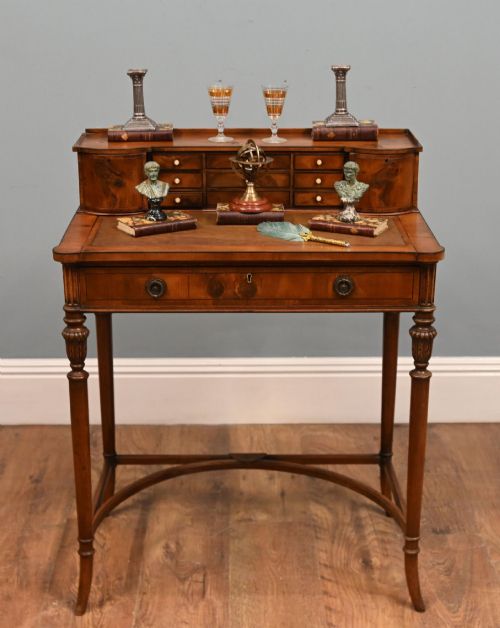
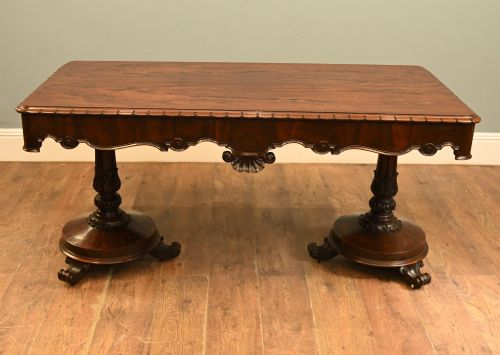



Regency Revival Desk
A regency revival desk brings classical symmetry and rich timber into a room, offering a dedicated writing surface rooted in nineteenth-century taste.
Regency Revival Desk
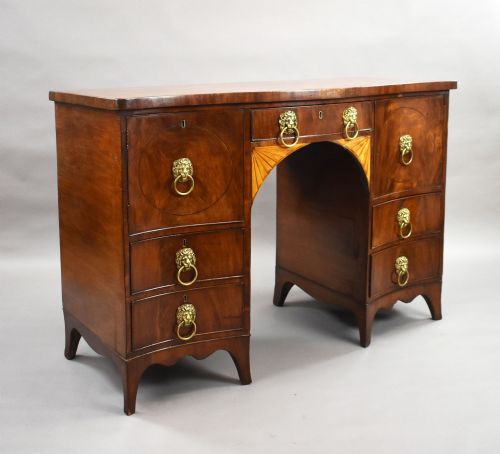
A regency revival desk draws upon earlier classical forms, most frequently appearing in mahogany construction during the nineteenth century. These pieces combine compact proportions with refined writing surfaces designed for domestic libraries and studies.
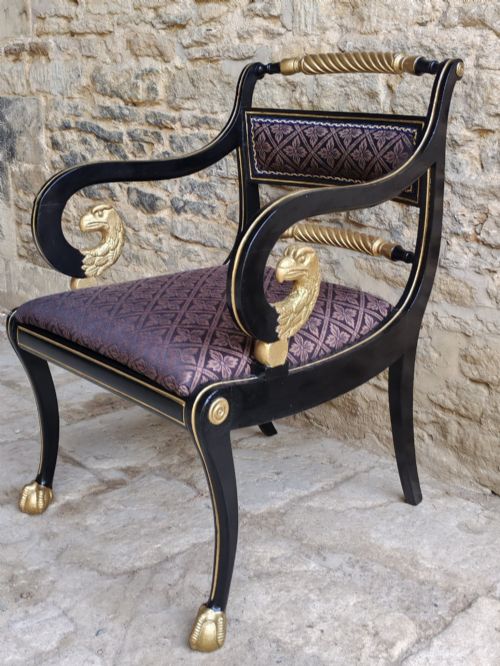
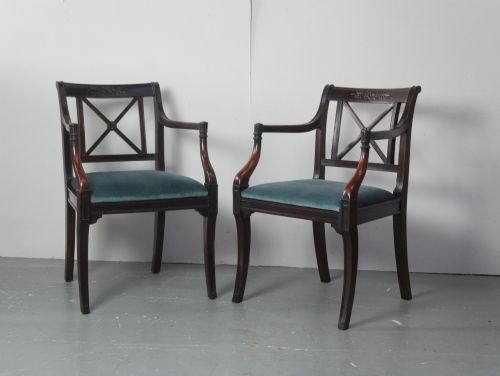
The selections encountered here span various related historical revivals, reflecting how later makers reinterpreted classical motifs from earlier centuries in their own workshops.
How they were made
Makers utilised solid and veneered mahogany, often pairing the timber with brass mounts, leather inserts, and parcel gilt detailing to achieve the desired classical appearance.
Construction techniques followed traditional cabinet-making standards of the period, ensuring sturdy frames designed for practical daily use alongside decorative appeal.
Regency Revival Desk Retail Price Guide 2026
Typical asking prices for regency revival desk among the pieces listed under this phrase on Sellingantiques today, from the lower quarter to the upper quarter. They describe what is for sale here now, not the wider market.
Current listings demonstrate mahogany as the dominant material, accompanied by brass and gilt metal details across nineteenth-century and revival forms.
What varies in quality
The standard of a regency revival desk rests on the selection of timber grain, the crispness of any carved or applied brass ornamentation, and the overall harmony of the proportions.
Finer examples demonstrate greater care in the joinery and finish, whereas simpler pieces rely on more straightforward construction methods while retaining the characteristic silhouette.
The Regency Revival Desk Glossary
- Mahogany
- A durable tropical hardwood prized for its rich reddish-brown colour and fine grain. It served as the primary timber for high-quality furniture of this period.
- Parcel Gilt
- A decorative technique involving partial gilding applied to specific carved details or mouldings. This highlights the architectural lines of the piece against the dark wood background.
- Revival
- A stylistic movement where makers deliberately copied or adapted historical designs from earlier eras. It produced furniture that looked back to classical antiquity and the Regency period.
- Brass
- A copper and zinc alloy used extensively for cast handles, mounts, and decorative details. It provided a bright metallic contrast to dark mahogany surfaces.
Regency Revival Desk: Frequently Asked Questions
What is a regency revival desk?
A regency revival desk is a piece of furniture produced later in the nineteenth century or beyond, drawing stylistic inspiration from the original Regency period of the early eighteen hundreds.
These pieces capture classical symmetry, clean architectural lines, and traditional timber choices such as mahogany.
How do I date these desks?
Dating relies on examining the construction methods, secondary timbers, and the specific style of brass hardware or veneer used in the piece.
Comparing the manufacturing traits against documented nineteenth-century cabinet-making standards helps establish the likely era of production.
Where were these desks used?
Such desks were typically placed in home libraries, studies, or private chambers for correspondence and reading.
Their domestic scale allowed them to sit comfortably in principal reception rooms without overwhelming the space.
What wood was used?
Mahogany is the predominant timber found in these pieces, valued for its stability and deep colour.
Occasional examples incorporate alternative decorative woods and veneers to accent the primary surfaces.