
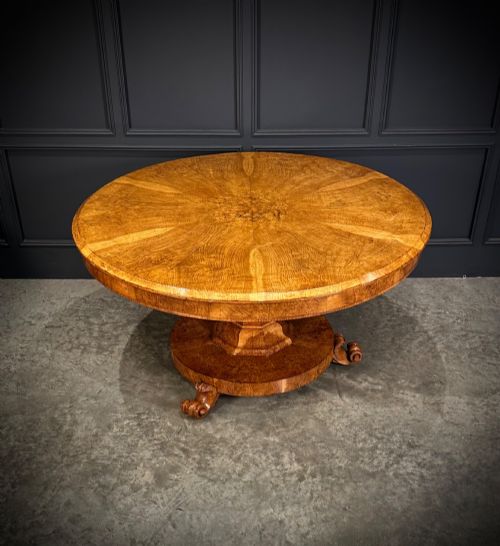


Regency Pollard Oak Table
A regency pollard oak table brings rich, mottled timber figure and architectural restraint to a room.
Regency Pollard Oak Table
A regency pollard oak table is typically encountered in forms designed for dining, library work, or occasional use, spanning the Regency, George IV, and William IV eras. The selection ranges from compact writing tables and drop flap work tables to substantial library tables and drum tables.
Makers such as Williams and Gibton of Dublin or Pennington of London occasionally mark these pieces, reflecting high standards of British and Irish cabinet making. The timber displays the distinctive dense knots of pollard oak, often contrasted with plain oak or highlighted with brass inlay.
Materials and construction
Cabinet makers utilised pollard oak and burr oak veneers laid over solid wood carcasses, often combining them with brass, giltwood, and glass components. The characteristic mottled figuring results from pruning the tree near the trunk, producing tight clusters of knots that require careful sawing and polishing.
Structural elements frequently rest on carved pedestals, tripod bases, or legs terminating in brass paw feet and castors. Joinery aligns with traditional Georgian and Regency methods, supporting hinged flaps, drawers, and lift tops on occasional and writing tables.
One recorded clock manages to keep time while wearing a very respectable coat of pollard oak.
Judging quality
Quality rests upon the selection and matching of the timber figure across the top surface, where even distribution of pollard knots creates visual depth. Lesser examples show mismatched veneer patches or plain timber substituting for the richly figured sections.
The sophistication of the secondary mounts, such as cast brass feet, inlay work, and carved bases, separates standard production from exceptional cabinet work. Proportion and stability in complex forms like drum tables and pedestal card tables further distinguish finer workshops.
Williams and Gibton·Pennington of Camberwell
The Regency Pollard Oak Table Glossary
- Pollard oak
- Timber taken from a tree that has been pollarded, creating dense clusters of knots and a mottled grain pattern. This distinctive figuring is prized in Regency furniture veneers.
- Centre table
- A freestanding table finished on all sides so it can stand in the middle of a room rather than against a wall. These often feature circular or drum tops.
- Drop flap
- A hinged leaf attached to the side of a table that folds down when not in use. It allows the surface area to expand for dining or writing.
- Giltwood
- Wood that has been coated with gold leaf or gold paint for decorative effect. It appears alongside pollard oak in console tables and decorative mounts.
Regency Pollard Oak Table: Frequently Asked Questions
What rooms suit a pollard oak table?
These tables fit well into libraries, studies, and drawing rooms where the dark, figured timber complements traditional interiors. Their varied forms allow them to function as desks, side tables, or central display surfaces.
Because the wood grain is naturally decorative, placing them near natural light helps highlight the mottled patterns of the pollard oak veneer without needing heavy ornamentation.
How do I maintain pollard oak?
Maintenance involves regular dusting with a soft, dry cloth and occasional application of appropriate furniture wax to nourish the timber veneer. Avoiding direct sunlight and sustained heat sources prevents the wood from drying out.
Care should be taken with brass inlays and giltwood elements, cleaning them gently without harsh chemical polishes that might damage the surrounding wood.
Are these tables sturdy enough for daily use?
Most examples are constructed with solid oak frames beneath the pollard veneers, offering robust support for normal writing, dining, or display tasks. Tables equipped with pedestals or tripod bases distribute weight evenly across the floor.
Moving larger tables requires lifting them rather than dragging, particularly when they feature castors or delicate paw feet that can strain under lateral pressure.
How do I identify Regency pieces?
Regency pieces often display classical architectural influences, balanced proportions, and specific decorative details like brass stringing, paw feet, and pedestal bases. The timber choice frequently leans towards figured oaks and exotic veneers.
Comparing construction techniques underneath drawers and tabletops reveals hand-cut dovetails and traditional jointing methods consistent with early nineteenth-century workshop practices.