


Regency Oak Writing Table
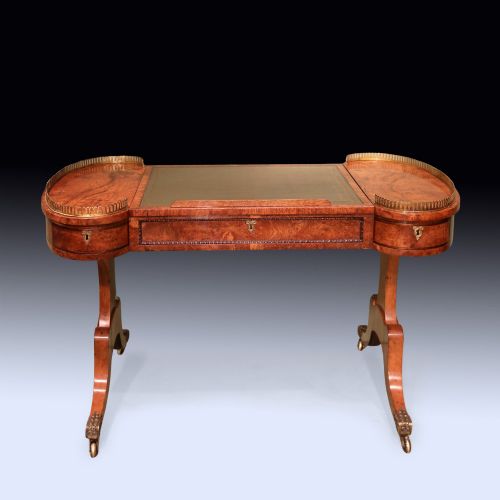
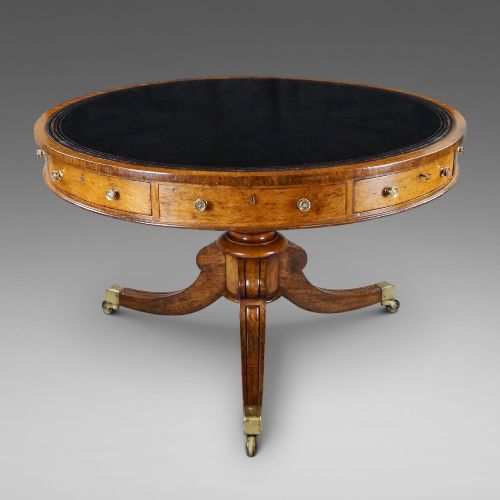
A regency oak writing table offers a sturdy workspace combining plain utility with the rich figuring of oak, pollard oak, or burr oak.
Regency Oak Writing Table
A regency oak writing table is a practical piece of furniture designed for study and correspondence, originating predominantly from the early nineteenth century and the Regency period. These tables often appear in smaller proportions or as broader library tables and partner desks intended for institutional or domestic use. The form typically balances the architectural austerity of the Georgian era with the bolder decorative timbers favoured in subsequent decades.
The stylistic influences span Georgian, Regency, and William IV periods, reflecting a transitional design vocabulary where traditional English hardwoods take on more dramatic figuring. While standard end supports and drum configurations recur, the underlying purpose remains a dedicated surface for writing and administrative tasks. Each piece displays the characteristic joinery and timber selection of its nineteenth-century origin.
Materials and construction
Makers constructed these tables primarily using solid oak frames paired with decorative veneers of pollard oak or burr oak to create striking visual contrast on the writing surfaces and friezes. Secondary timbers such as mahogany sometimes appear in internal linings, whilst brass hardware provides functional and decorative accents.
Surfaces often incorporate inset leather writing pads framed by the timber grain, while ebonised wood details define structural edges. The assembly relies on traditional cabinet-making joinery suited to heavy hardwoods, ensuring structural stability across standard end supports and pedestal bases.
Some nineteenth-century writers concealed their inkwells beneath sliding panels, trusting that visitors would mistake their administrative chaos for mere decoration.
What separates the finest examples
Proportion and scale also determine distinction, as smaller writing desks require delicate balance whilst larger library tables demand robust engineering to support broad expanses of solid hardwood without warping.
Williams and Gibton of Dublin
The Regency Oak Writing Table Glossary
- Pollard oak
- Timber taken from trees that have been pollarded, producing a dense, knotty grain pattern highly prized for decorative veneer. This figured wood creates distinctive mottled surfaces on Regency furniture.
- Burr oak
- An excrescence on the oak tree yielding distorted, highly figured grain configurations used by cabinet-makers for premium table tops. It offers exceptional visual depth compared to straight-grained timber.
- Library table
- A large freestanding table designed for the storage and consultation of books, often featuring drawers around the frieze. These pieces are finished on all sides for central placement in a room.
- Partners desk
- A large desk designed to be used simultaneously from both sides, typically featuring opposing banks of drawers or cupboards. They provide symmetrical workspace for two individuals.
- Ebonised wood
- Timber treated with a dark stain or finish to imitate ebony, providing sharp linear contrast against lighter oak and pollard oak surfaces.
Regency Oak Writing Table: Frequently Asked Questions
What is a regency oak writing table used for?
These tables were originally designed for writing letters, managing correspondence, and handling household or estate accounts in nineteenth-century homes.
Today, they serve equally well as functional writing desks in a study or as decorative centre tables in a living space.
How do I identify a regency period table?
Regency pieces often feature clean architectural lines, specific timber choices like pollard or burr oak, and stylistic details such as brass mounts or ebonised wood accents.
They bridge late Georgian restraint and the heavier proportions of the subsequent William IV era.
Are these tables suitable for everyday use?
Constructed from durable nineteenth-century hardwoods like solid oak, these tables are inherently sturdy and built to withstand daily administrative work.
Care should be taken to protect inset leather writing surfaces and polished timber tops from excessive moisture and heat.
What is the difference between a writing table and a library table?
Writing tables are generally proportioned for individual clerical tasks, often featuring compact dimensions or specific drawer arrangements for stationery.
Library tables are typically larger and heavier, designed to stand centrally in a room to hold books and papers.