

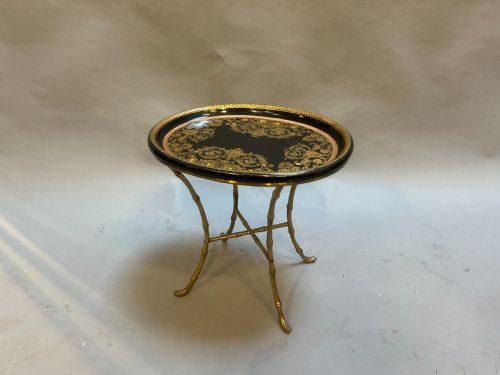


Regency Lacquer Coffee Table
A regency lacquer coffee table brings dramatic Chinoiserie surface art and versatile low-level display to a modern room.
Regency Lacquer Coffee Table
A regency lacquer coffee table encompasses low display surfaces adapted from earlier forms, primarily taking the shape of nest of tables or trays mounted upon stands. These pieces translate compact serving items and multi-tier sets into functional central surfaces for a contemporary sitting room.
The materials and construction span traditional 19th Century items alongside later 20th Century revivals from 1910 and 1920, incorporating both authentic Regency period pieces and subsequent Regency style interpretations. Papier-mâché and lacquered timber form the primary foundation for these low tables.
Buyers will most frequently encounter nesting sets comprising four tables and individual trays elevated on folding or fixed wooden stands. The decorative vocabulary relies heavily on Chinoiserie motifs executed in gold leaf, gilt paint, and traditional dark lacquer.
How they were made
Makers built these low tables using robust timber cores and pressed papier-mâché for tray surfaces, applying multiple layers of dark lacquer to create a deep, glossy foundation. Artisans then built up the decorative schemes directly onto this polished base.
Gold leaf and specialist gilt paint provided the metallic brilliance characteristic of Chinoiserie ornamentation, depicting figures, landscapes, and floral patterns. These pictorial elements required steady brushwork and meticulous sealing to protect the delicate metallic leaf from everyday wear.
Regency Lacquer Coffee Table Retail Price Guide 2026
Typical asking prices for regency lacquer coffee table among the pieces listed under this phrase on Sellingantiques today, from the lower quarter to the upper quarter. They describe what is for sale here now, not the wider market.
Jennens & Bettridge patented improvements to papier-mâché, turning boiled paper into a canvas fit for an emperor.
What varies in quality
The refinement of the hand-painted Chinoiserie decoration dictates the visual success of each piece, distinguishing lively, detailed pictorial scenes from stiff or repetitive brushwork. Crisp execution in the gold leaf and gilt paint elevates the overall aesthetic impact.
The structural integrity of the stands and the depth of the original lacquer finish separate superior examples from standard alternatives. Genuine 19th Century execution displays a richer integration of materials compared to later 1910 and 1920 revivals.
Jennens & Bettridge
The Regency Lacquer Coffee Table Glossary
- Papier-mâché
- A composite material made from paper pulp or reinforced sheets of paper mixed with glue, pressed into moulds and baked. This technique created lightweight, sturdy tray tops capable of holding heavy porcelain and silver.
- Gilding
- The application of gold leaf or powder to a surface to impart a metallic lustre. On these tables, it highlights the intricate details of the black lacquer background.
- Nest of tables
- A set of graduated tables designed to fit neatly one beneath another when not in use. They provide flexible surface space without dominating a room.
Regency Lacquer Coffee Table: Frequently Asked Questions
How do I use a nest of tables?
Spread the graduated tables around the seating area to hold drinks or books during gatherings, then slide them back together into a single compact stack when floor space is needed.
This tiered arrangement keeps extra surfaces ready without cluttering the room.
Are tray tables stable enough for daily use?
Tray tables rely on a separate wooden stand that supports the removable papier-mâché or metal tray top securely. When placed on an even floor, they handle standard household objects easily.
Take care when lifting the top if items remain resting upon the surface.
How do I care for a lacquer surface?
Dust the surface gently with a soft, dry cloth and avoid harsh chemical cleaners or abrasive pads that can dull the glossy finish. Keep the piece away from direct sunlight and extreme heat sources to prevent warping.
Using coasters protects the delicate lacquer and gilt paint from moisture rings.
How do I tell a 19th-century piece apart from a later revival?
Examine the wear patterns, the composition of the timber or papier-mâché, and the hand-mixed pigments used in the Chinoiserie decoration. Earlier examples exhibit subtle irregularities characteristic of manual production.
Revivals from the early 20th century often display cleaner, more uniform backing materials and modern varnishes.