

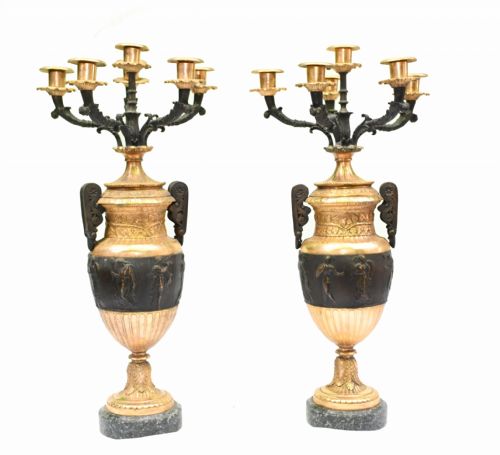


Regency Gilt Candelabra
Regency gilt candelabra bring striking neoclassical elegance to a room, combining rich metalwork with classical forms.
Regency Gilt Candelabra
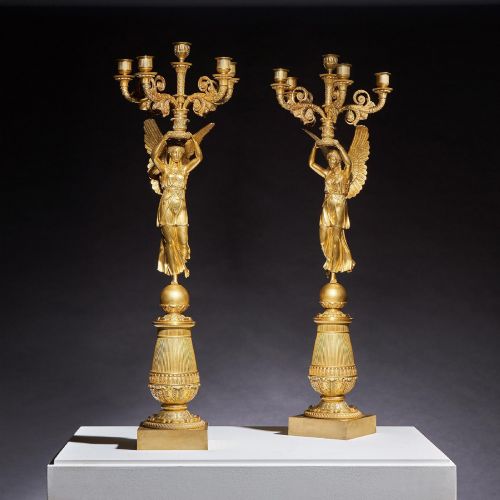
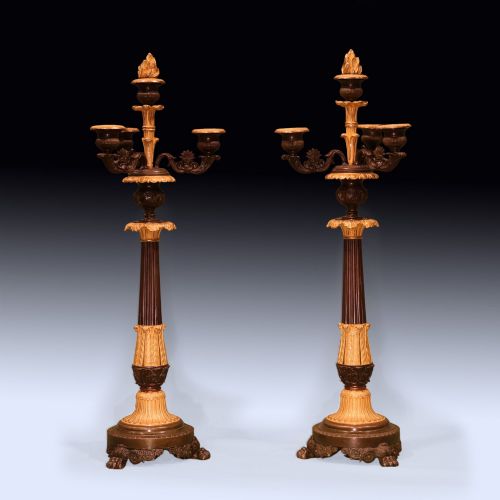
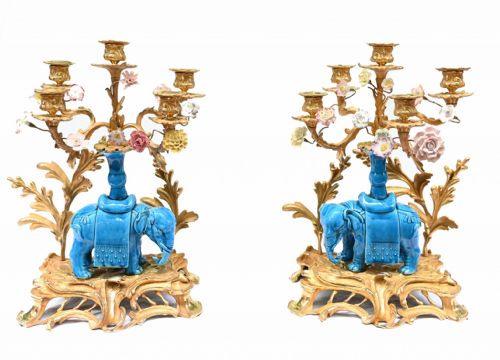
When you search for regency gilt candelabra, you find lighting pieces that define the grand interiors of the early nineteenth century and later revival periods. These objects combine practical candle illumination with sculptural presence, often taking the form of paired mantel or table ornaments.
The versions you meet most frequently on this page belong to the nineteenth century, including pieces from the Regency era proper alongside later revival interpretations. They appear as multi-arm candelabra, simpler candlesticks, and adapted standard lamps featuring gilt surfaces.
Makers and designers of these pieces drew heavily upon classical antiquity, incorporating motifs from French Empire, Swedish Empire, and Egyptian Revival styles. Alongside standard candelabra forms, the selection includes related lighting fixtures such as chandeliers and girondole wall mirrors.
Assessing Quality and Execution
Proportion and structural ambition also dictate value, with multi-arm configurations and figural supports demanding greater skill from the foundry. The integration of high-grade cut crystal drops and solid marble bases further separates standard production from exceptional workshop output.
Current listings feature pieces spanning the early nineteenth century through to the late nineteenth-century revival periods, incorporating cut crystal and marble.
Pierre Philippe Thomire·Thomas Hope
The Regency Gilt Candelabra Glossary
- Ormolu
- Gilded bronze, produced by applying an amalgam of gold and mercury to a bronze base and heating it to drive off the mercury. This technique creates a durable, matte-gold surface characteristic of fine nineteenth-century metalwork.
- Patinated bronze
- Bronze treated chemically to achieve a dark brown or black surface finish. This dark tone provides a visual foil for the bright ormolu highlights.
- Lustre
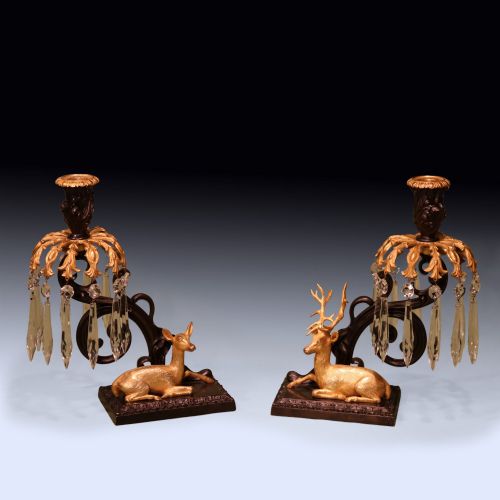
- A glass pendant or drop hung from the bobeche or arms of a candelabrum to reflect and multiply candlelight. These cut crystal elements add sparkle and movement to the fixture.
- Girondole
- A wall-mounted mirror fitted with one or more candle branches attached to the frame. The reflective glass serves to amplify the light cast by the candles.
- Bobeche
- The small drip pan situated beneath the candle nozzle to catch melting wax. In better pieces, this component matches the chased decoration of the main stem.
Regency Gilt Candelabra: Frequently Asked Questions
How do I clean ormolu candelabra?
Dust these pieces gently with a soft, dry brush to prevent accumulation in the recesses of the chasing. Avoid all chemical cleaning agents and metal polishes, which strip the fragile historical gilt surface.
Water can damage underlying materials, particularly if marble or old assembly pins are present. Professional conservation is advisable if deeper cleaning becomes necessary.
Were these electrified later?
Many nineteenth-century candelabra and standard lamps underwent conversion for electricity during the twentieth century. This adaptation often involved running cords down the central shaft or through drilled base plates.
Collectors weigh the original candle-only state against the practical convenience of wired lighting. Reversible conversions preserve the integrity of the piece without altering permanent structure.
What is the difference between ormolu and gilt bronze?
The terms describe the same material substance, with ormolu denoting the specific historical mercury-gilding process used in France and England. True ormolu has a distinctive warm, matte lustre unlike modern electroplated finishes.
Older pieces retain this mercurial layer, which resists tarnishing differently than standard gold plate. Close inspection under magnification reveals the microscopic texture left by the original fire-gilding method.
How do I spot a Regency revival piece?
Revival items, such as those from the late nineteenth century, often display machine-assisted finishing rather than hand-chasing. The mounting pins, screw threads, and internal construction methods typically reflect industrial manufacturing standards of eighteen-eighty onward.
Stylistic cues can also betray a later date, as Victorian interpretations sometimes exaggerate classical proportions. Comparing pieces to documented early nineteenth-century examples clarifies these chronological distinctions.