
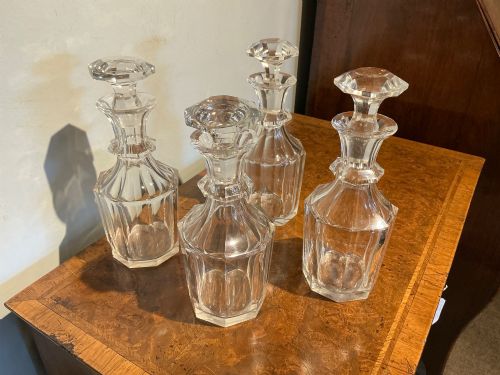
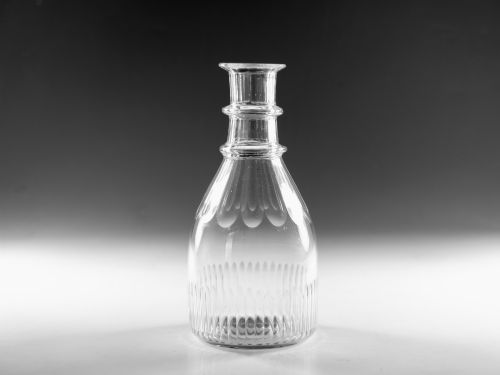
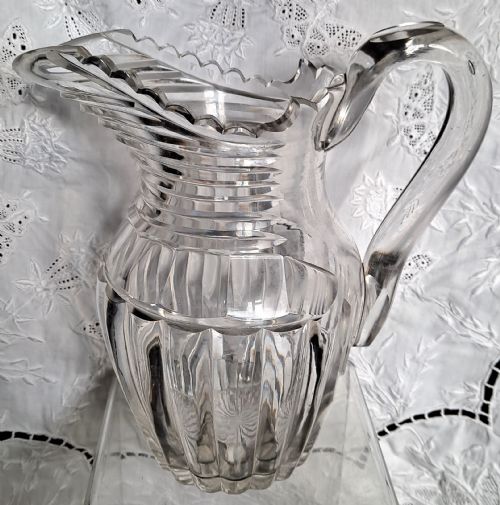
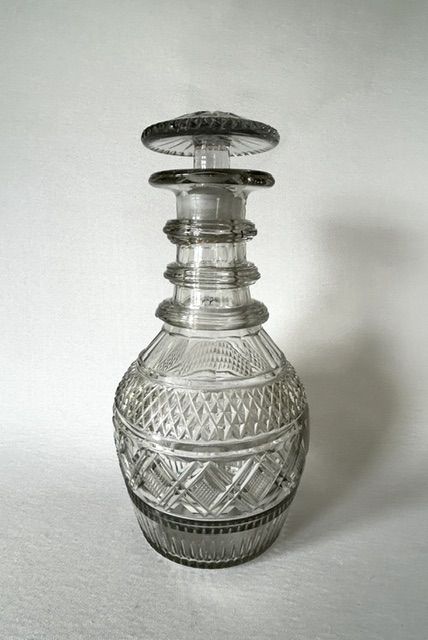


Regency Cut Glass Decanters
Regency cut glass decanters are heavy lead crystal vessels designed to hold wine and spirits upon a formal dining table.
Regency Cut Glass Decanters
Regency cut glass decanters are drinking vessels made during the early nineteenth century, appearing in forms such as ship's decanters, spirit decanters, and three-ring decanters. Buyers seeking these pieces generally encounter English and Irish examples dating from around eighteen hundred to eighteen thirty, alongside later nineteenth-century interpretations.
The inventory on this page ranges from single spirit decanters and rum decanters to matched pairs, sets of four liqueur decanters, and associated cruet sets mounted in silver or Old Sheffield Plate. Forms span traditional tapered bodies with concentric neck rings to wide-based ship's decanters designed to remain stable at sea or upon moving dining tables.
How they were made
These pieces are fashioned from heavy lead crystal or flint glass, shaped by blowing into moulds or free-blowing before artisans applied cold-cutting techniques. The brilliant facets are ground and polished by hand on stone or iron wheels, creating sharp prisms that catch candlelight.
Necks are frequently finished with applied glass rings, sometimes numbering three to separate the fingers during pouring. Mounts and associated cruet stands involve sterling silver, marked with hallmarks such as those from London, or fused Old Sheffield Plate.
Object types on this page include spirit decanters, rum decanters, ship's decanters, water jugs, and complete cruet sets on stands.
What varies in quality
The distinction between ordinary and exceptional examples lies in the crispness of the wheel-cutting and the clarity of the metal. Superior pieces display deep, sharp facets with polished recesses, whereas lesser items show shallow, rounded cutting that lacks definition.
Weight and balance dictate the calibre of the vessel, with finer lead crystal offering a resonant ring when struck gently. The presence of matching stoppers, original neck rings, and unblemished bases further elevates the standing of an individual decanter.
Charles Thomas Fox
The Regency Cut Glass Decanters Glossary
- Ship's decanter
- A form with a broad, flat base and a conical body designed to prevent tipping on board rolling vessels. This shape ensures stability during service.
- Lead crystal
- Heavy, brilliant glass containing lead oxide, which increases refractive index and makes the material softer for deep cutting. It forms the primary medium for these vessels.
- Neck ring
- Raised bands of glass applied around the neck of a decanter to provide a secure grip when pouring. They are often triple-ringed in Regency examples.
- Toddy lifter
- A small glass tube used to transfer liquor from a bowl to a glass during the Georgian period. It operates on suction created by a thumb over the upper aperture.
- Old Sheffield Plate
- A composite material formed by fusing a thin sheet of silver to a thicker copper base under heat. It appears on nineteenth-century cruet stands and frames.
Regency Cut Glass Decanters: Frequently Asked Questions
How do I clean old glass decanters?
Cleaning internal residue requires warm water and non-abrasive methods, avoiding harsh detergents that might cloud the ancient crystal. Specialist bottle brushes and soft rice grains can assist with stubborn stains.
Care must be taken with old lead crystal to prevent thermal shock from sudden temperature changes during washing.
Are original stoppers important?
Original stoppers that match the cut pattern and fit the neck correctly are essential for collector value. A matched stopper completes the silhouette and ensures a proper seal.
Replacements can often be identified by slight differences in glass tint, wear patterns, or the fit within the aperture.
How do I spot Irish glass?
Irish glass from this era typically exhibits a distinct blue-grey tint and exceptional weight due to high lead content. The facet cutting is frequently deep, bold, and exceptionally sharp.
Cork-based production centres in Ireland produced some of the most sought-after heavy crystal of the Regency period.