
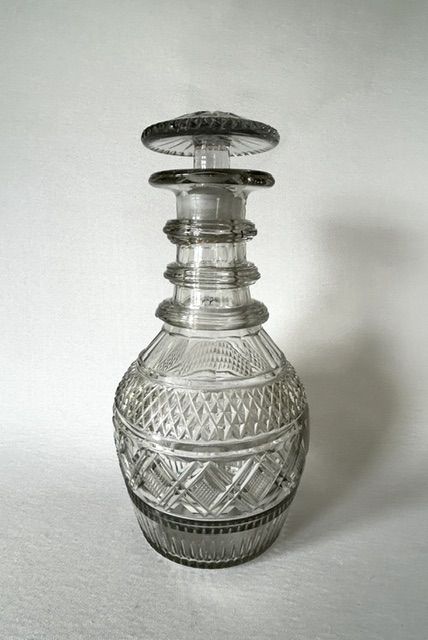


Mushroom Stopper Decanter
These mushroom stopper decanter pieces combine heavy cut glass with distinctive rounded tops, offering the robust utility and crisp refraction that collectors seek.

Mushroom Stopper Decanter
When you search for mushroom stopper decanter, you encounter serviceable vessels designed for spirits and wine during the Georgian, Regency, and Victorian eras. The evidence shows forms ranging from standard profiles to Prussian-style spirit vessels and ship's decanters.
Most examples appearing on this page belong to the Regency and Georgian periods, alongside early Victorian items. Makers shaped these objects from lead glass and crystal, often applying distinctive three-ring necks to assist with handling.
Materials and construction
The pieces recorded in the evidence rely upon lead glass, lead crystal, and cut crystal as their primary media. Artisans shaped these heavy materials through glassblowing before applying deep wheel cuts to form facets, flutes, and decorative rings.
Mushroom stoppers were ground by hand to fit individual necks securely, preventing evaporation of the contents. The resulting vessels possess the substantial weight and clarity characteristic of eighteenth and nineteenth-century British glasshouses.
Mushroom Stopper Decanter Retail Price Guide 2026
Typical asking prices for mushroom stopper decanter among the pieces listed under this phrase on Sellingantiques today, from the lower quarter to the upper quarter. They describe what is for sale here now, not the wider market.
Three rings on the neck give your fingers something to grip when pouring spirits after a heavy dinner.
Assessing quality and character
Quality in these vessels rests upon the depth and crispness of the cutting, which determines how sharply the glass refracts light. Superior examples display precise symmetry in their neck rings and a heavy, resonant handle that marks high lead content.
The match between the stopper and the neck also dictates standard; an original, hand-ground mushroom stopper that sits flush adds integrity to the piece. Differences in metal clarity and surface wear distinguish everyday utility items from finer parlour examples.
The Mushroom Stopper Decanter Glossary
- Mushroom stopper
- A rounded, bulbous glass closure resembling a mushroom cap, designed to seal spirit and wine decanters securely. This form provides a solid grip for removal.
- Prussian-style
- A specific decanter profile featuring a broad base tapering towards a narrower neck, often encircled by multiple decorative glass rings. This shape offers stability during transport.
- Lead crystal
- Glass containing a significant percentage of lead oxide, increasing the weight, brilliance, and workability of the material. It allows for deeper and sharper facet cutting.
- Ship's decanter
- A form with a wide base and low centre of gravity, originally designed to prevent tipping aboard vessels at sea. These practical items remain stable on modern sideboards.
Mushroom Stopper Decanter: Frequently Asked Questions
What are mushroom stopper decanters?
These are glass vessels designed to hold wine or spirits, featuring a distinctive rounded closure shaped like a mushroom.
They appear primarily in Georgian, Regency, and Victorian styles made from lead glass and crystal.
How were these decanters used?
Owners used them to serve port, sherry, and spirits at the dining table or from the sideboard.
The heavy glass construction and secure stoppers kept contents fresh during meals and social gatherings.
Are the stoppers original?
Ground-glass stoppers were individually fitted to each neck by hand during manufacture to ensure a proper seal.
Matching the optical clarity and wear patterns between the vessel and the mushroom top helps confirm alignment.