

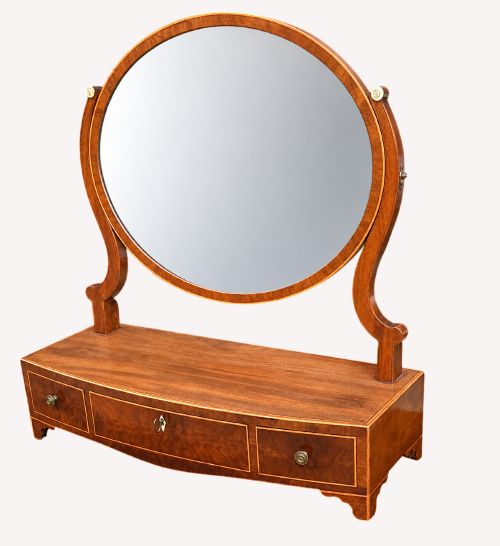
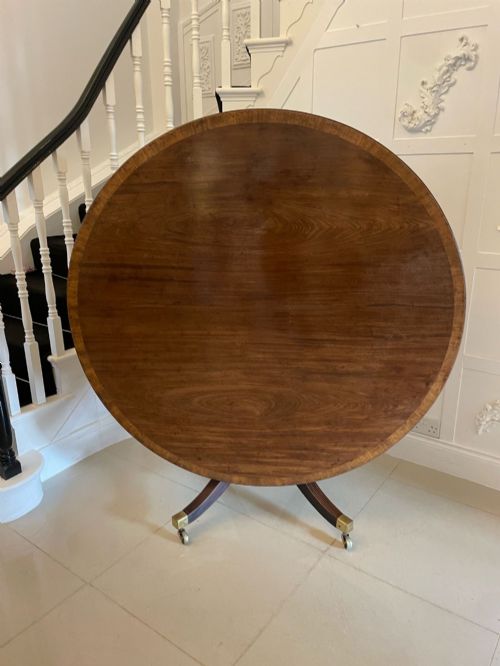
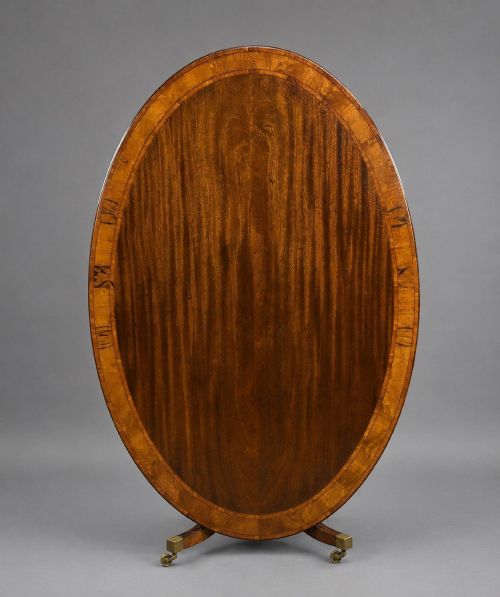
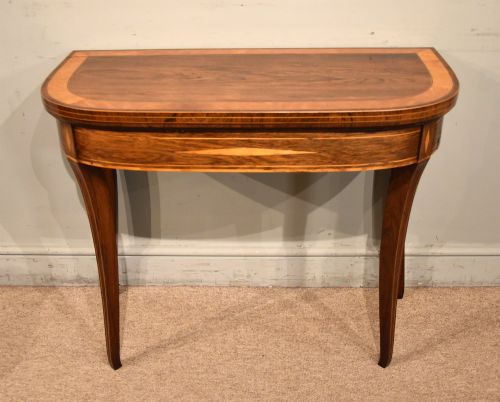


Regency Crossbanded Table
A regency crossbanded table brings contrasting timber borders to dining, card and sofa forms.
Regency Crossbanded Table
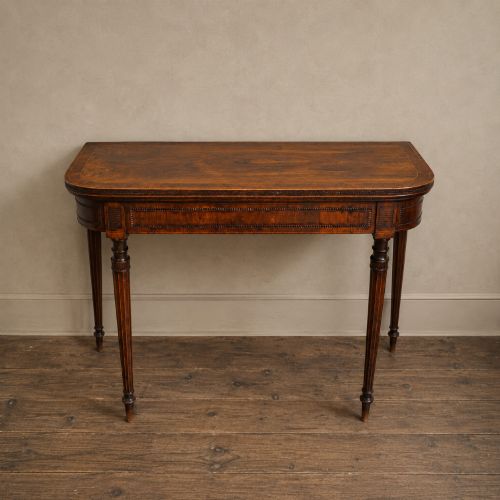
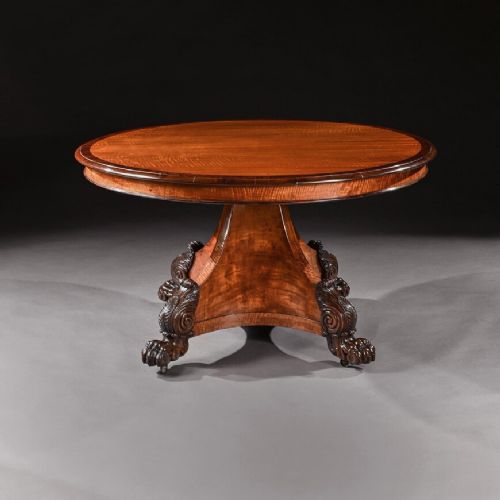
A regency crossbanded table encompasses forms designed for dining, social games and writing, most frequently encountered in mahogany, rosewood and satinwood. The inventory spans authentic period pieces from the Regency and Georgian eras alongside later revival examples produced in the Edwardian period and the early twentieth century.
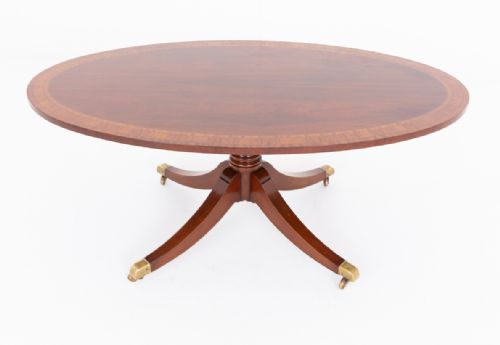
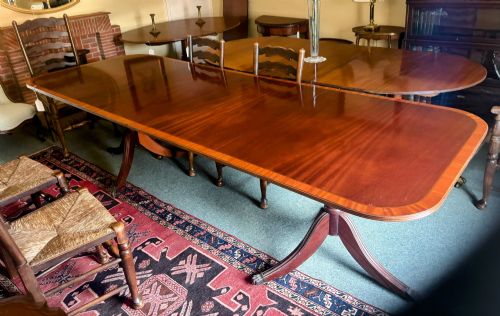
Buyers will find dining tables, sofa tables, card tables and breakfast tables, often featuring contrasting timber borders applied to the edges. These pieces range from compact occasional and wine tables to large multi-pedestal dining formats intended for principal rooms.
How they were made
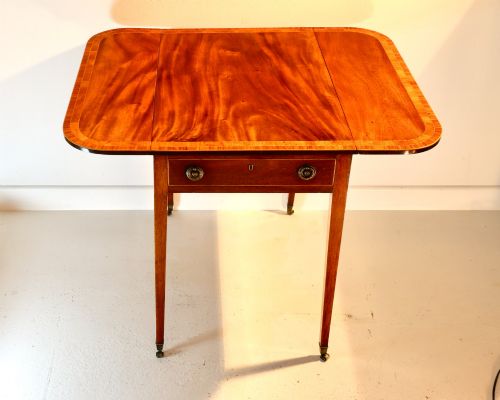
Cabinet makers built these tables using solid timbers such as mahogany and rosewood for structural elements and legs, while applying fine veneers to large flat surfaces. Crossbanding involved laying thin strips of grain-contrasting wood, frequently satinwood, burr yew or rosewood, perpendicularly around the perimeter of the tabletop.
Makers integrated brass castors, scroll pedestals and reeded sabre legs to support tilt-top breakfast tables, Pembroke forms and library tables. Inlaid borders often incorporated boxwood and ebony stringing to define the geometric outlines of card and tea tables.
Listings feature woods such as coromandel, gonçalo americo alves and birdseye maple alongside standard mahogany and rosewood.
What varies in quality
Quality depends upon the choice and figuring of the timber veneers used for the primary surfaces and the crossbanded borders. Superior examples display precise mitred corners in the banding and harmonious grain patterns selected by skilled cabinet makers.
Construction methods also separate standard production from exceptional work, visible in the stability of pedestal bases, the crispness of brass mounts and the retention of original mechanisms in fold-over card tables and drop-flap sofa tables.
Peters of Genoa·James Mein Kelso
The Regency Crossbanded Table Glossary
- Crossbanding
- A border of veneer applied to the edge of a tabletop where the grain runs perpendicular to the central panel. This technique frames the primary wood with a contrasting colour.
- Sofa table
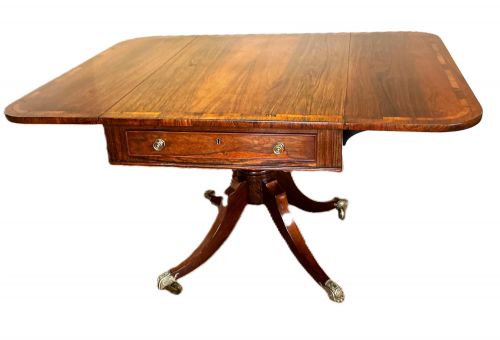
- A rectangular occasional table fitted with drop leaves on opposite sides and usually two small drawers beneath the top. They were designed to stand directly in front of sofas.
- Card table
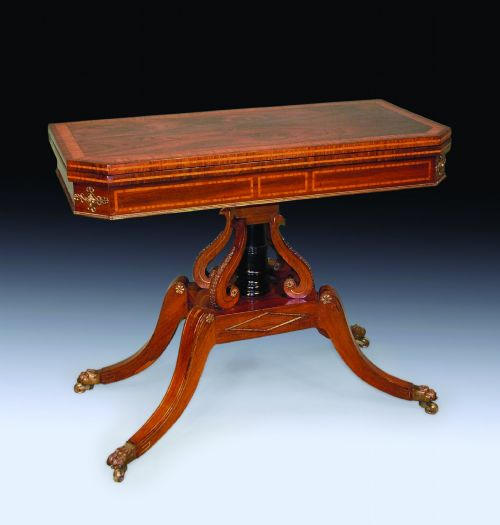
- A fold-over table with a hinged top that opens to reveal a baize-lined playing surface for games such as whist. Many feature swivel actions supported by a single pedestal or folding rear legs.
- Tilt-top table
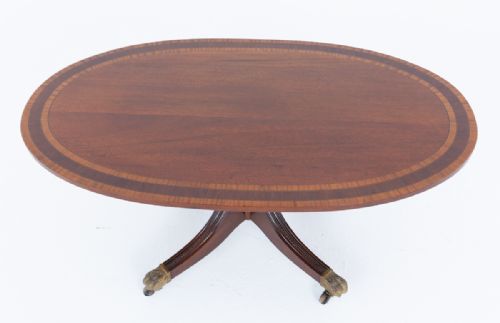
- A breakfast or centre table fitted with a mechanism allowing the top to pivot vertically when not in use. This design enabled the furniture to be stored compactly against a wall.
- Stringing
- Thin inlaid lines of contrasting timber or light-coloured wood set into the surface of furniture. It creates fine linear borders around panels and drawer fronts.
Regency Crossbanded Table: Frequently Asked Questions
Where should I place a sofa table?
Sofa tables fit naturally behind a freestanding sofa or against a hallway wall where their narrow profile remains functional without blocking circulation.
Because their drop leaves can be raised or lowered, they adapt easily to changing spatial needs in sitting rooms and studies.
How do I care for antique rosewood?
Antique rosewood surfaces require minimal moisture and protection from direct sunlight to prevent fading and veneer lifting. Regular dusting with a dry soft cloth maintains the natural lustre of the polished timber.
Occasional application of appropriate wax feeds the wood without building up heavy residues that obscure the fine grain patterns.
What is a tilt-top breakfast table used for?
Tilt-top breakfast tables served initially for morning dining before the mechanism allowed the top to be folded flat against the wall to save floor space. In modern rooms, they function as permanent centre tables where the mechanism remains a notable mechanical feature.
Their sturdy pedestal bases provide ample legroom for seating compared to traditional four-leg dining tables.
How do I distinguish Regency from Edwardian revival pieces?
Regency pieces date from the early nineteenth century and exhibit the natural ageing, timber shrinkage and hand-cut construction marks characteristic of that period. Edwardian revival examples, made around nineteen-ten to nineteen-twenty, often display machine-sawn elements and different secondary woods underneath.
Examining the underside, drawer linings and screw types helps clarify the precise era of manufacture.