
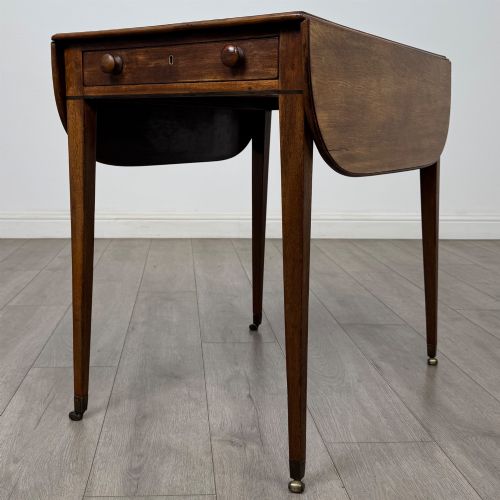
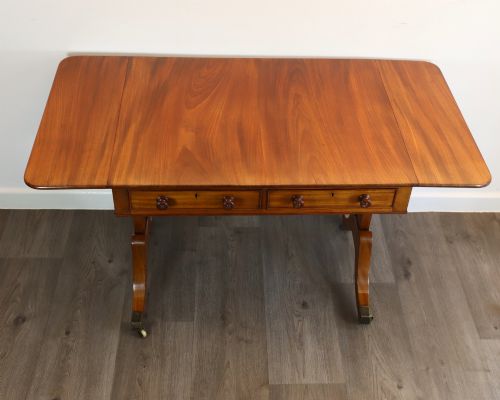
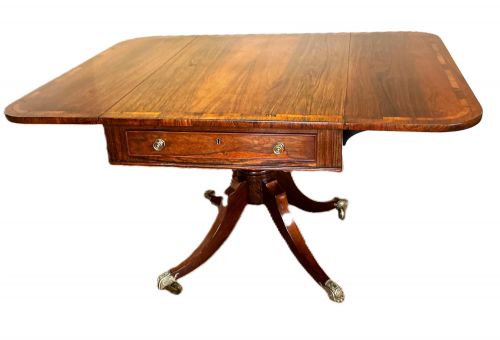
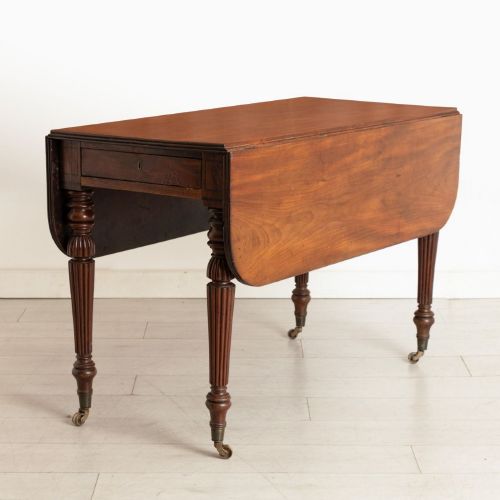
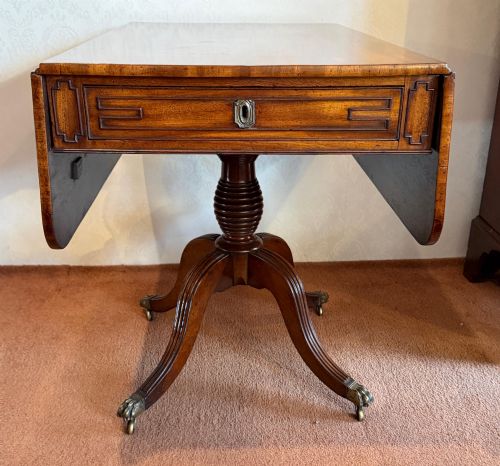


Brass Castor Drop Leaf Table
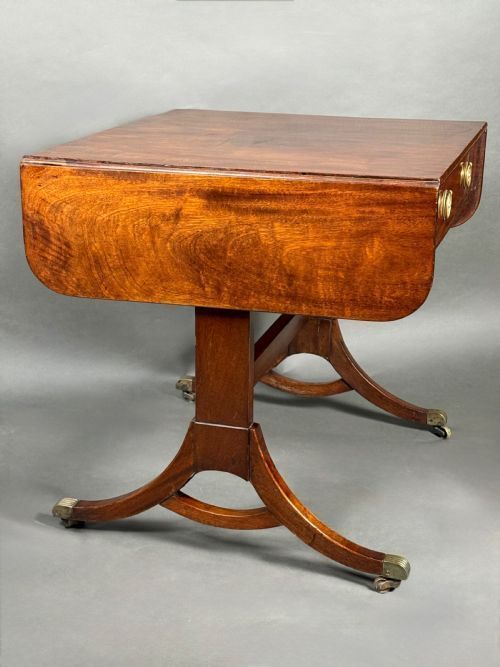
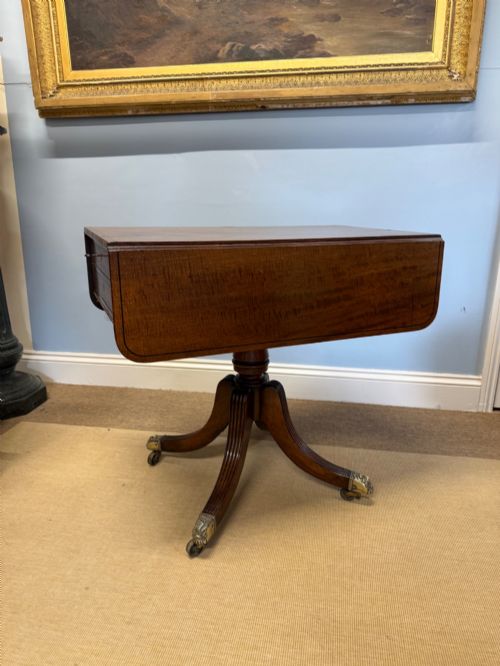
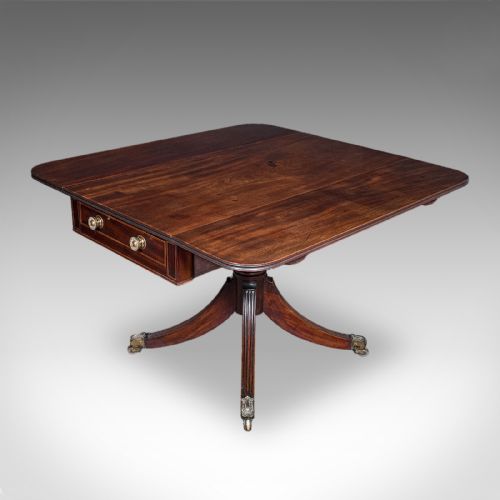
A brass castor drop leaf table brings versatile folding leaves and rolling mobility together in rich mahogany.
What they are
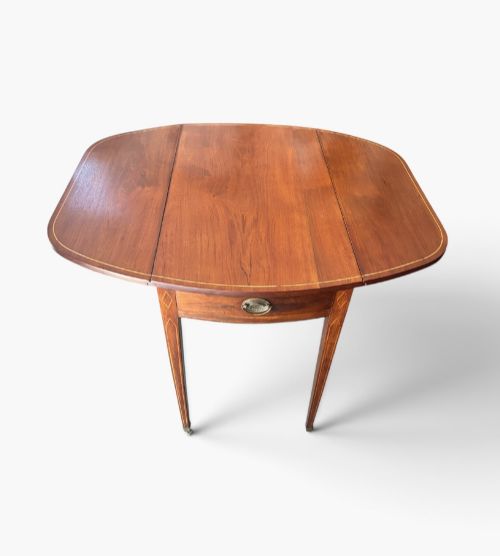
A brass castor drop leaf table is a versatile folding piece designed for flexible living spaces and easy repositioning across rooms. These pieces predominantly appear as Pembroke tables and sofa tables dating from the Georgian period through the nineteenth century.
The form relies on drop leaves supported by hinged flaps, paired with pedestal bases or quadruped legs fitted with brass castors. Examples span Regency, George IV, and Grand Regency styles, often incorporating two drawers and boxwood inlay.
How they were made
Cabinet makers utilised solid mahogany and rich veneers for the primary surfaces, applying careful boxwood inlay to create fine decorative contrast along the borders and edges. The timber was seasoned, shaped, and polished to highlight the natural grain.
Metalworkers cast and polished the brass castors that allowed heavy timber tables to glide smoothly across carpets and floors. Mechanical joints, drop leaf hinges, and pedestal supports were engineered to bear the weight of folding leaves.
Retail Price Guide 2026
Typical UK retail prices for brass castor drop leaf table, calculated from the Sellingantiques database of over a million retail prices indexed since 2003. This retail price guide relies exclusively on Sellingantiques data; no external sources or auction records are used, so the figures do not describe the wider market.
Listings feature mahogany, brass, and boxwood inlay across Regency, George IV, and Grand Regency styles.
What varies in quality
Quality rests in the crispness of the boxwood inlay and the careful selection of figured mahogany veneers across the top and leaves. Superior pieces exhibit seamless joints and balanced proportions between the pedestal base and the extended leaves.
The refinement of the brass castors and the smoothness of the drawer construction distinguish higher tier examples. Finer workshops invested greater detail into the turning of the pedestal and the stability of the quadruped legs.
The Brass Castor Drop Leaf Table Glossary
- Pembroke table
- A small rectangular table with hinged drop leaves on either side, often featuring one or two drawers. This form became popular during the eighteenth century for breakfasting and writing.
- Sofa table
- A long, narrow table designed to sit immediately in front of a sofa, featuring drop leaves and frequently mounted on a pillar or pedestal base. They emerged during the Regency period.
- Quadruped legs
- A four-legged support structure branching outward from a central pedestal column. This configuration provides stability for tables with expanding leaves.
- Boxwood inlay
- A decorative technique where thin strips of pale boxwood are inserted into recesses cut into darker timber. It creates sharp linear contrasts on table tops and drawer fronts.
- Cross-banded
- A method of veneer placement where the grain runs perpendicular to the main surface. This frames the top panel with a contrasting border.
Frequently Asked Questions
What is a Pembroke table?
A Pembroke table is a compact design featuring hinged side flaps that lift to extend the surface area. It typically includes one or two small drawers beneath the top.
These tables were originally used for casual dining or writing and could easily be folded down when space was required.
How do sofa tables differ?
Sofa tables are proportioned to stand against the back of a sofa or directly in front of seating. They are generally longer and narrower than standard occasional tables.
The inclusion of drop leaves allows the ends to expand when extra surface space is needed.
What timber was used?
Mahogany is the primary timber found in these nineteenth-century pieces, prized for its deep colour and durability. Craftsmen often enhanced the appearance using boxwood inlay for fine decorative framing.
The wood was polished to a warm finish that highlighted the natural grain patterns.
Why are brass castors fitted?
Brass castors provide smooth mobility, allowing heavy timber furniture to be repositioned easily across rooms. They lift the legs slightly off the floor and reduce friction during movement.
On Regency and Georgian pieces, these metal fittings also serve as a polished decorative accent.
How are periods identified?
Periods are identified through structural characteristics, stylistic details, and cabinet-making techniques. Regency and George IV pieces display classical proportions and specific decorative motifs like inlay.
Comparing leg designs, hardware, and timber preparation helps narrow down the era of manufacture.