
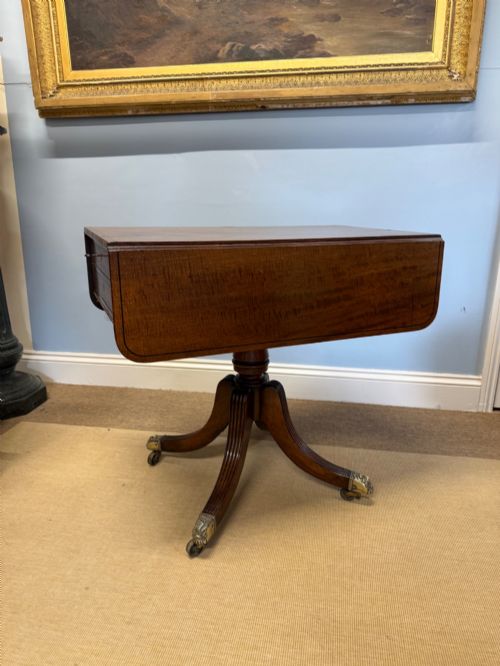
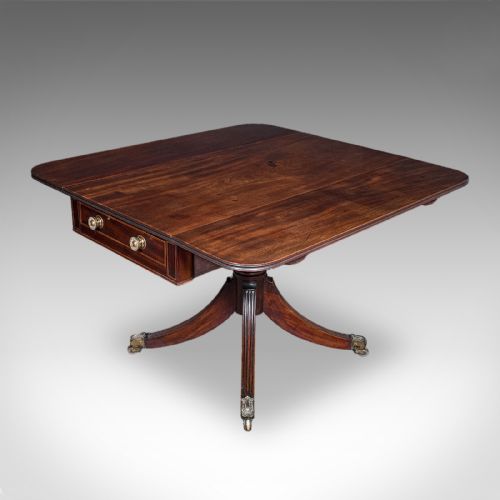
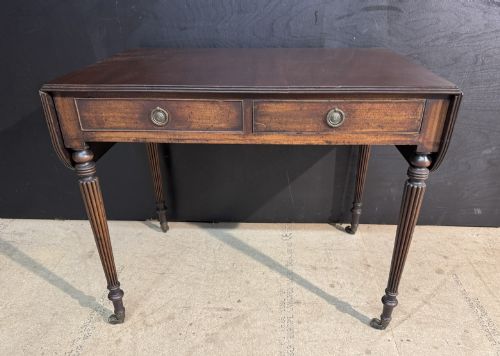
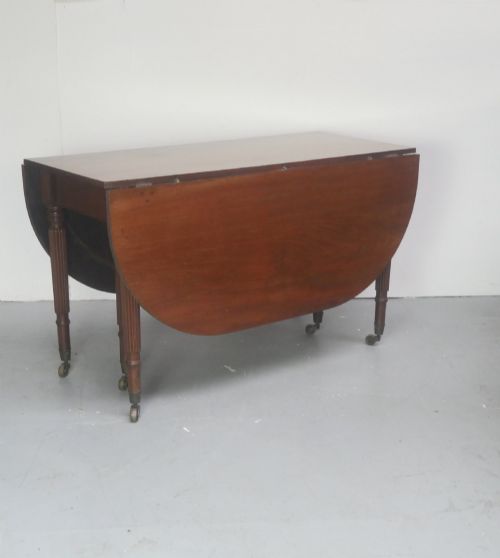
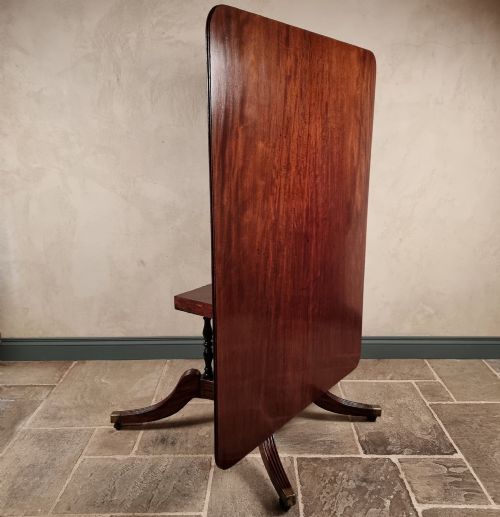
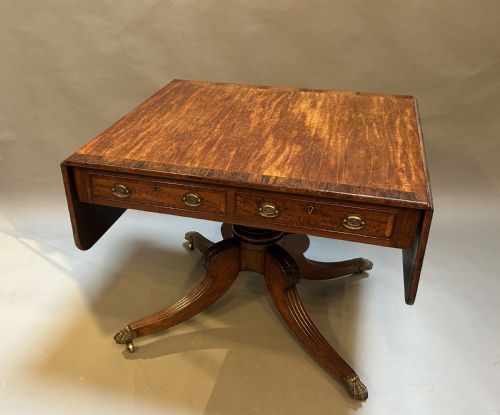
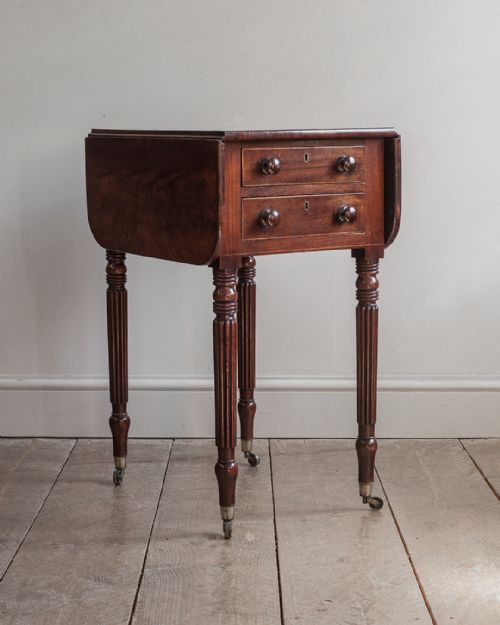


Reeded Leg Drop Leaf Table
A reeded leg drop leaf table brings together drop leaf ingenuity and finely carved legs, offering a flexible surface that folds away when floor space is at a premium.
Reeded Leg Drop Leaf Table
A reeded leg drop leaf table is a versatile form designed to expand when dining or working and contract against a wall when not in use. The selections here span dining tables, pembroke tables, sofa tables, and work tables, predominantly originating from the Regency, Georgian, and 19th Century periods.
The version you are most likely to meet on this page is a mahogany pembroke or dining table featuring characteristic turned and reeded upright supports. Pieces attributed to specific aesthetic lineages such as Sheraton and Gillows style appear alongside country and Victorian variants.
How they were made
Cabinet makers constructed these tables primarily in mahogany, occasionally incorporating satinwood, oak, pine, and veneer over solid carcases. Brass components appear on castors and handles, while fabric occasionally lines the interiors of work tables.
Makers utilised structural folding mechanisms, drop leaves, and pedestals alongside delicate turning to carve vertical reeding into the timber legs. Surface finishing relied on hand-applied polish to highlight the figured grain of the mahogany.
Object types catalogued here range from large dining tables and sofa tables down to compact work and side tables.
What varies in quality
Quality rests in the crispness of the reeding carved into the timber legs and the selection of figured mahogany for the top surfaces. Tables displaying balanced proportions and well-executed secondary timbers stand above simpler utility pieces.
The sophistication of the mechanism, whether a pembroke flap support, a drop leaf action, or pedestal bracing, dictates the refinement of the piece. Superior examples exhibit seamless joints and original brass hardware.
William Trotter·Duncan Phyfe
The Reeded Leg Drop Leaf Table Glossary
- Reeding
- Parallel convex moulding carved into wood to resemble parallel reeds. This decorative technique often adorns table legs during the Regency period.
- Pembroke table
- A small table with hinged drop leaves on two opposing sides. It often includes one or two drawers and slender legs.
- Sofa table
- A rectangular occasional table designed to stand in front of a sofa. These typically feature drop leaves and double pedestals or trestle ends.
- Cumberlands table
- A type of dining table with drop leaves supported by pivoting gate legs or swinging wooden arms. They fold down compactly for storage.
- Veneer
- A thin layer of figured wood applied over a secondary timber base. This method allows makers to display striking grain patterns economically.
Reeded Leg Drop Leaf Table: Frequently Asked Questions
What is a reeded leg drop leaf table?
It is a folding table featuring hinged flaps supported by brackets or swing legs, mounted on turned uprights decorated with parallel carved convex mouldings known as reeding.
These pieces function as dining tables, sofa tables, or pembroke tables, adapting easily to different room layouts.
How do you use a drop leaf table daily?
You drop the side leaves to save floor space when the table is not in use, pushing it against a wall as an occasional or side table.
When extra surface area is needed for dining, writing, or sewing, simply raise the leaves and swing out the supporting legs.
How do I identify a Regency period table?
Regency tables often display classic architectural proportions, dark figured mahogany timbers, and classical details like brass paw castors and reeded legs.
Construction methods from this era rely on solid secondary woods and hand-cut joints rather than modern fasteners.
Where should I place a pembroke table?
A pembroke table fits well beside a sofa, against a hallway wall, or as a small writing surface in a bedroom.
Because the leaves fold down, it occupies minimal depth while remaining ready to extend when a flat surface is required.