


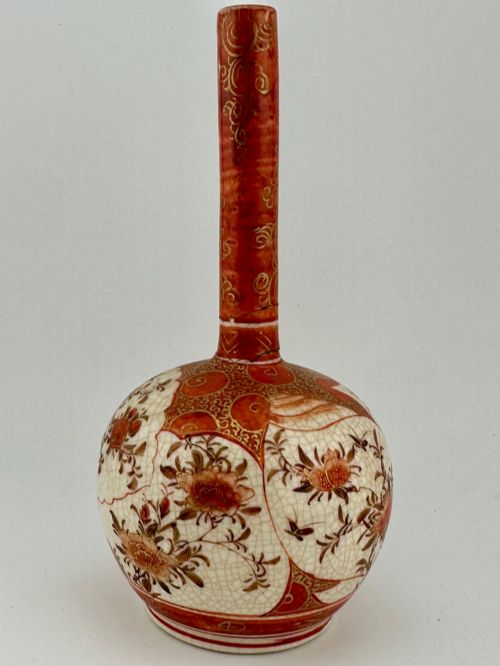



Red Gilt Japanese Vases
Red gilt japanese vases bring vibrant colour and metallic brilliance into a room, drawing the eye instantly to intricate hand-painted detail.
Red Gilt Japanese Vases
Red gilt japanese vases encompass a striking array of porcelain forms spanning the Edo, Meiji, and Taisho periods. When searching for red gilt japanese vases, buyers encounter classic Imari patterns and Kutani wares decorated with rich iron red pigments and gold leaf.
The selection here ranges from large lidded jars and cylindrical vessels to bottle vases and spill vases. Many examples date from the nineteenth century, reflecting the peak of export craftsmanship that captivated European and domestic interiors alike.
How they were made
Potters shaped fine porcelain bodies before applying cobalt underglazes, iron red enamels, and meticulous gold leaf highlights. Firing these pieces required precise temperature control to fuse the complex glaze palette without damaging the delicate metallic details.
Artisans built up the surface decoration in distinct layers, using rich glaze and enamel to create depth. Gilding was applied by hand to accent borders, motifs, and panels, ensuring each vase caught the light differently.
Red Gilt Japanese Vases Retail Price Guide 2026
Typical asking prices for red gilt japanese vases among the pieces listed under this phrase on Sellingantiques today, from the lower quarter to the upper quarter. They describe what is for sale here now, not the wider market.
Some nineteenth-century makers cleverly repurposed antique lidded jars into table lamps, shedding new light on old porcelain.
What varies in quality
Quality rests in the precision of the brushwork and the richness of the iron red and gilt application. Finer pieces display crisp, confident lines and balanced compositions that command attention across a room.
The weight and finish of the porcelain body also distinguish standard production items from masterworks. Superior vessels maintain crisp moulded or fluted details beneath the glaze without blurring the hand-painted motifs.
The Red Gilt Japanese Vases Glossary
- Kutani
- A style of Japanese porcelain traditionally characterised by vibrant green, yellow, purple, and strong iron red enamels enriched with gold. This ware originated in Ishikawa Prefecture and gained immense popularity during the nineteenth century.
- Imari
- A type of Japanese porcelain decorated in underglaze blue, iron red, and gilt, often featuring intricate floral and brocade designs. The style developed in Arita and was widely exported to the West.
- Meiji Period
- The era of Japanese history lasting from 1868 to 1912, marked by the opening of trade with the West and a flourishing of decorative arts. Pieces from this time often exhibit exceptional technical mastery.
- Edo Period
- The period spanning from 1603 to 1867 under the Tokugawa shogunate, establishing foundational ceramic traditions and export styles. Early wares from this era display distinct restraint compared to later Victorian-influenced export pieces.
- Spill vase
- A tall, slender vessel historically used to hold wooden spills for lighting candles or fires. These practical objects evolved into purely decorative mantelpieces.
Red Gilt Japanese Vases: Frequently Asked Questions
How do I date a Kutani vase?
Dating relies on stylistic clues, pigment depth, and historical export markers. Nineteenth-century examples often display denser iron red and heavier gilding compared to later twentieth-century productions.
Examine the base for kiln marks and the texture of the porcelain paste. Earlier pieces generally exhibit a heavier, drier foot ring.
Are Imari vases waterproof?
Most antique Imari vases feature fully vitrified porcelain bodies and glazed interiors, making them suitable for holding water. However, thermal shock can damage fragile historical glazes.
It is safer to use a hidden plastic liner inside valuable antique vessels if you plan to display fresh floral arrangements.
Where should I display large lidded jars?
Large lidded jars work best anchored on sturdy sideboards, mantelpieces, or dedicated pedestals where their height and colour can balance a room. Pairs look striking when mirrored on either side of a fireplace.
Ensure they sit away from heavy foot traffic to prevent accidental knocks against the protruding covers.
What is the difference between Imari and Kutani?
Imari porcelain traditionally relies on a tripartite palette of underglaze blue, iron red, and abundant gold, often arranged in brocade patterns. Kutani ware leans heavily into iron red and gold alongside distinct green and purple enamel washes.
Both styles emerged from different production centres and evolved distinct decorative vocabularies over the centuries.