
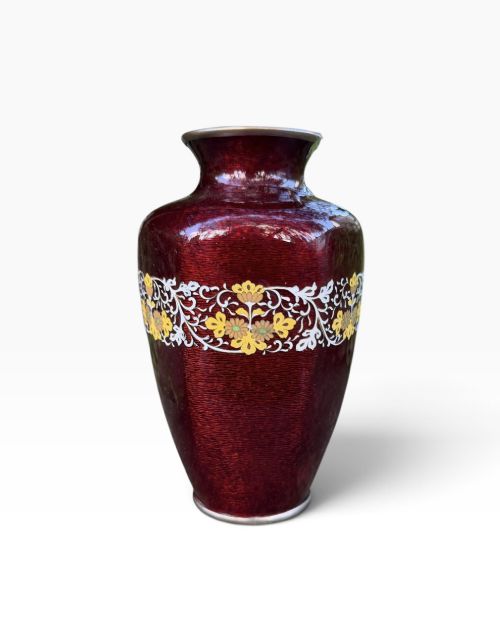



Red Enamel Japanese Ceramic
These red enamel japanese ceramic pieces bring bright mineral colour and disciplined forms into a room, carrying centuries of kiln craft from the Far East.
Red Enamel Japanese Ceramic
When you search for red enamel japanese ceramic, you are looking at items shaped from porcelain and clay, carrying iron-rich red pigments alongside cobalt blue and gold leaf. These works span the Edo, Meiji, and Taisho periods, showing how domestic vessels evolved into elaborate display items over three hundred years.
The objects on this page most often take the form of decorative bowls, chargers, and vases, alongside small incense burners and dishes. You will encounter Imari wares with their dense iron-red and blue palettes, alongside Kutani pieces that deploy heavy red enamel work across surface panels.
Earlier examples lean towards the restrained Arita styles of the seventeenth century, while later nineteenth and early twentieth-century pieces embrace the intense ornamentation of the Meiji period. Each era brings a distinct weight and glaze character to the surface.
Materials and methods
Makers shaped these pieces from fine porcelain and local clays before applying mineral glazes and underglaze cobalt blue. Artisans then added overglaze red enamel pigments, sometimes integrating gold leaf, foil, or copper elements to enrich the finished surface.
Firing required precise kiln control to fix the base glazes before secondary firings fused the delicate red enamel layers onto the porcelain. The addition of ginbari techniques involved textured foil grounds beneath translucent enamel coats to build shimmering depth.
Listings feature pieces spanning the seventeenth century through to the Taisho period, constructed from porcelain, copper, and gold leaf.
Judging quality in red enamel japanese ceramic
The distinction between ordinary and exceptional work lies in the discipline of the brushwork and the purity of the enamel surface. Superior pieces display crisp, confident hand-painted motifs where the red enamel sits evenly without bubbling or clouding.
Balance of form and the integration of gold gilt or copper mounts further separate ambitious studio output from standard utilitarian production. Weight, potting precision, and the clarity of the underlying glaze reveal the maker's control.
Shozo
The Red Enamel Japanese Ceramic Glossary
- Imari
- A type of Japanese porcelain produced in Hizen province and exported through the port of Imari, typically decorated in underglaze blue and iron-red enamel with gold highlights. These patterns established a dominant aesthetic for centuries.
- Kutani
- Japanese porcelain and pottery associated with Ishikawa Prefecture, known for bold overglaze enamel work, particularly rich red palettes and figurative scenes.
- Arita
- The Japanese town and surrounding region where porcelain production began in the early seventeenth century, giving rise to foundational styles like Imari and Aka-e.
- Ginbari
- A decorative technique using textured metal foil applied beneath a translucent enamel layer to create a reflective, patterned background.
- Koro
- A traditional Japanese incense burner, often standing on three feet and fitted with a pierced cover to release scented smoke.
Red Enamel Japanese Ceramic: Frequently Asked Questions
How do I care for these ceramics?
Dust these delicate enamel and porcelain surfaces gently with a dry, soft cloth. Avoid harsh cleaning agents or immersion in water to protect the historic overglaze pigments.
Keep pieces away from direct sunlight and areas subject to sudden temperature shifts to prevent stress on the antique glaze layers.
Where were these pieces made?
Production centred primarily around kilns in Hizen province, particularly Arita, which supplied the ports for widespread distribution. Other regional centres such as Kutani developed distinct local workshops focused on rich enamel decoration.
Raw materials like fine white clay and local minerals determined the specific kiln locations across Japan during the Edo and Meiji eras.
How can I tell the period?
Examine the potting style, glaze consistency, and palette characteristics to estimate the era of manufacture. Seventeenth-century Arita pieces show heavier bodies and simpler blue and red designs, whereas Meiji pieces often display dense, intricate hand-painted compositions.
Signatures, when present, offer further clues to specific makers or workshops active during the nineteenth and early twentieth centuries.