




Putti Clock Set
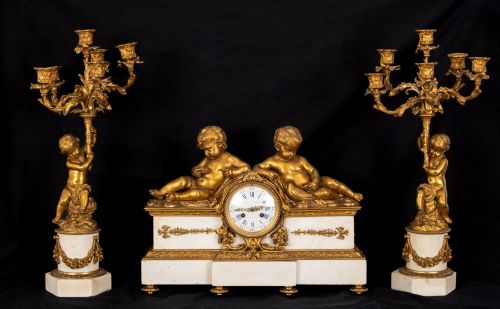
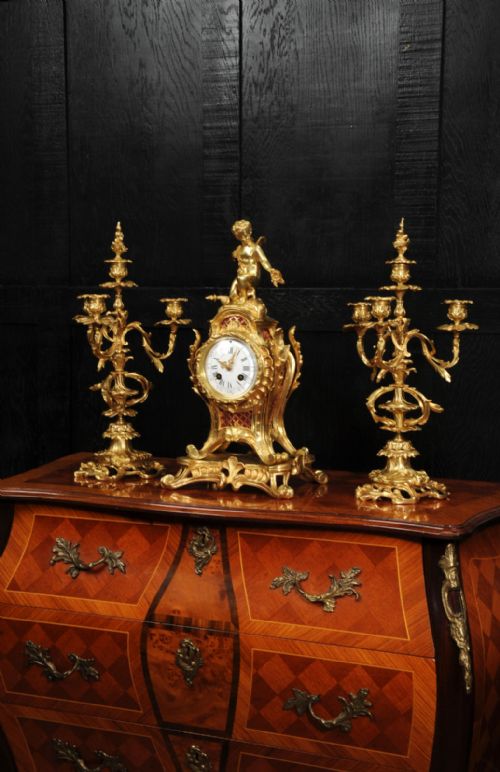
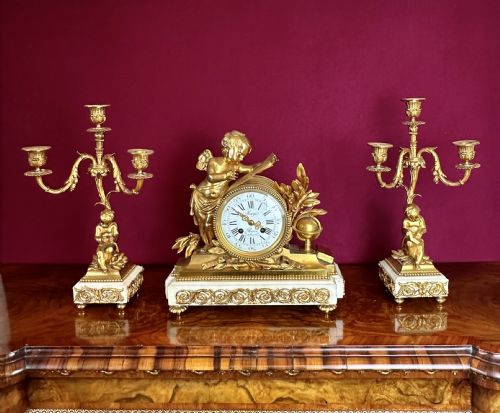
A putti clock set brings figural bronze and marble sculpture directly into domestic timekeeping, pairing a central mantel clock with matching candelabras.
Putti Clock Set
A putti clock set gathers nineteenth-century French mantel clocks and flanking garnitures populated by cherubs, cupids, and figures derived from mythology. These decorative groupings emerge primarily during the Victorian era through the 1870s, 1880s, and 1890s, reflecting revivals of Louis XV and Louis XVI styles.
The dominant configurations on this page include clock garnitures paired with candelabras, featuring sculptural cherubs rendered in bronze, gilt bronze, or ormolu alongside bases of white, red, or green marble. Pieces span broader nineteenth-century timelines and specific dates like 1870, 1880, and 1890.
Makers and manufacturers occasionally include established European works such as Meissen alongside French garnitures, though many sets remain uncredited in the titles. Buyers encounter both complete three-piece ensembles and individual mantel clocks incorporating visible pendulums and enamelled dials.
Materials and construction
Foundry work relies on cast bronze and gilt metal, frequently finished with ormolu gilding to achieve a bright golden surface across the figures of putti and floral mounts. Stonework forms the heavy architectural bases, utilising white marble, red marble, and green marble turned and polished to support the metal elements.
Dials employ white enamel painted with numerals, protected behind glass bezels and housed within elaborate Rococo or Louis XVI revival cases. The manufacturing process unites metalcasting, fire gilding or electrogilding, stonemasonry, and precision clockmaking into a unified garniture.
Materials recorded across the inventory include ormolu, gilt bronze, enamel, and multiple varieties of marble such as white, red, and green.
Distinctions in craftsmanship
The finesse of the chased detail on the bronze putti separates standard production from superior examples, where individual curls of hair, feathered wings, and facial expressions remain crisp and expressive. Heavier, more substantial marble plinths with precise levelling and clean stone selection indicate higher workshop standards.
The integration of the side candelabras with the central clock defines the success of a garniture, requiring consistent patination, matching mounts, and unified stylistic restraint across all three matching pieces.
Meissen
The Putti Clock Set Glossary
- Putti
- Plural of putto, depicting plump, winged male infants akin to cherubs or cupids. They appear frequently in Renaissance revivals and nineteenth-century French decorative arts.
- Garniture
- A set of decorative objects designed to be displayed together, typically comprising a central clock flanked by two matching candelabras or urns. These arrangements symmetry on a mantelpiece.
- Ormolu
- Finely ground high-carat gold applied to a bronze base using a mercury amalgamation technique or modern electroplating. The finish yields a rich, warm golden lustre characteristic of French luxury goods.
- Visible pendulum
- A clock movement design featuring a glass panel or open aperture in the dial or case, allowing the swinging pendulum to be seen during operation.
- Louis XVI Revival
- A nineteenth-century design movement drawing inspiration from the neoclassical tastes of mid-eighteenth-century France. It employs straight lines, classical motifs, urns, and restrained symmetry.
Putti Clock Set: Frequently Asked Questions
What is included in a clock set?
A standard set consists of a central mantel clock accompanied by two matching side pieces, usually candelabras or urns designed in the same decorative style.
These matching elements create a balanced arrangement for display upon a fireplace mantel or large piece of furniture.
How do I identify Louis styles?
Louis XV style pieces, often linked to Rococo revival, feature asymmetrical scrollwork, naturalistic foliage, and flowing curves. Louis XVI style pieces display stricter symmetry, classical architectural motifs, and straighter lines.
Both styles frequently incorporate putti, but the surrounding ornamentation dictates the specific period revival.
What materials are used in these sets?
Construction relies heavily on cast metals such as bronze, gilt metal, and ormolu combined with polished natural stone bases. White marble, red marble, and green marble provide weight and contrast to the metallic figures.
Enamel is standard for the clock faces, while glass protects the delicate hands and numerals.