




Putti Clock Garniture
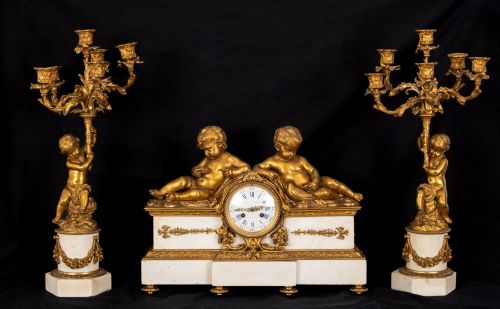
These putti clock garniture sets bring together heavy ormolu, marble, and sculptural cherubs to anchor a mantelpiece with nineteenth-century French drama.
Putti Clock Garniture
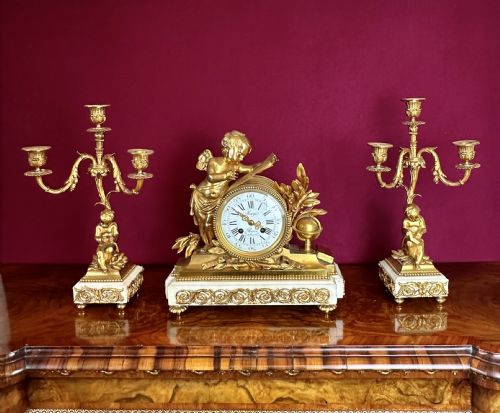
A putti clock garniture comprises a central mantel clock accompanied by matching side pieces such as candelabras, all dominated by sculptural depictions of cherubs, cupids, and cherubic figures. The pieces appearing here date from the nineteenth century, including Victorian examples and specific years such as 1870, 1880, and 1890.
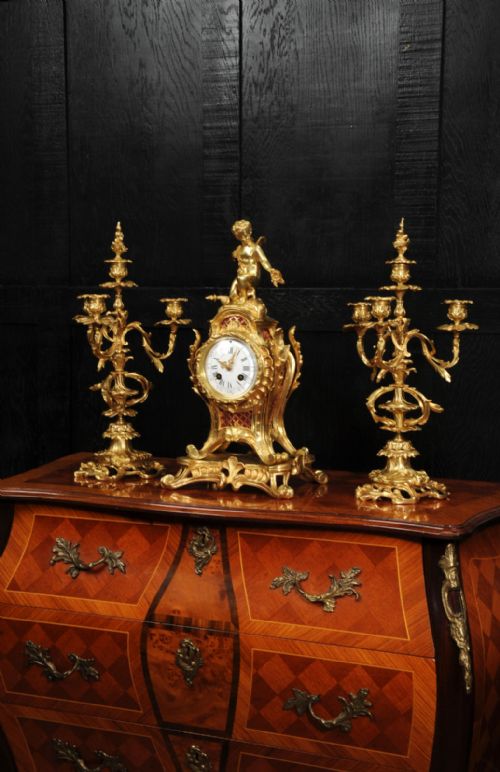
The dominant forms follow French design vocabularies, particularly Louis XVI style, Louis XVI Revival, Louis XV Revival, and French Rococo Revival. Buyers find complete three-piece sets alongside clock garnitures paired with candelabras, often utilising white marble, red marble, or green marble bases.
Makers and origins lean heavily toward French ateliers of the period, though continental porcelain factories such as Meissen also appear in the record. The core function remains decorative and timekeeping, designed to sit prominently on a salon or drawing room mantel.
How they were made
Foundries and workshops shaped these objects using gilt bronze, ormolu, and gilt metal, casting intricate cherub figures and mountings with pronounced scrolling foliage. Ormolu gilding involved applying a mercury and gold amalgam to bronze, then firing the piece to drive off the mercury and leave a rich metallic finish.
Stonemasons carved and polished white, red, and green marble to form the heavy architectural plinths and column bodies that support the metalwork. Enamel featured on clock dials, providing a smooth white surface for painted numerals, while visible pendulums offered a mechanical focal point.
Cupid and his cherubic companions silently guard the mantelpiece, brandishing arrows and holding back time itself.
What varies in quality
The crispness of the chasing on the gilt bronze and ormolu separates ordinary castings from superior work, as master chasers hand-tooled the metal after casting to sharpen every feather, curl of hair, and acanthus leaf. Softer, shallower definition in the putti figures indicates mass production rather than bespoke foundry output.
The selection and density of the marble plinths also dictate the grade of the garniture, with dense, flawless stone carrying greater weight and presence than inferior clouded slabs. Furthermore, the harmonious matching of the central clock with its accompanying candelabras determines whether a set was conceived together or assembled later from disparate parts.
Meissen
The Putti Clock Garniture Glossary
- Garniture
- A set of matching decorative objects for a mantelpiece, typically comprising a central clock and two flanking candelabras or urns. These sets dominated nineteenth-century formal interiors.
- Ormolu
- Finely ground high-carat gold mercury-gilded onto a bronze base. This technique creates the deep, warm yellow lustre seen on nineteenth-century French metalwork.
- Putto
- A plump, naked male child figure, often winged, derived from classical art and frequently termed a cherub or cupid in nineteenth-century French clock descriptions.
- Louis XVI Revival
- A nineteenth-century design movement drawing on neoclassical symmetry, straight architectural lines, and classical motifs from the reign of Louis XVI. It stands in contrast to the asymmetrical curves of the Rococo style.
- Candelabra
- A branched candlestick holder designed to match the central clock in a garniture set. They provide balanced visual weight at either end of a mantel.
Putti Clock Garniture: Frequently Asked Questions
What is a putti clock garniture?
A putti clock garniture is a matched set consisting of a mantel clock and side pieces featuring sculptural cherubic figures. They were designed in nineteenth-century France to decorate grand mantelpieces.
These sets combine heavy metalwork like ormolu and bronze with marble bases. The cherubs, or putti, are integrated into both the clock case and the matching candelabras.
How do I date a putti clock garniture?
Dating relies on stylistic clues, materials, and manufacturing techniques recorded across the nineteenth century. Pieces from this era often reflect Louis XV or Louis XVI revival aesthetics.
Examinations of the dial enamel, the type of marble used, and the casting quality of the gilt bronze help narrow down the decade. Victorian imports from France frequently bear period hallmarks or serial numbers on the clock movements.
What styles are common for these clocks?
The dominant styles are French Rococo, Rococo Revival, and Louis XVI Revival. These aesthetics favour ornate scrolling, naturalistic foliage, and classical symmetry.
Finer sets incorporate architectural marble columns alongside playful putti figures. The crossover between Rococo asymmetry and Louis XVI neoclassical restraint defines the visual appeal of these nineteenth-century objects.
How were garniture sets used historically?
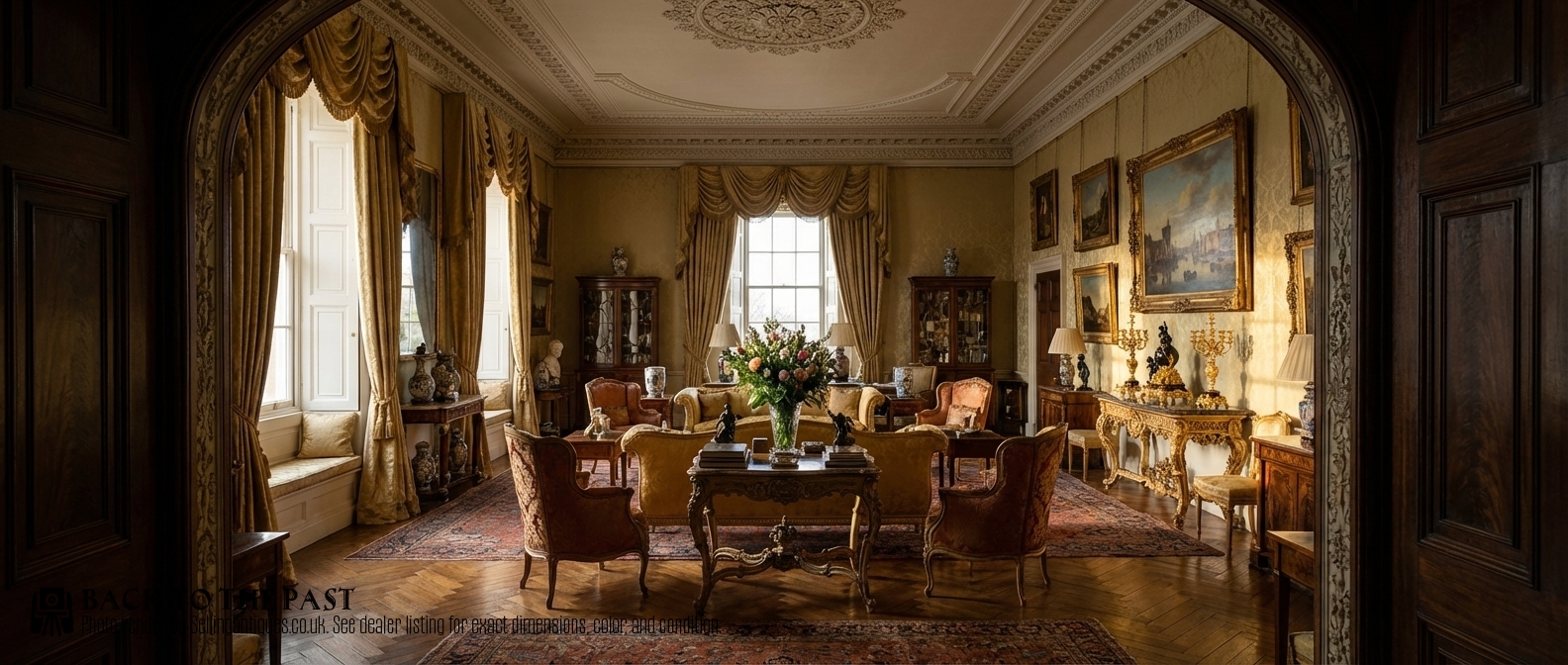
Garniture sets served as the visual centrepiece for formal reception rooms and parlours during the Victorian era. They anchored the mantelpiece above the fireplace.
The central clock provided timekeeping while the flanking candelabras contributed symmetrical lighting and decorative balance. Together, they demonstrated the household's taste and affluence.
What materials make up these sets?
The primary materials are gilt bronze, ormolu, and various types of marble including white, red, and green varieties. Clock faces typically feature white enamel.
Secondary metals such as gilt metal also appear in place of solid bronze on certain pieces. Sculptural elements rely on metal casting complemented by hand-chased surface details.