



Post War Oil Painting
A post war oil painting captures a period of intense artistic rebuilding, offering tactile brushwork and mid-century character for your walls.
Post War Oil Painting
When you search for a post war oil painting, you encounter works spanning landscape, portraiture, and abstraction created during the turbulent decades following conflict. These pieces reflect the artistic shifts of the mid-century era, encompassing movements such as Mid-Century Modernism, Constructivism, and Post-War British Realism.
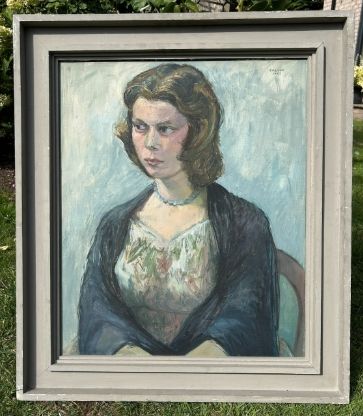
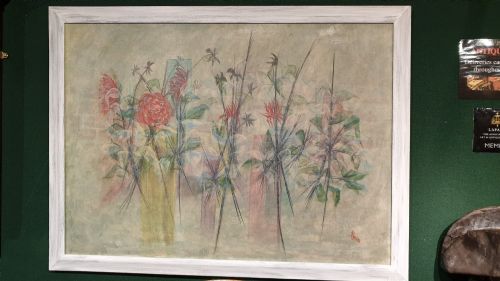
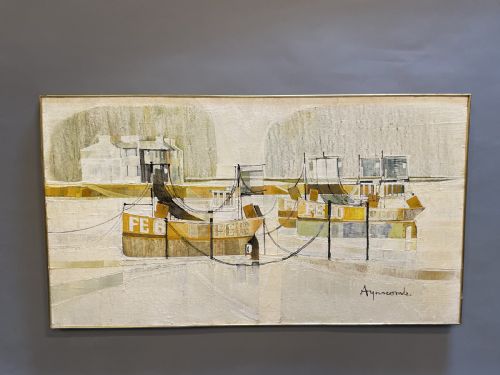
The selections available here range from coastal scenes and industrial factory views to intimate female portraits and expressive still life studies. Most examples date from the nineteen-fifties and nineteen-forties, capturing both domestic tranquility and wartime aftermath with distinct period pigment.
Buyers seeking a post war oil painting often find pieces associated with regional British scenes, St Ives modernism, and continental European subjects. These works bridge traditional academic technique with emerging modernist sensibilities.
How they were made
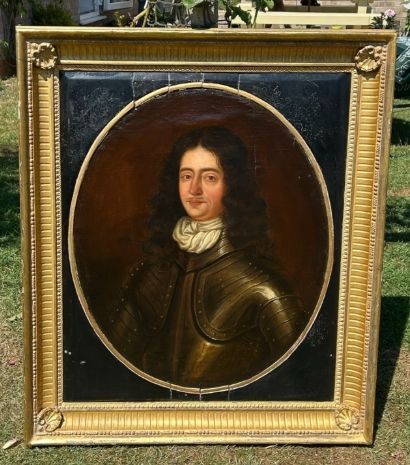
Artists of this era applied oil paint directly onto stretched canvas, wooden board, or panel supports, often building up thick textures that retain the energetic movement of the brush. Many works incorporate framing in giltwood or simple moulding typical of mid-century presentation.
The physical construction relies on durable woven fabric or sturdy timber boards prepared with traditional grounds before the application of oil medium. Pigments range from earthy tones to vibrant modern hues that define the post-war palette.
Materials recorded across these listings include canvas, wood, board, gilt, and oil paint applied in both representational and abstracted styles.
What varies in quality
Quality in a post war oil painting rests on the decisiveness of the brushwork and the clarity of the composition, distinguishing confident studio execution from casual output. Works showing strong handling of light and form within modernist or realist frameworks command greater visual presence.
The depth of provenance and documented connection to recognised schools, academies, or specific regional movements elevates a piece. Superior examples demonstrate a cohesive relationship between subject matter and the physical application of oil paint.
Kenneth Cozens·Paul-Jean Anderbouhr·Denis Mitchell·Barbara Hepworth·William McCance·Richards Rubin·John Osborn·John Gilroy
The Post War Oil Painting Glossary
- Oil on board
- A painting technique where oil pigments are applied directly to a rigid wooden or composite board rather than woven fabric. This surface offers a flat, stable ground favoured by mid-century artists.
- Mid-Century Modern
- A stylistic descriptor covering architecture, furniture, and art from roughly the middle decades of the twentieth century. It prioritises clean lines, abstracted forms, and functional simplicity.
- Constructivism
- An artistic approach originating in Russia that rejects traditional composition in favour of abstract spatial structures. In post-war painting, it often manifests as geometric industrial scenes.
- St Ives School
- A group of artists based in Cornwall associated with the development of British modernism. Painters in this circle explored landscape abstraction through expressive brushwork.
- Giltwood
- Timber framing treated with a thin layer of gold leaf or metallic gilt finish. These frames frequently accompany mid-century canvases to complement the artwork.
Post War Oil Painting: Frequently Asked Questions
What defines a post war oil painting?
A post war oil painting is a work executed in oil medium during the decades immediately following the mid-twentieth-century conflicts. These pieces embody the aesthetic shifts of the period, moving between traditional realism and emerging abstraction.
They serve as historical records of artistic output from the nineteen-forties and nineteen-fifties, capturing contemporary life, landscape, and industrial themes.
How do I hang a canvas safely?
Hanging an oil painting on canvas requires secure fixings suited to the weight of the frame and the wall construction. Ensure the piece is kept away from direct heat sources and strong sunlight to protect the pigments.
Using professional picture wire and wall anchors distributes the load evenly across the structure of the frame.
How can I identify a mid-century style?
Mid-century style is recognised through abstracted forms, simplified palettes, and a focus on industrial or natural subjects rendered with expressive brushwork. Artists during this time often broke away from strict academic rules.
The inclusion of constructivist elements or bold still life arrangements further signals this distinct era of twentieth-century art.
Where were these paintings created?
These works originated across Britain and continental Europe, with notable hubs in artist communities such as St Ives in Cornwall. Many reflect local landscapes, urban reconstruction, or domestic interiors.
Regional galleries and retailers often handled the distribution and framing of these pieces during the period.