


Persian Saddlebag Face Rug
A persian saddlebag face rug is a portable piece of tribal weaving made for nomadic life, prized for concentrated designs and rich natural colour.
Persian Saddlebag Face Rug
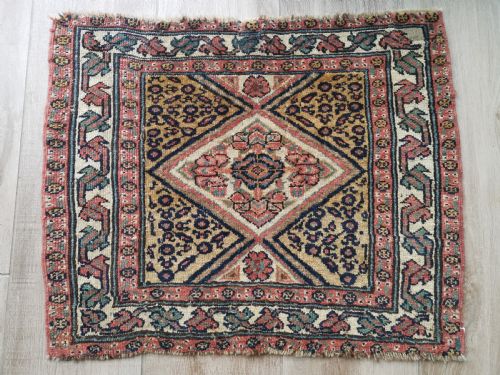
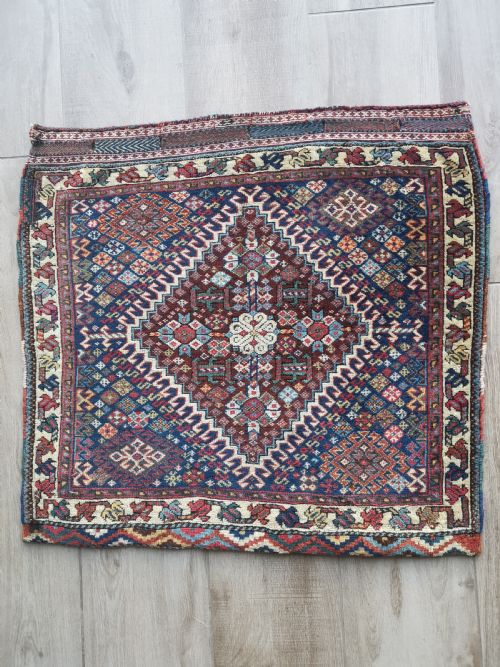
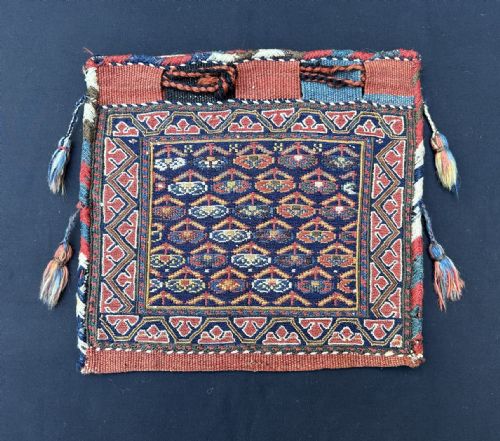
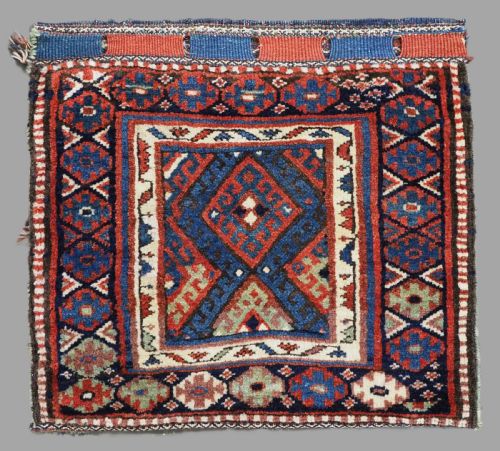
When you search for a persian saddlebag face rug, you encounter the front panel or surviving fragment of a khorjin, the double pouch used by nomadic groups to carry possessions on pack animals. These items represent the utilitarian output of tribal confederations such as the Qashqai, Shahsavan, Afshar, and Jaf Kurd.
The most common form on this page is a single square or rectangular bag face, often detached from its original plain weave back or paired companion pouch. They originate across western and southern Persia, reflecting the distinct visual vocabulary of specific tribal groups.
Pieces range from whole bags complete with backs to half-faces and panels, spanning the nineteenth and early twentieth centuries. They function today as small decorative wall hangings or cabinet rugs rather than utilitarian containers.
What Varies in Quality
Quality rests primarily in the handling of wool and the saturation of natural dyes, where lustrous, luminous fleece elevates a piece above standard domestic output. Crispness of tribal geometry and the complexity of motifs such as boteh or central medallions separate standard bags from finer examples.
Condition and completeness also govern worth, as survival of the original plain weave back or complete side panels marks a higher degree of preservation. Finer knot density in hand-knotted faces indicates greater technical skill by the nomadic weaver.
The listings span from the mid-nineteenth century through the early twentieth century, utilising hand-spun wool and natural dyes across tribal regions.
The Persian Saddlebag Face Rug Glossary
- Khorjin
- A traditional double saddlebag used by nomadic tribes for transport. These bags were slung over pack animals and often cut apart over time.
- Soumac
- A flat-weave textile technique involving coloured wrap-threads around the warp, creating a textured surface without cut pile. Shahsavan weavers employed this method frequently.
- Bag face
- The decorative front panel of a storage or riding bag that remained visible when packed. These comprise the majority of surviving nomadic textile fragments.
- Boteh
- A pear-shaped floral motif symbolising life and eternity, common in Afshar and tribal Persian weaving. The shape appears in various stylised forms across regional pieces.
- Warp
- The vertical foundation threads stretched tightly on the loom before weaving begins. Wool and cotton serve this structural purpose in nineteenth-century Persian pieces.
Persian Saddlebag Face Rug: Frequently Asked Questions
What is a persian saddlebag face rug?
It is the decorative front portion of a nomadic pack bag used for transport across Persia.
Over decades, these panels were separated from their original wool backs and preserved as small decorative textiles.
How did nomads use khorjin bags?
Nomadic tribes packed household goods, salt, or grain into twin pouches slung across horses or camels.
The bags endured harsh travel conditions before being retired and divided into collectible fragments.
How do I identify tribal origins?
Specific motifs, colour palettes, and weaving structures point to particular groups like the Qashqai, Afshar, or Shahsavan.
Sparsely detailed provenance notes in titles often reference provinces such as Fars or Kerman.
Can I hang these rugs on walls?
Their compact size and sturdy construction make them well-suited for display as wall textiles.
Mounting them flat distributes the weight evenly across the wool foundation without straining the fibres.