




Bird Motif Oriental Rug
A bird motif oriental rug brings ancient Persian and Caucasian weaving traditions into a room through vivid depictions of local fauna.
Bird Motif Oriental Rug
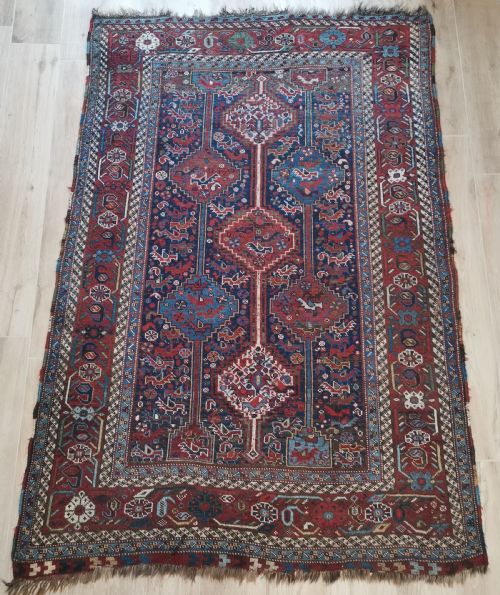
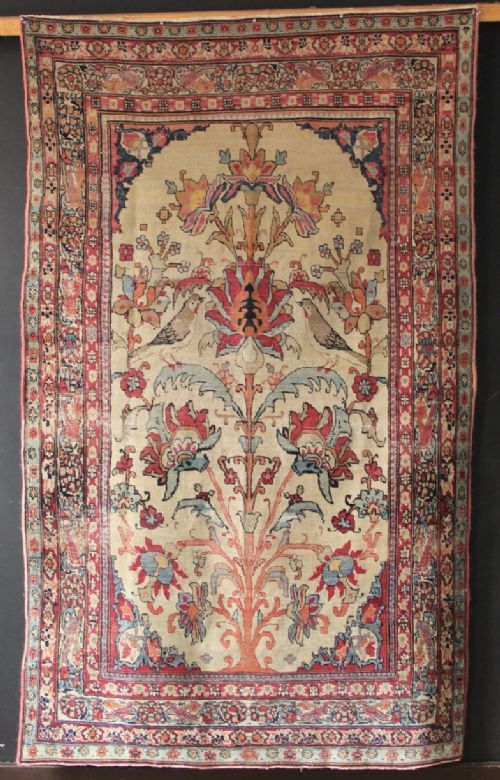
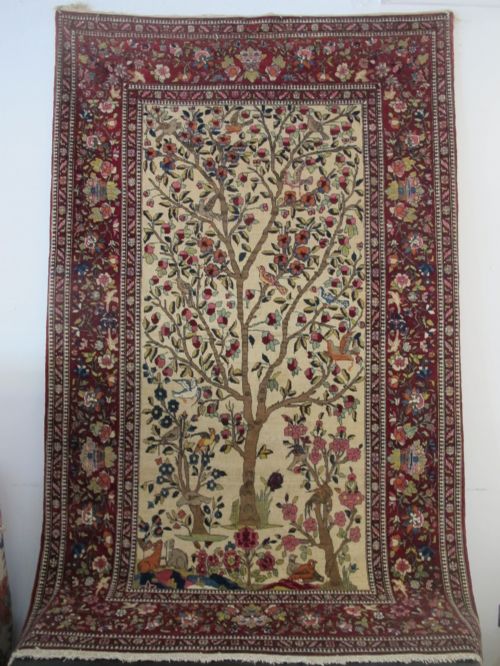
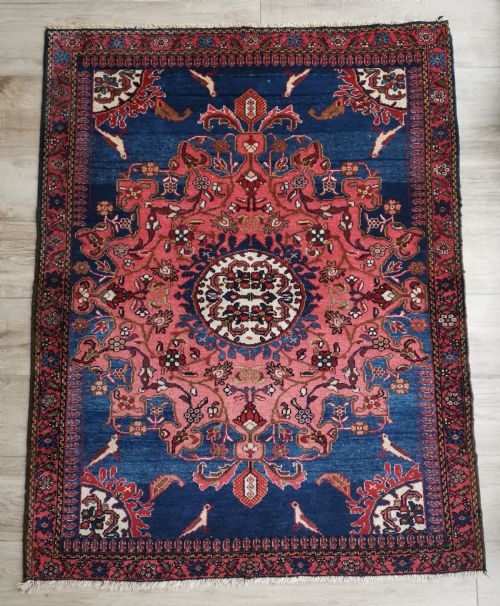
A bird motif oriental rug brings together nomadic and village textiles from Persia and the Caucasus, spanning the late nineteenth and early twentieth centuries. These floor coverings and textile pieces range from small bag faces to large tribal carpets displaying birds, pecking chickens, and protective creatures. Khamseh, Caucasian Shirvan, and Fereghan Sarouk examples dominate the pieces seen here.
Makers include village weavers and tribal groups such as the Khamseh, Shahsavan, and Luri who incorporated indigenous symbols into their daily craft. The formats include area rugs, runners, and saddle bag faces executed in regional styles like Persian Tribal and Caucasian.
The bird iconography often extends to include related motifs such as pomegranates, boteh, flowers, and dragons, woven into distinct central fields and decorative borders. Each region utilised specific geometric or curvilinear layouts to frame the avian figures, distinguishing a South Persian nomadic piece from a Caucasian village rug.
Materials and construction methods
The construction relies fundamentally on hand-spun wool foundations and pile yarns, supplemented by cotton structures in certain urban or village workshops. Weavers manipulated these animal fibres alongside flatweave techniques seen in Soumak bag faces.
Colour comes from natural and vegetable dyes that yield soft, faded tones or vibrant palettes across the surviving carpets and rugs. These dyes interact with the hand-spun wool to create the subtle abrash and colour variations characteristic of late nineteenth and early twentieth-century tribal weaving.
Several carpets specifically record flocks of pecking chickens alongside traditional tribal birds and protective dragons.
Factors determining quality
Quality rests upon the crispness of the drawing and the density of the knotting within the pile, which defines the clarity of the avian and floral motifs. Stronger structural integrity ensures the survival of detailed elements like individual pecking chickens or secondary borders.
The nuance of the palette, achieved through the application of vegetable and natural dyes, separates ordinary weaving from exceptional textile art. Pieces displaying well-balanced proportions and imaginative spatial arrangements among the birds command greater attention.
The Bird Motif Oriental Rug Glossary
- Khamseh
- A confederation of five tribes in south-west Persia known for producing geometric tribal rugs featuring bold bird motifs and chickens. Their work often includes dark wool grounds with colourful latch-hooked polygons.
- Soumak
- A flatweave technique where the coloured pattern threads are wrapped over the warp threads in a herringbone effect, common in Shahsavan bag faces. This method creates a durable, non-pile textile with a textured surface.
- Boteh
- An ancient almond-shaped motif representing a floral spray or cypress tree, frequently paired with birds in Persian Malayer and Fereghan rugs. It forms a repeating pattern across the field of many central and western Persian carpets.
- Bag face
- The front panel of a nomadic storage sack, preserved and mounted as a small rug or textile art piece. These panels display concentrated tribal iconography within compact dimensions.
- Abrash
- A natural variation in rug colour caused by changes in dye batches or successive dyepots used during the creation of hand-spun wool yarn. It creates a subtle banded or striated visual texture across the field.
Bird Motif Oriental Rug: Frequently Asked Questions
What is a bird rug?
A bird rug is a traditional woven textile from Persia or the Caucasus featuring stylized avian figures, chickens, or mythical birds integrated into the field or border design. These pieces were produced by tribal groups and village weavers using local wool and natural dyes.
Examples range from small nomadic bag faces to large carpets, capturing centuries-old regional symbolism within geometric or semi-naturalistic compositions.
How do I identify a Khamseh rug?
Khamseh rugs originate from south-west Persia and are identifiable through their distinctive tribal iconography, including small pecking chickens, birds, and geometric lattice patterns. They typically employ dark wool foundations and vibrant or softly faded natural dye palettes.
Many feature multiple borders surrounding a deep indigo or red field filled with playful zoomorphic elements and stylised flora.
Are these rugs made with natural dyes?
The period pieces on this page utilise hand-spun wool dyed with traditional vegetable and natural colourants derived from local plants and minerals. These dyes age gracefully, developing soft patinas and tonal variations known as abrash.
Chemical dyes became more common towards the early twentieth century, making the identification of natural dye use a key indicator of age and origin.
How should I care for an antique tribal rug?
Antique tribal rugs require gentle, regular vacuuming without rotating brush heads to protect the wool pile and delicate flatweave edges. Keeping them out of direct sunlight prevents the natural dyes from fading prematurely.
Professional cleaning should be undertaken periodically by specialists familiar with antique Persian and Caucasian wool textiles to preserve their structural integrity.