
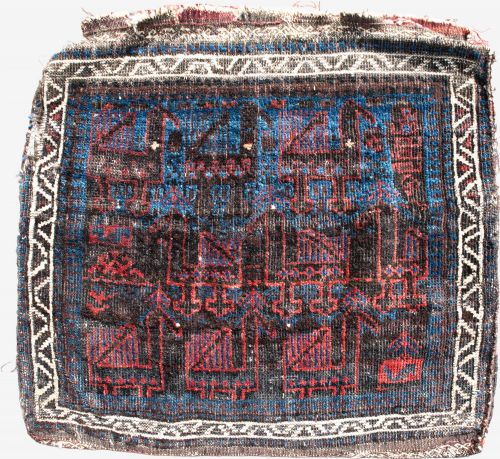
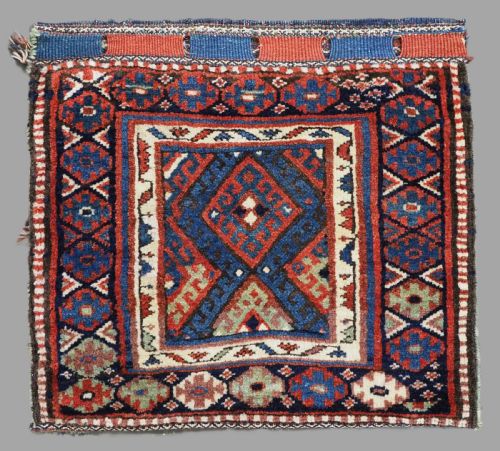


Wool Khorjin Bag Face
When you examine a wool khorjin bag face, you hold a nomadic storage piece woven to carry possessions across Persian landscapes.
Wool Khorjin Bag Face
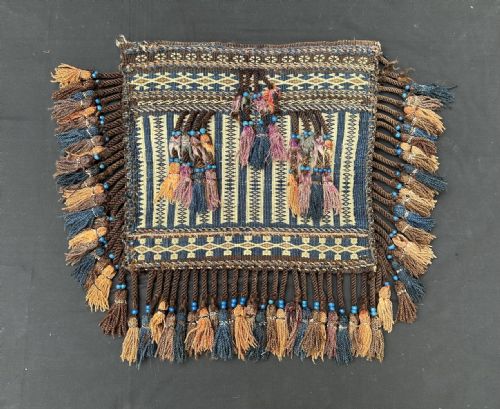
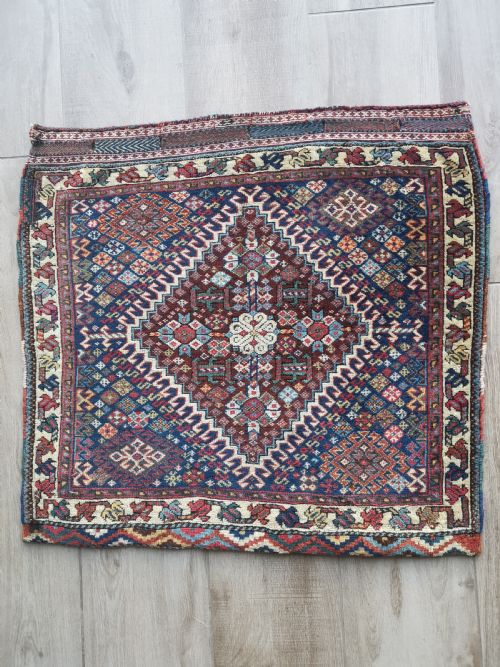
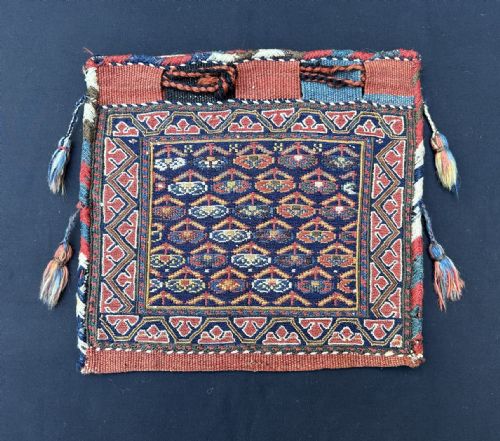
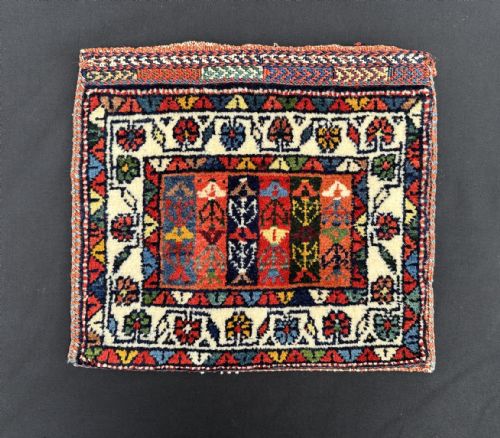
A wool khorjin bag face is the front portion of a traditional Persian saddlebag, separated from its paired pouch over time. These pieces originate from tribal confederations and nomadic groups such as the Qashqai, Afshar, Shahsavan, Luri, and Baluch.
Makers wove these items on portable ground looms during seasonal migrations across regions like Fars, Luristan, and Kerman Province. The surviving examples on this page date from the mid-nineteenth century up to the early twentieth century.
Most entries function as individual wall hangings, small rugs, or cushion covers after losing their original rear compartments. Collectors encounter single bag faces far more frequently than complete double bags with intact backs.
How they were made
Weavers relied primarily on hand-spun wool for the pile and foundation, often incorporating cotton elements and supplementary glass bead decorations. Natural dyes provided the deep chromatic palette seen across these nomadic textiles.
Structures include pile knotting alongside flat-woven sumac techniques, creating varied surface textures within a single piece. Plain weave structures commonly form the reverse sides where backs remain attached.
Several bags retain tiny glass beads stitched alongside the wool to ward off the evil eye during long migrations.
What varies in quality
Quality rests in the handling of natural dyestuffs and the density of the hand-knotted pile. Finer knotting permits sharper articulation of geometric medallions, boteh motifs, and tile designs.
The integrity of the wool supply dictates the tactile presence of the surface. Lustrous, oily wool retains resilience over generations, whereas dry fibre yields a harsher handle.
The Wool Khorjin Bag Face Glossary
- Khorjin
- A traditional Persian saddlebag used by nomadic tribes for transport and domestic storage. Khorjin bag faces represent the decorative front panels of these functional items.
- Sumac
- A supplementary weft-wrapping technique that produces a durable, flat-woven textile surface without pile knots. Shahsavan examples frequently display this method.
- Boteh
- A stylised floral motif resembling a almond or bent pear shape, common in Afshar and Persian tribal weaving. This design appears repeatedly across nineteenth-century bag faces.
- Chanteh
- A small personal bag or vanity pouch woven by nomadic women for intimate possessions. These diminutive items parallel larger saddlebags in construction and design.
Wool Khorjin Bag Face: Frequently Asked Questions
What is a khorjin bag face?
A khorjin bag face is the decorative front panel of a traditional Persian saddlebag. Nomads used these paired pouches to transport belongings on animals during seasonal migrations.
Over decades of use, many pairs split apart, leaving the durable front panels to survive independently as textile art.
How were these bags used?
Nomadic tribes utilised these woven containers for storing household goods, grain, and personal items inside tents or during travel. Their robust construction handled the daily friction of camp life.
Today, collectors repurpose these fragments as small floor rugs, cushion covers, or wall hangings.
How do I identify tribal origins?
Tribal attribution relies on specific colour palettes, structural weaves, and recurring motifs characteristic of groups like the Qashqai, Afshar, or Shahsavan. Each confederation employed distinct geometric patterns and knotting densities.
Local materials from specific regions of Persia also guide identification.
Are these pieces made with natural dyes?
Nineteenth-century and early twentieth-century nomadic weavings typically incorporated natural dye sources derived from plants and insects. These colourants yield rich, saturated tones that age with a characteristic patina.
Subtle variations in hue across the wool indicate traditional dyeing methods.