


Persian Prayer Mat
A persian prayer mat brings centuries of nomadic and village weaving traditions into a room, offering both devotional imagery and striking tribal geometry.
Persian Prayer Mat
When searching for a persian prayer mat, buyers encounter a range of woven floor coverings primarily originating from tribal and village contexts across the region. These textiles date predominantly from the late nineteenth century into the early decades of the twentieth century, reflecting traditional weaving practices.
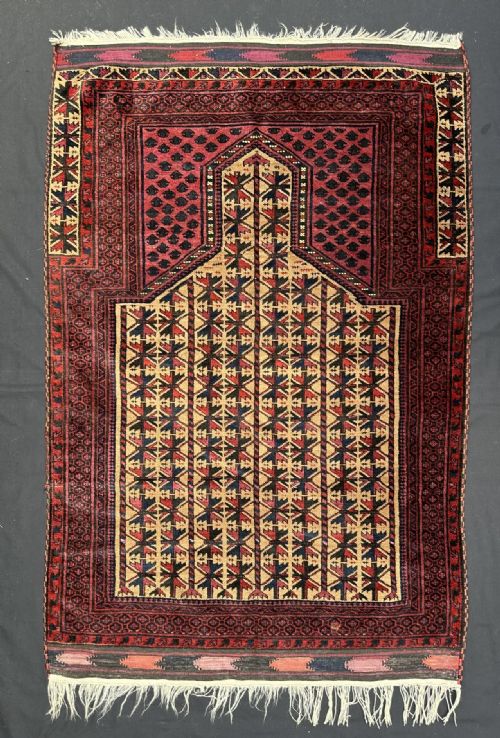
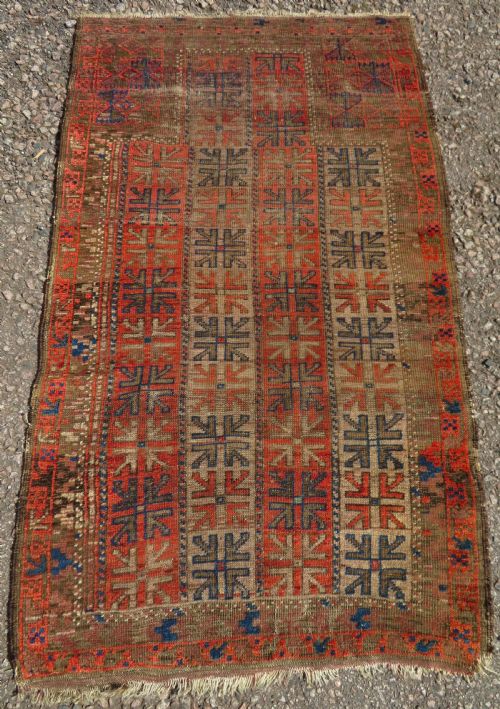
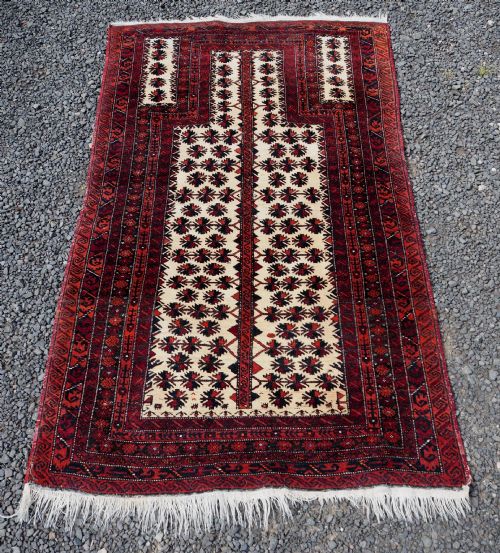
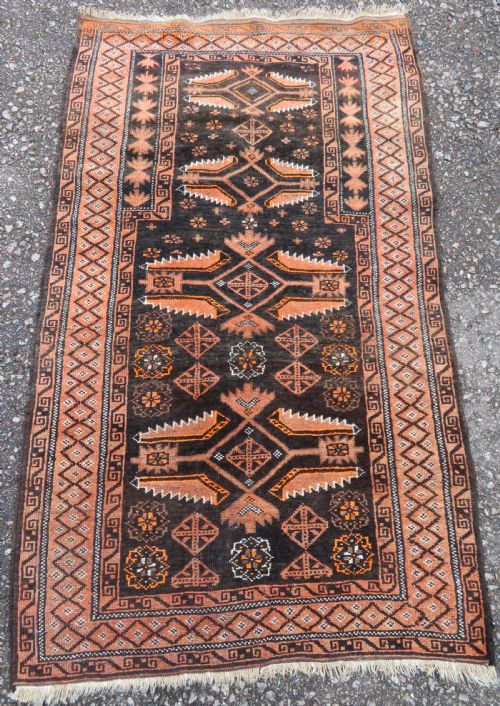
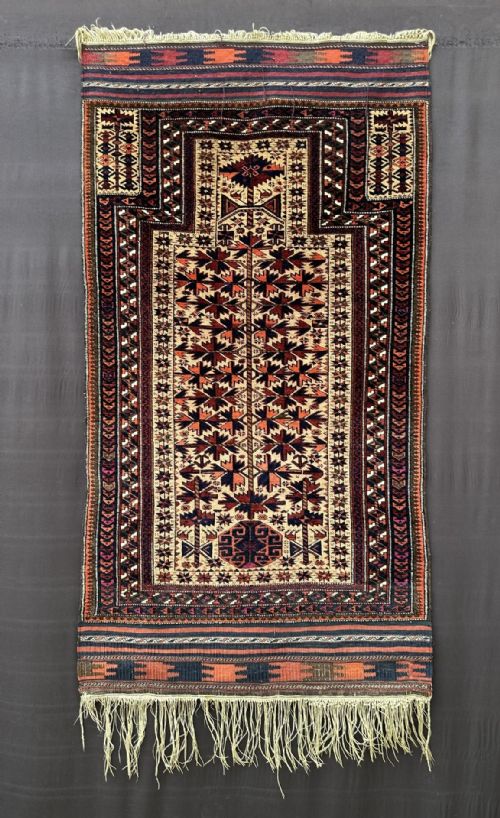
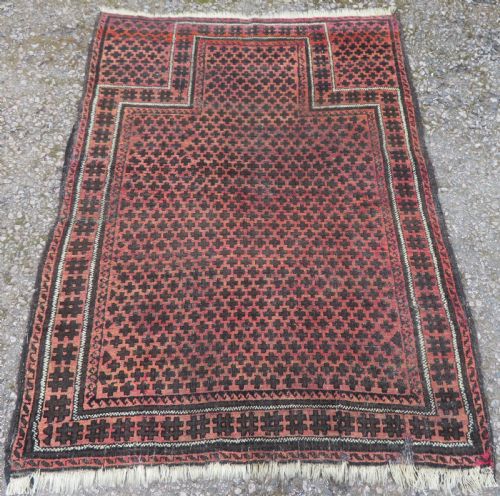
The selections on this page heavily feature Baluch and Timuri tribal pieces, often showcasing distinct mihrab arches designed for directional prayer. Alongside these nomadic rugs, town-woven examples from centres such as Kashan and Kerman occasionally appear, bringing intricate floral vases and millefleurs motifs into the category.
Most specimens arrive as smaller formats suited to wall hanging or accent placement, constructed by tribal groups working in the borderlands of Persia and neighbouring Afghanistan. Buyers will find recurring motifs including trees of life, repeat leaf patterns, and geometric octagons woven into wool and camel hair foundations.
Materials and construction methods
The structural foundation of these rugs typically relies on hand-spun wool and cotton, with select tribal pieces incorporating natural camel hair for a soft, durable brownish ground. Weavers utilised natural dyes derived from plants and minerals, creating rich blue, red, and earthy tones that age with considerable depth.
The pile is hand-knotted onto the warp and weft threads, a technique executed on portable horizontal looms by nomadic and village weavers. Silk is also observed in specific fine pieces, yielding a lighter handle and a distinct sheen compared to standard wool construction.
Persian Prayer Mat Retail Price Guide 2026
Typical asking prices for persian prayer mat among the pieces listed under this phrase on Sellingantiques today, from the lower quarter to the upper quarter. They describe what is for sale here now, not the wider market.
Materials recorded across the inventory include wool, cotton, silk, natural dyes, and camel hair used in foundations and pile construction.
Assessing quality in tribal weaving
Quality in these rugs relates directly to the tightness of the knotting, the precision of the tribal design execution, and the integrity of the wool. Finer examples display crisp geometry in motifs like the Dokhtar-e-Qazi design or intricate floral vases without losing the spontaneous character inherent to tribal work.
The depth and permanence of the palette also distinguish superior pieces, particularly where natural dyes have maintained their saturation over generations. Surviving original borders and intact foundational edges indicate better overall preservation and structural competence.
The Persian Prayer Mat Glossary
- Mihrab
- The arched architectural niche depicted on the field of a prayer rug, symbolising the direction of Mecca. It serves as the primary focal point of the composition.
- Tree of life
- A symbolic motif representing spiritual growth and eternity, frequently rendered as a vertical tree rising through the centre of the rug field.
- Warp
- The vertical foundation threads running the entire length of the rug upon which the knots are tied. The ends of these threads often emerge as visible fringing.
- Weft
- The horizontal threads passed alternately over and under the warp threads to lock the knots in place. This grid forms the stable textile backing of the piece.
- Millefleurs
- A dense pattern composed of a thousand small flowers covering the field. This botanical style is often associated with town-woven classical workshop carpets.
Persian Prayer Mat: Frequently Asked Questions
How do I use a prayer rug at home?
These smaller formats function well as distinct wall hangings, table covers, or focal point accent pieces on wooden floors. Due to their historical nature, placing them in moderate-traffic areas helps preserve the pile.
Securing a suitable underlay beneath the rug prevents slipping and reduces fibre friction against hard flooring. This simple precaution extends the lifespan of older wool and cotton foundations.
What is a mihrab design?
The mihrab is the arched niche depicted at one end of the rug, pointing the worshipper toward Mecca during prayer. It remains the defining characteristic of this textile group.
Tribal weavers often interpreted this arch with stepped geometry or floral fills, distinguishing regional workshops from nomadic groups.
How can I tell a tribal rug from a town rug?
Tribal rugs typically display geometric motifs, camel hair backgrounds, and asymmetrical formats woven by nomadic groups in regions like Khorassan. Their designs rely on tribal memory rather than pre-drawn cartoon templates.
Town rugs, conversely, utilise city workshops with cotton foundations, symmetrical knotting, and refined floral vase or millefleurs compositions.
Why do some rugs feature camel hair?
Weavers incorporated undyed camel hair into the pile or ground of specific tribal rugs for its natural durability and distinct warm tone. This material yields a characteristic soft handle.
Over long periods, camel hair can develop localized wear patterns distinct from standard sheep wool, requiring careful observation during evaluation.