
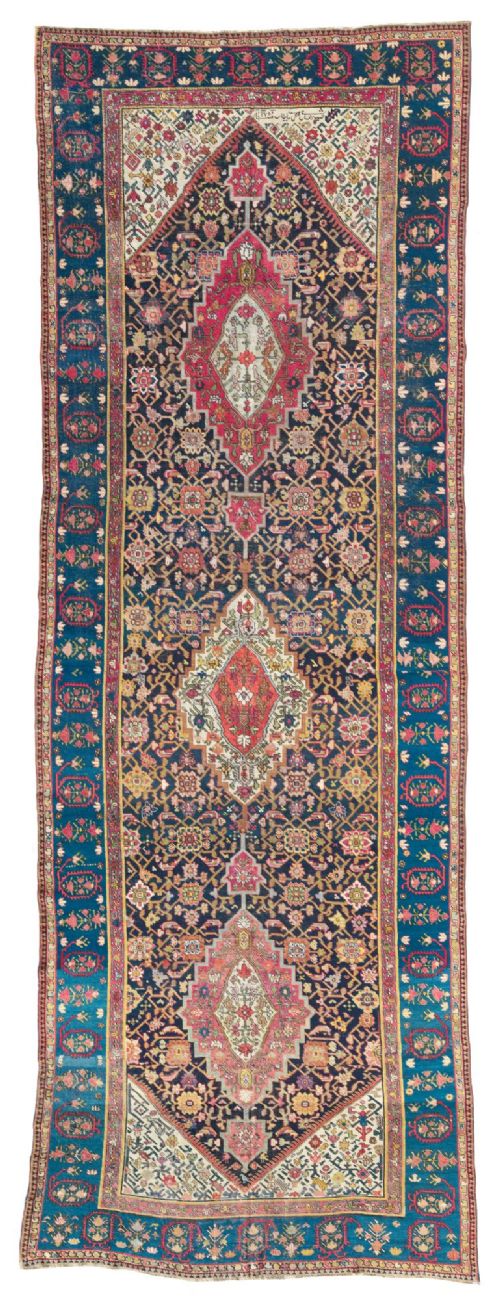


Persian Kelleh Long Rug
A persian kelleh long rug delivers grand scale and rich tribal patterns, anchoring large spaces with historical weight.
Persian Kelleh Long Rug
A persian kelleh long rug represents an elongated format of traditional carpet, typically associated with nineteenth and early twentieth-century weaving traditions. These substantial floor coverings originate from various regional workshops and nomadic groups across Persia, including Kurdish, Bidjar, Malayer, and Baktiari traditions. The proportions are distinctly rectangular and extended, serving historical purposes in grand domestic interiors.
Buyers encountering this selection will frequently find examples originating from around 1850 through to 1930. The designs encompass classical village and tribal motifs such as the tree of life, boteh patterns, harshang crab borders, and shrub lattices. Regional identities remain strong through distinct border treatments and field compositions.
Materials and construction
Weavers constructed these long carpets using hand-spun wool and standard wool piles set upon cotton foundations. The natural characteristics of hand-spun wool yield varied absorption of traditional dye stuffs, giving the surface a nuanced, organic tonal variation across the span of the rug.
Structural density differs by region, with certain village pieces displaying heavy, rigid foundations designed for endurance. Knotting techniques reflect local tribal customs, passing down specific border geometries and field layouts through generations of makers.
Current listings feature pieces spanning from 1850 to 1930, utilising hand-spun wool and cotton across diverse regional styles.
Assessing quality in regional weaving
Quality rests upon the integrity of the wool, the crispness of the drafted design, and the precision of the knotting beneath the pile. Superior examples maintain balanced proportions and clear articulation of complex motifs like dragon borders or detailed lattice work without compressed drawing.
Condition and originality dictate the standing of an individual carpet within its type. Even wear across a substantial surface indicates balanced historical use, whilst intact original borders and secured selvedges preserve the intended aesthetic balance of the composition.
The Persian Kelleh Long Rug Glossary
- Kelleh
- A format designation for a large, elongated Persian carpet, traditionally narrower than a standard room-size rug. This format suits hallways or expansive reception spaces.
- Boteh
- A stylised floral motif resembling a almond or bent pear shape, frequently repeated across fields and borders. This ancient symbol appears widely in regional Persian weaving.
- Harshang
- A traditional crab-like geometric border pattern common in North West Persian carpets. It provides a structured frame for intricate central fields.
- Selvedge
- The bound edge running along the length of a rug, protecting the foundation threads from fraying. Original or well-maintained selvedges matter greatly to the structural integrity.
Persian Kelleh Long Rug: Frequently Asked Questions
What is a kelleh rug?
A kelleh is an extended, narrow format of Persian carpet designed for specific architectural spaces like long rooms or corridors. These pieces bridge the dimensions between standard area rugs and massive hall carpets.
They combine the intricate iconography of village workshops with proportions well suited to linear spaces in modern homes.
How do I style a long rug?
Position these substantial runners in grand hallways, large living areas, or beneath long dining tables where their extended format commands attention. Ensure adequate floor space remains visible around the perimeter to showcase the borders.
Pair them with neutral surroundings to let the natural wool tones and traditional motifs stand out without visual competition.
Where were these rugs made?
These textiles originate from diverse regions across Persia, including Kurdish districts, Bidjar, Malayer, Baktiari, and Khamseh tribal territories. Each area utilised distinct regional palettes and knotting structures.
Local weaving traditions dictated whether a piece featured geometric tribal symbols or more fluid floral compositions.
How do I care for antique wool?
Maintain wool pile carpets through regular, gentle vacuuming without rotating brush heads that can catch hand-spun fibres. Keep them out of direct sunlight to prevent natural dyes from fading unevenly across the span.
Consult a specialist in antique textiles for professional cleaning rather than attempting wet washing at home.