
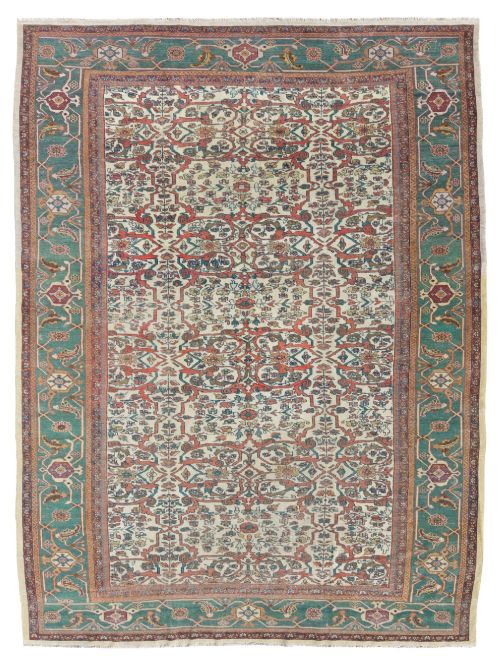
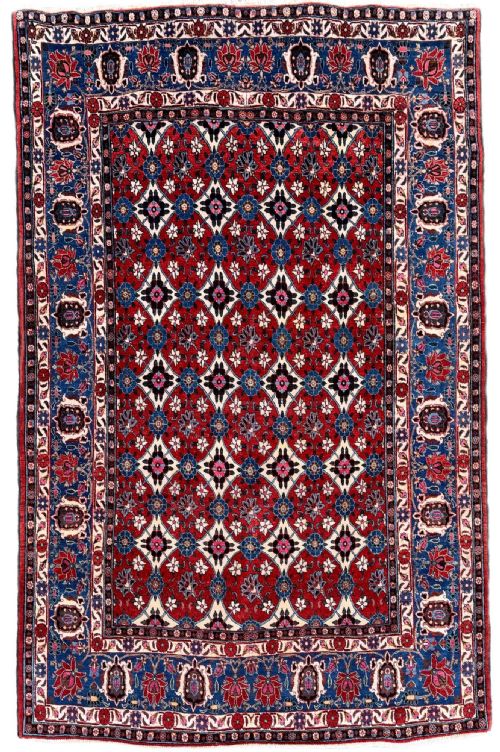
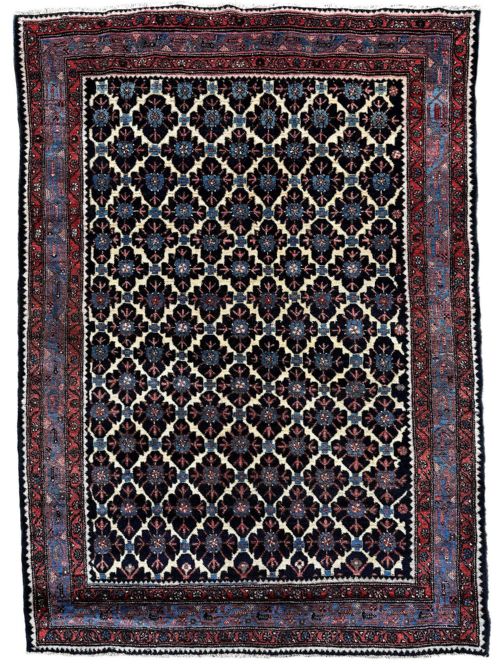


Persian Floral Lattice Rug
A persian floral lattice rug brings structured botanical design and enduring wool construction straight to a traditional interior.
Persian Floral Lattice Rug
A persian floral lattice rug is a floor covering defined by an interconnected grid pattern enclosing botanical and floral motifs across the field. These pieces emerge from various regional weaving traditions including Sultanabad, Veramin, Hamadan, Mahal, Bidjar, Khorasan Baluch, Kurdish Varamin, and Kirman, alongside Indian production.
The objects span from the late nineteenth century into the early decades of the twentieth century, taking the form of carpets, area rugs, and hallway runners. Buyers meeting these examples on the page encounter room-sized carpets, narrower runners, and smaller area rugs shaped by regional village and workshop weavers.
The core visual structure relies on repeating geometric or curvilinear trellis networks that organise stylised blossoms, palmettes, and leaves. Regional variations shift the scale of the lattice and the density of the floral fill, connecting nineteenth-century production directly to later twentieth-century village weaving.
Materials and construction methods
The foundational construction relies on wool pile knotted onto sturdy cotton foundations, providing the structural durability necessary for heavy floor use. Weavers utilised resilient local wool fibres that accepted traditional natural and early synthetic dyes, creating stable colour fields that patinate with age.
Knot density and structural rigidity vary by origin, ranging from the sturdy, heavy weave of village carpets to the finer knotting seen in larger workshop productions. The pile is sheared by hand to an even height, allowing the intricate lattice geometry and secondary floral details to remain crisp and legible.
Some nineteenth-century weavers slipped small intentional irregularities into their lattice grids to ward off the evil eye.
Judging quality in woven lattice carpets
Quality rests in the precision of the grid geometry and the harmonious balance of colour across the field, where master weavers maintained exact symmetry within complex floral repeats. The handling of the lattice lines dictates whether the field appears dynamic and unified or rigid and crowded.
The depth of the wool pile and the integrity of the original cotton foundation dictate how well the textile withstands continuous pressure over decades. Finer knot counts allow for greater curvilinear grace in the floral motifs, separating standard village utilities from exceptional workshop carpets.
The Persian Floral Lattice Rug Glossary
- Lattice
- A repeating geometric network of crisscrossing lines that forms a grid across the rug field. This framework holds individual floral motifs in an orderly arrangement.
- Mina Khani
- A traditional repeating floral lattice pattern typically composed of daisy-like blossoms connected by delicate vines. It is frequently encountered in Persian village and tribal weaving.
- Pile
- The vertical or diagonal loops of yarn that form the usable surface of the rug. It is sheared to height after knotting to reveal the design.
- Runner
- A long, narrow carpet format specifically designed for hallways, corridors, and staircases. These pieces balance linear geometry with restricted width dimensions.
Persian Floral Lattice Rug: Frequently Asked Questions
Where were these rugs made?
Production spans specific regional centres and villages across Persia, including Veramin, Mahal, Sultanabad, Hamadan, Bidjar, and Kirman. Additional examples originate from Indian looms influenced by Persian aesthetic traditions.
Each weaving district developed distinct colour palettes and knotting techniques while maintaining the core structural lattice framework characteristic of these historic floor coverings.
How do I care for a vintage wool carpet?
Regular gentle vacuuming without a rotating beater bar prevents dust accumulation in the wool pile. Professional specialist cleaning maintains the integrity of the cotton foundation and wool fibres.
Positioning the rug out of direct, intense sunlight preserves the saturation of the dyes and prevents uneven fading across the lattice field.
What is a Mina Khani design?
The Mina Khani pattern is a specific floral lattice motif featuring repeating interconnected blossoms linked by scrolling stems. It creates a balanced, rhythmic field design across village and tribal weavings.
This layout provides a structured visual order while allowing individual weavers freedom in the choice of secondary flower forms and colour combinations.
How do I distinguish regional village rugs from workshop carpets?
Village rugs typically exhibit bolder, more stylised geometric lattice lines and heavier wool foundations produced in local homes. Workshop carpets generally feature finer knotting, greater scale, and more intricate curvilinear floral detailing.
Both categories utilise wool pile on cotton foundations, but the density of the weave and the precision of the botanical drawing reflect the environment of their creation.