
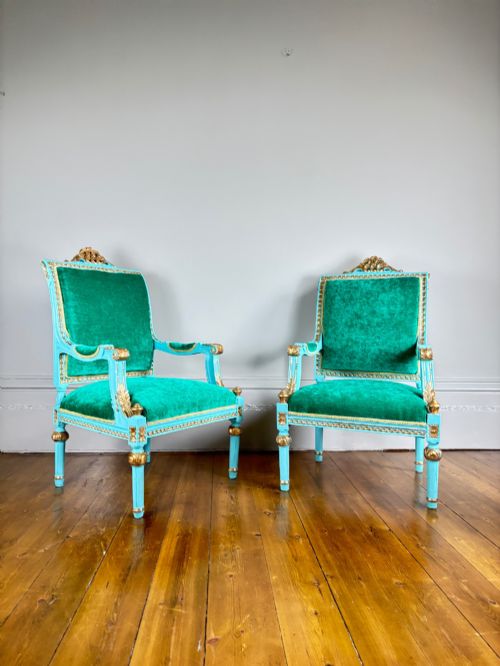
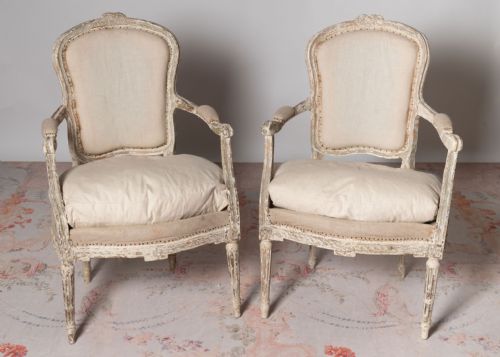


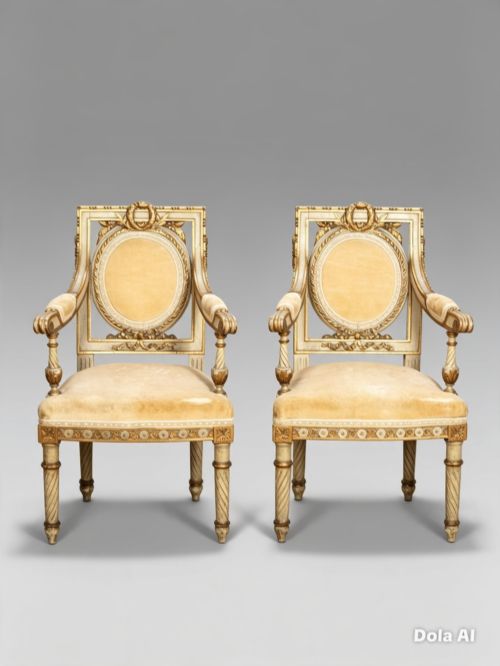


Pair Painted Salon Chairs
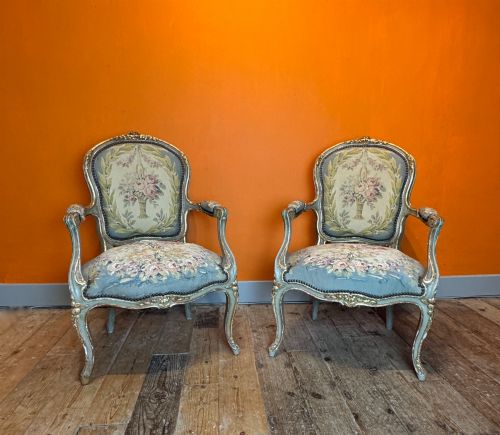
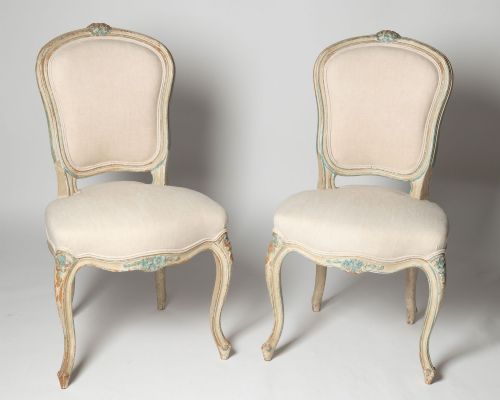
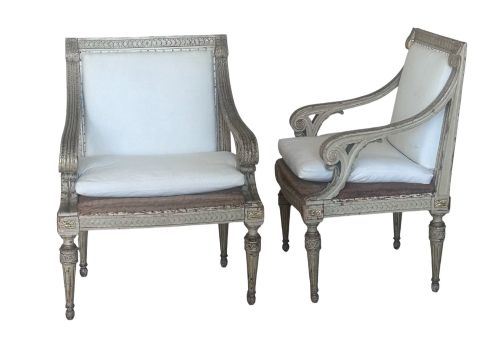
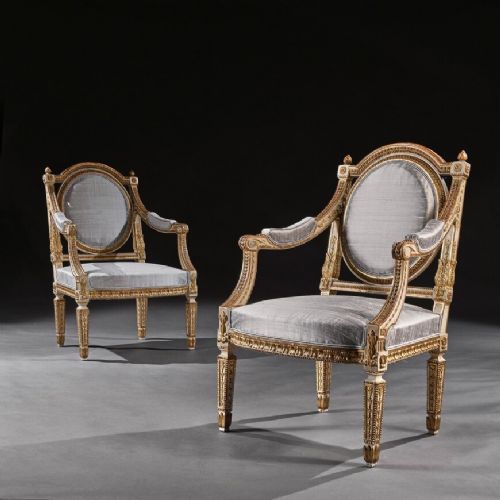
These pair painted salon chairs bring decorative French and Italian revival design into reception rooms.
Pair Painted Salon Chairs
When you search for pair painted salon chairs, you are looking at matched sets of decorative seating designed for formal reception rooms. The pieces appearing here span the nineteenth century into the early twentieth century, drawing heavily on French and Italian design traditions.
The form encompasses open armchairs, fauteuils, bergères, side chairs, and small boudoir seating. Most examples follow Louis XV and Louis XVI revival styles, alongside neoclassical and Barocchetto influences originating from France, Italy, and Scandinavia.
Buyers encounter matching pairs that share identical frames, carving details, and surface decoration. These seats served a social function in period drawing rooms, offering light, movable seating that complemented the interior decor.
Materials and Construction
Makers shaped these frames from beech and other hardwoods, applying gesso to smooth the carved surfaces before painting. Paint finishes often combine with parcel gilt highlights to accentuate the carved details and neoclassical motifs.
Upholstery materials recorded in the evidence include fabric, velvet, linen, and tapestry, frequently supported by traditional webbing and stuffing. Cane panels also appear on specific bergère and side chair forms.
The documented periods span the eighteenth-century Barocchetto through nineteenth-century revival movements and into the Edwardian era.
Distinctions in Execution
Quality rests in the crispness of the carved wood decoration beneath the paint and the fidelity of the period revival style. Finer examples display deeply carved floral and ribbon motifs rather than shallow surface moulding.
The integration of the painted surface with parcel gilding reveals the maker's hand, where layers of gesso and pigment age with greater depth and subtlety than later re-paint applications.
The Pair Painted Salon Chairs Glossary
- Fauteuil
- An open-framed upholstered armchair with wooden arms, characteristic of French seating design. These chairs feature padded armrests and exposed carved wooden frames.
- Bergère
- An enclosed upholstered armchair with sides filled in with upholstery or cane. This form offers a deeper and more enclosed seat than an open fauteuil.
- Parcel Gilt
- Partially gilded ornament applied to specific carved details on a painted wooden surface. This technique highlights particular motifs such as acanthus leaves or fluting.
- Gesso
- A plaster-like mixture applied to wood to create a smooth surface for painting and gilding. It allows carvers to achieve sharp definition in decorative mouldings.
- Louis XVI Revival
- A late nineteenth-century style drawing on the straight lines, neoclassical symmetry, and tapered fluted legs of the French eighteenth-century reign.
Pair Painted Salon Chairs: Frequently Asked Questions
What rooms suit pair painted salon chairs?
These decorative chairs work well in drawing rooms, bedrooms, and entrance halls where occasional seating is required. Their light frames make them easy to position alongside larger sofas and tables.
The painted and gilded finishes complement both traditional interiors and neutral modern spaces seeking a decorative focal point.
How do I identify Louis XV style?
Louis XV style chairs feature asymmetrical curves, cabriole legs, and carved organic motifs like flowers and foliage. The lines are flowing and curved rather than straight.
This aesthetic developed in mid-eighteenth-century France and experienced a strong revival during the nineteenth century, which accounts for many pieces found today.
Are these chairs comfortable for daily use?
Salon chairs were originally built for formal entertaining and conversation rather than lounging. Their upright backs and open arms encourage a formal posture.
Adding appropriate modern cushions can alter the sitting experience while preserving the antique frame and upholstery style.
What is the difference between an armchair and a boudoir chair?
Armchairs generally offer wider proportions and substantial armrests designed for principal reception rooms. Boudoir chairs are typically smaller and lighter, scaled for private dressing rooms and smaller spaces.
Both types share the same decorative painted finishes and revival design vocabulary.