


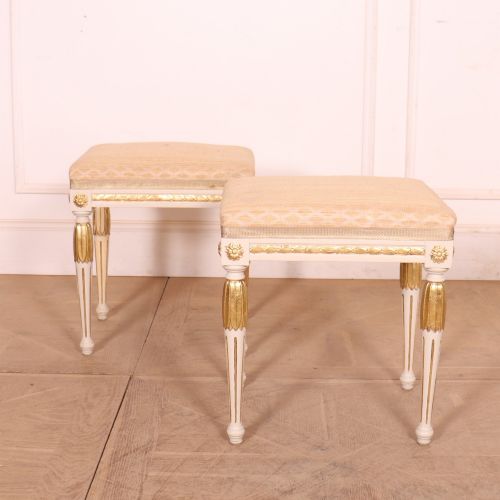


Pair of Painted Ottomans
A pair of painted ottomans offers practical seating and decorative presence, bringing traditional form and surface finish directly into the room.
Pair of Painted Ottomans
A pair of painted ottomans primarily comprises matched seating forms such as stools, taking inspiration from periods like the nineteenth century, Regency, and the 1930s. Buyers searching for a pair of painted ottomans will most frequently encounter painted wood stools reflecting styles from French Rococo Revival and Louis XV to Gustavian design.
These pieces function as versatile low seating or footstools within domestic spaces. The selection includes examples originating from continental workshops and Sweden, spanning carved wood constructions alongside upholstered variants.
Forming cohesive sets, these items display coordinated dimensions and surface treatments. The inventory also includes divergent decorative objects such as Belgian Iznik-style vases from the twentieth century alongside the core seating.
How they were made
Construction relies upon wood as the primary structural material, shaped through carving techniques to form the frames of the stools. Artisans applied paint and gold leaf directly to the timber surfaces to achieve decorative finishes.
Upholstery and fabric treatments complete the seating elements, utilising textiles like velvet to provide cushioned surfaces. These traditional methods combine structural woodwork with decorative surface application.
Pair of Painted Ottomans Retail Price Guide 2026
Typical asking prices for pair of painted ottomans among the pieces listed under this phrase on Sellingantiques today, from the lower quarter to the upper quarter. They describe what is for sale here now, not the wider market.
Materials recorded across the inventory include painted wood, gold leaf, fabric, velvet, upholstery, and carved wood.
What varies in quality
Quality differentiates through the execution of the carved wood detail and the finesse of the painted surface application. Finer examples display crisp carving work and carefully preserved or applied paint and gold leaf finishes.
The sophistication of the stylistic interpretation, whether following Gustavian simplicity or elaborate French Rococo Revival forms, defines the upper tier of execution.
The Pair of Painted Ottomans Glossary
- Gustavian
- A Swedish style characterised by light-coloured paintwork and simplified neoclassical motifs. It emerged in the late eighteenth century and influenced later nineteenth-century seating design.
- Louis XV Style
- A design movement drawing upon mid-eighteenth-century French aesthetics, featuring asymmetrical curves and elaborate carved ornamentation. Pieces in this style often incorporate cabriole legs and rich surface decoration.
- Gold Leaf
- Extremely thin sheets of beaten gold applied to wooden frames for decorative effect. This technique enhances architectural and furniture details with a metallic sheen.
- Iznik Revival
- A twentieth-century ceramic style imitating the vibrant floral motifs and distinctive colour palette of historic Ottoman pottery. Items in this style demonstrate international decorative influences.
Pair of Painted Ottomans: Frequently Asked Questions
Where were these pieces used?
These pieces functioned primarily as seating or footrests within principal domestic rooms, serving both decorative and practical roles.
Their matched nature suited them for placement in formal sitting spaces or bedrooms where symmetry was desired.
How do I identify different styles?
Style identification relies on examining the surface finish and structural carving, comparing them against established period characteristics like Gustavian restraint or Rococo curves.
Details such as the application of paint, gold leaf, and upholstery choices provide further guidance on origin and date.
What materials are used?
Construction primarily involves wood, frequently finished with paint, gold leaf, and carved detailing.
Seating versions incorporate fabric, velvet, and underlying upholstery to create padded surfaces.
How do I care for them?
Maintenance requires gentle dusting of the painted and carved wooden frames to protect the surface finish.
Upholstered components benefit from careful vacuuming and protection from direct sunlight to preserve the fabric and velvet.