



Rococo Style Footrests
These rococo style footrests bring flamboyant carving and low seating from the nineteenth century into modern rooms.
Rococo Style Footrests
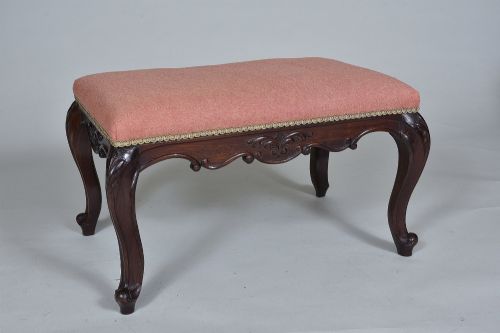
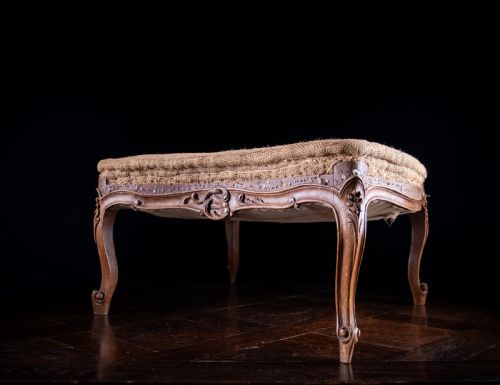
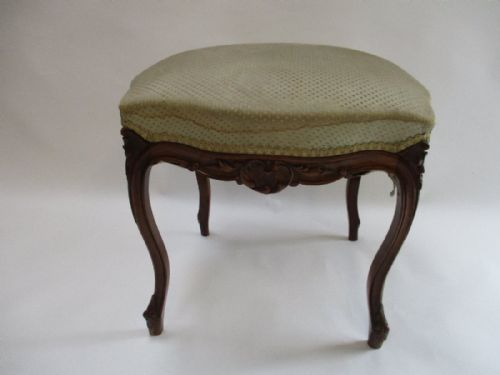
When you search for rococo style footrests, you are looking at low upholstered seats designed for resting feet or sitting near a hearth. The examples available here span the nineteenth century, including Victorian interpretations and specific revivals of French court aesthetics.
Most pieces date from the later decades of the eighteen-eighties and eighteen-nineties, alongside earlier Regency or Victorian manifestations. The forms appear primarily as stools and footstools, standing on curved supports rather than straight legs.
Makers of these pieces drew heavily on Louis XV design vocabulary, translating organic asymmetry into British and continental seating. You will encounter single stools and pairs finished in paint, gilding or polished hardwoods.
How they were made
Cabinetmakers shaped the frames of these stools from solid hardwoods such as mahogany, walnut and beech. Selected pieces received layers of gold leaf or paint directly over the carved timber to achieve a decorative surface.
Carvers worked by hand to apply asymmetric scrolls, floral motifs and shell details characteristic of revival aesthetics. Upholstery fabric, velvet and traditional textiles were then secured over padding to complete the top surface.
Rococo Style Footrests Retail Price Guide 2026
Typical asking prices for rococo style footrests among the pieces listed under this phrase on Sellingantiques today, from the lower quarter to the upper quarter. They describe what is for sale here now, not the wider market.
Some nineteenth-century makers could not decide between France and Britain, resulting in polite Victorian walnut wearing very loud French boots.
What varies in quality
The crispness of the hand carving dictates the visual success of each frame. Sharper chisel work on the wooden scrolls and foliage separates finer workshop production from simpler commercial output.
The choice of primary timber and surface finish also establishes the grade of the piece. Solid walnut and intricate giltwood finishes indicate higher ambition than basic painted or secondary woods.
The Rococo Style Footrests Glossary
- Cabriole leg
- A furniture leg that curves outward at the knee and inward at the ankle, mimicking animal limbs. This form is fundamental to Louis XV revival seating.
- Giltwood
- Timber coated with a thin layer of gold leaf or gold paint. It provides a bright, reflective surface popular in formal nineteenth-century rooms.
- Rococo Revival
- A nineteenth-century design movement that reinterpreted the curving, ornate style of the mid-eighteenth-century French court. It favours asymmetry and natural motifs.
- Upholstery
- The materials, including padding, springs, webbing and fabric, that form the soft covering of a seat. Original textile choices often indicate the period of re-covering.
Rococo Style Footrests: Frequently Asked Questions
How do I use a footrest today?
These low stools function effectively as moveable seats in a living room or as supports for tired feet.
Their compact scale allows them to sit easily beside armchairs or under tables when not in use.
What periods do these stools represent?
The listings span the nineteenth century, from Regency pieces through Victorian revivals up to nineteen hundred.
Maker interpretations shifted between strict historical references and more exuberant local expressions during this timeframe.
Are these pieces sturdy enough to sit on?
Most antique stools retain solid hardwood frames constructed with traditional joinery.
However, buyers should consider whether the internal webbing and padding require professional reinforcement for regular seating.
How do I identify rococo style features?
Look for C-scrolls, asymmetric floral carvings, and flowing lines that avoid rigid symmetry.
Cabriole legs and shell motifs further signal the influence of mid-eighteenth-century French design.