




Carved French Bedroom Stools
These carved french bedroom stools bring traditional European seating forms into domestic spaces through decorative woodwork and upholstered tops.
Carved French Bedroom Stools
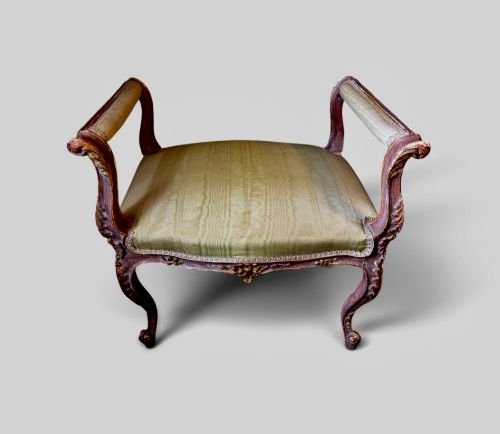
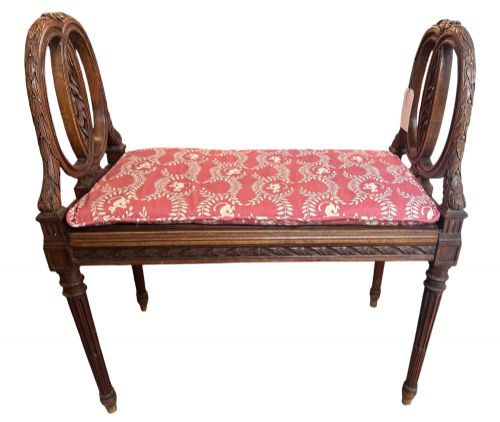
Carved french bedroom stools comprise low seating forms including footstools, window seats, duet stools, and salon benches. The selection here spans the Victorian era through the early twentieth century, showing historical revival styles across multiple decades.
Makers drew on established design vocabularies such as Louis XVI style, French Régence, and Rococo Revival. These influences appear in rectilinear or curved frames designed for bedroom and salon use.
The objects take various formats, from single hand-carved decorative stools to matched armchairs with accompanying footstools. Walnut, rosewood, and giltwood provide the primary structural framework for these upholstered seats.
How they were made
Craftsmen shaped structural timbers like walnut, rosewood, and painted wood into frames featuring cabriole legs and linear supports. Hand-carved decorative motifs adorned the wooden rails and aprons of the seats.
Surfaces received specialised treatments including complete gilding in giltwood, applied paint finishes, or polished wood grain. Upholsterers then finished the pieces using traditional fabrics and silk coverings.
Listings span the nineteenth century and early twentieth century, incorporating walnut, rosewood, giltwood, and painted wood frames.
What varies in quality
The depth and execution of the hand carving distinguish finer examples from simpler production. Crisp lines on floral and scrollwork indicate skilled hand tool use by the maker.
Material selection and finish integrity create distinct tiers in the surviving pieces. Original giltwood surfaces and high-grade timber frames demonstrate superior craftsmanship compared to plain painted alternatives.
The Carved French Bedroom Stools Glossary
- Cabriole leg
- A furniture leg that curves outward at the knee and tapers inward toward the foot, inspired by animal limbs. This form appears frequently on nineteenth-century seating.
- Giltwood
- Timber coated with a thin layer of gold leaf or gilt paint. This finish creates a reflective metallic surface on decorative frames.
- Duet stool
- An elongated seating form designed to accommodate two people at once. These pieces often feature upholstered tops supported by carved wooden frames.
- Window seat
- A long stool or bench sized specifically to fit within a window recess. These forms often incorporate arms at either end.
- Louis XVI style
- A neoclassical design movement characterised by straight lines, symmetry, and classical ornamentation. The style emerged again in revival pieces throughout the nineteenth century.
Carved French Bedroom Stools: Frequently Asked Questions
What rooms suit these stools?
These seating pieces fit naturally at the foot of a bed, beside dressing tables, or within private sitting rooms.
Their compact scale allows them to function as movable seats or window benches in various domestic settings.
How do I identify the style?
Styles become apparent through leg shapes, carving details, and the overall silhouette of the wooden frame.
Referencing period markers like Louis XVI straight lines or Rococo curves helps distinguish one design influence from another.
What materials make up the frames?
Frames consist primarily of solid hardwoods such as walnut and rosewood, alongside softer woods that received paint or gilt.
Surface treatments range from natural polished wood grains to complete applications of gold leaf.
Are these pieces strictly for bedrooms?
While often termed bedroom stools or salon benches, historical forms served multiple domestic functions.
Many examples function equally well as low coffee tables, window seats, or piano benches in living areas.