



Pair of French Stools
A pair of French stools brings symmetry and Continental character to a room, offering low seating or foot support through carved frames and upholstered tops.
Pair of French Stools
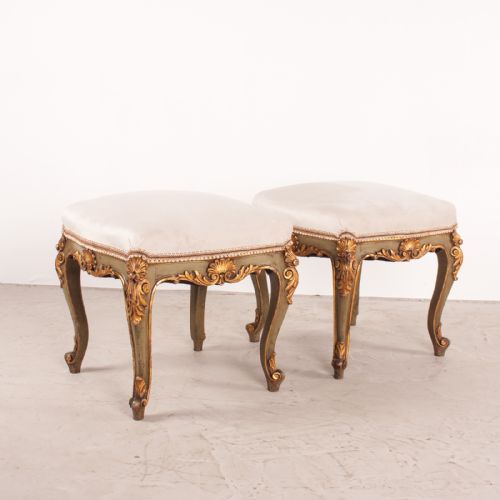
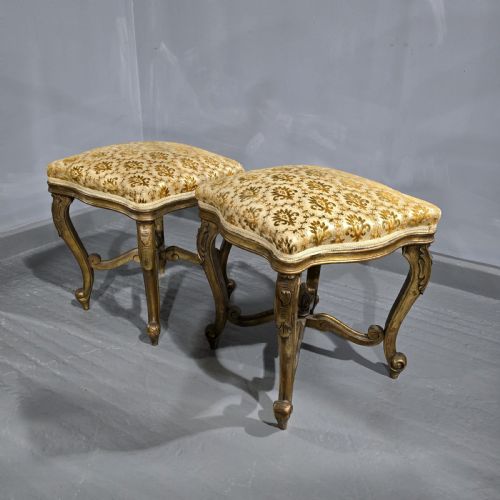
A pair of French stools encompasses footstools, low seating forms, and window seats originating across the nineteenth and early twentieth centuries. These pieces reflect Continental aesthetics ranging from restrained Regency examples to elaborate revival designs.
The version most commonly met on this page is the walnut or giltwood footstool, often featuring carved woodwork and upholstered surfaces. Alongside these are painted wooden frames and occasional country pieces in fruitwood or elm.
How they were made
Makers constructed these frames from solid hardwoods like walnut, beech, mahogany, and oak, frequently applying giltwood, paint, or polish to the exposed timber. Carved details define the structural woodwork, particularly on revival pieces following Louis styles.
Upholstery methods utilise traditional materials, including velvet, fabric, needlepoint, and ticking stripes, sometimes finished with buttoning or brass ormolu mounts.
The listings span the nineteenth and early twentieth centuries, recording walnut, mahogany, oak, beech, and fruitwood alongside velvet, needlepoint, and giltwood finishes.
What varies in quality
The depth and crispness of the wood carving dictate much of the distinction between standard items and finer examples. Hand-carved walnut and fire-gilded surfaces demonstrate superior craftsmanship compared to simpler painted or machine-finished alternatives.
The integrity of the frame construction and the quality of the textile covering, whether rich velvet or detailed needlepoint, separate everyday utility pieces from more ambitious workshop productions.
The Pair of French Stools Glossary
- Giltwood
- Timber coated with gold leaf or a gold-coloured finish. This treatment appears frequently on formal nineteenth-century seating.
- Cabriole leg
- A furniture leg that curves outward and then tapers inward, ending in a pad or foot. This form is central to Louis XV and related revival styles.
- Prie-Dieu chair
- A devotional chair fitted with a low shelf for kneeling. These items often share stylistic traits with companion stools.
- Ormolu
- Gilded bronze mounted onto furniture as decorative hardware. It adds metallic contrast to walnut and satinwood surfaces.
- Needlepoint
- Hand-stitched yarn embroidery used for upholstery. It provides durable decorative surfaces on period footstools.
Pair of French Stools: Frequently Asked Questions
How were French stools used historically?
These pieces served primarily as footstools before larger seating or as low auxiliary seats in formal reception rooms and parlours.
Larger versions also functioned as window seats or companion pieces placed beside matching armchairs and sofas.
How do I style a pair of French stools today?
Position them symmetrically in front of a sofa, beneath a window, or at the foot of a bed to add balanced decorative weight.
Their compact scale allows them to function as movable seating or occasional display surfaces in living spaces and hallways.
How can I tell the period of a French stool?
Examine the timber species, joinery methods, and the style of the carved ornament to gauge the likely era of manufacture.
Nineteenth-century pieces frequently revive earlier monarchical designs like Louis XIV or Louis XV, merging historic motifs with contemporary workshop practices.
What is the difference between giltwood and painted stools?
Giltwood frames feature a gold leaf or metallic surface treatment designed to reflect candlelight and project formality in a grand interior.
Painted stools utilise applied pigments, often in muted or neutral tones, providing a softer aesthetic associated with provincial or later revival pieces.