

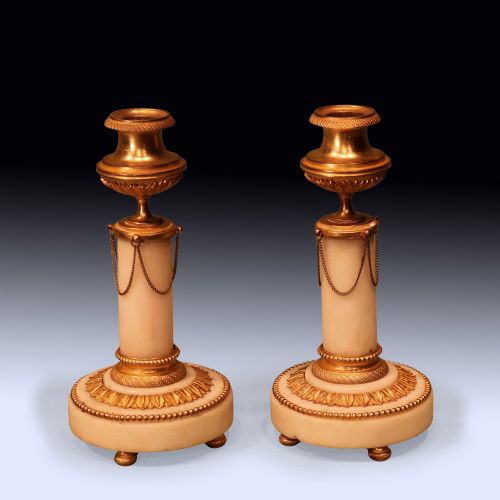


Pair Marble Candle Holders
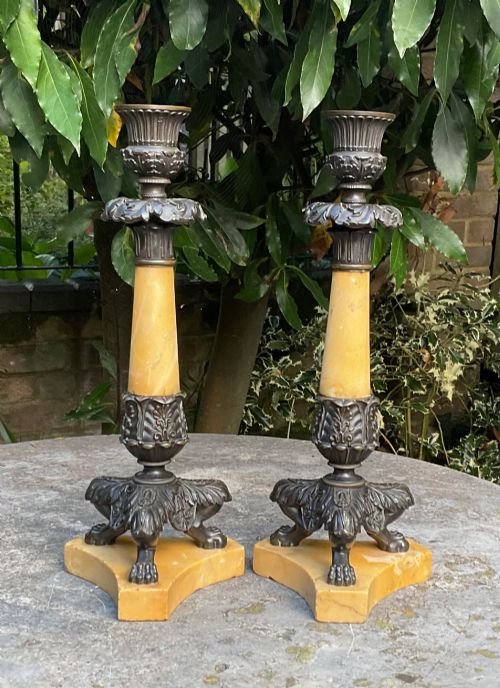
Pair marble candle holders combine carved stone bases with cast metal mounts, bringing classical proportion and heavy material presence to a room.
Pair Marble Candle Holders
When you search for pair marble candle holders, you find objects created primarily during the nineteenth century, alongside pieces originating in the Regency period and the eighteenth century. The selection spans French Empire, Louis XVI, Regency, and Victorian styles, reflecting diverse European design traditions from Neoclassical to Rococo Revival.
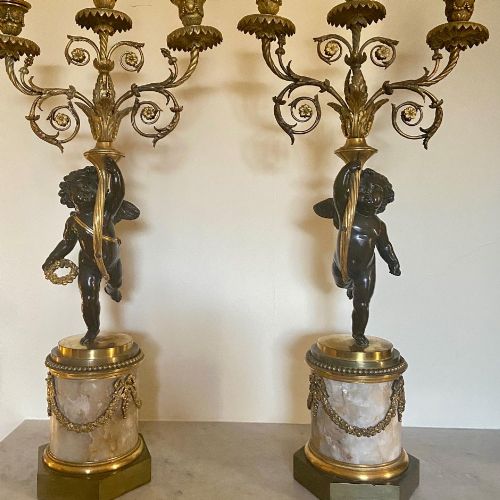
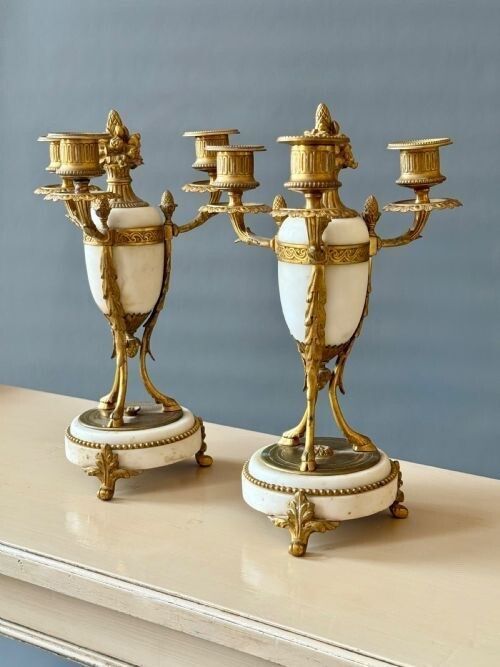
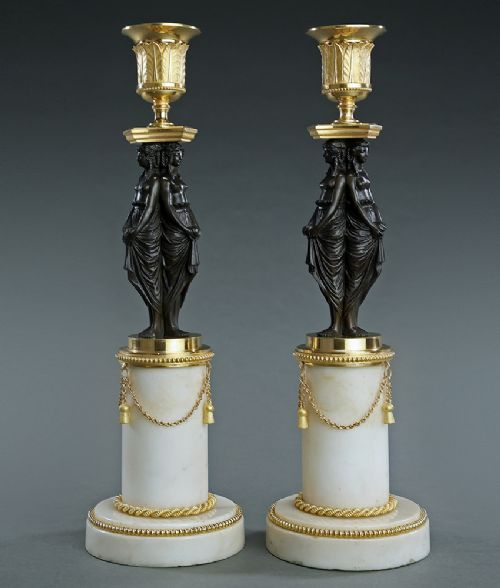
Most examples combine turned or carved stone bases with metal components, taking the form of simple candlesticks or more complex multi-armed candelabra. Figures such as putti, cherubs, caryatids, and maidens frequently appear supporting the sconces, drawing upon Grand Tour subjects and classical mythology.
The materials used extend beyond standard white marble to include green marble, sienna marble, Ashford marble, and fluorspar, paired with cast bronze, patinated bronze, ormolu, brass, and gilt bronze.
How they were made
Makers shaped the stone bases on a lathe or by hand, achieving smooth, geometric columns or polished plinths designed to anchor the weight of the metal above. Metal components such as putti, arms, and drip pans relied on the lost-wax casting method or sand casting in bronze or brass.
Craftsmen applied surface treatments including fire gilding with ormolu, chemical patination to darken the bronze, and parcel gilding to highlight specific details on figures and foliage. The stone and metal elements were then joined mechanically using internal threaded rods, screws, and pins.
Materials span white, green, sienna, and Ashford marble alongside fluorspar.
What varies in quality
Quality rests in the crispness of the metal chasing, where hand-tooled details on feathers, hair, and drapery separate superior castings from soft, mass-produced versions. The selection of the marble itself matters, with dense, evenly figured stone and precise turning showing greater care than flawed or poorly matched blocks.
Proportion and architectural balance dictate the overall success of the piece, as finer examples maintain harmonious relationships between the heavy stone plinth and the delicate branching of the arms.
Francois Redmond·Dugourc·Claude Clodion·Holtzapffel·Thomas Hope
The Pair Marble Candle Holders Glossary
- Ormolu
- Gilt bronze produced by applying a mixture of gold and mercury to a bronze base and heating it to vaporise the mercury. This technique creates a durable golden finish characteristic of French decorative arts.
- Candelabra
- A branched candlestick holding multiple lights on separate arms. These pieces often feature central figures or decorative columns rising from a shared base.
- Fluorspar
- A colourful halide mineral sometimes utilised for ornamental bases and decorative inserts. It displays natural banding and vibrant colour variations.
- Patinated bronze
- Bronze treated with chemicals or heat to alter its surface colour. This process produces deep brown, black, or greenish tones distinct from raw or gilded metal.
- Grand Tour
- A traditional trip through Europe undertaken by young upper-class men to study classical art. Souvenirs from these journeys frequently included small bronzes and marble antiquities.
Pair Marble Candle Holders: Frequently Asked Questions
What periods do these come from?
The pieces span the eighteenth, nineteenth, and early twentieth centuries, with a strong concentration of nineteenth-century French and Victorian examples.
Stylistic markers like Neoclassical symmetry or Rococo Revival ornamentation help connect individual items to specific design eras.
How were they used historically?
They served as functional domestic lighting on mantelpieces, dining tables, and sideboards before the widespread adoption of electricity.
Their substantial weight and reflective metal surfaces also functioned as decorative centrepieces indicating social status.
How do I clean marble bases?
Dust the stone gently with a dry, soft cloth to remove surface particles without scratching the polished finish.
Avoid acidic cleaning solutions or excessive water, which can penetrate porous marble or damage surrounding metal mounts.
How do I tell cast bronze from brass?
Bronze typically displays a heavier weight and a deeper, warmer metallic tone when patinated or polished.
Brass contains higher zinc content, often yielding a brighter yellow colour unless chemically darkened.