

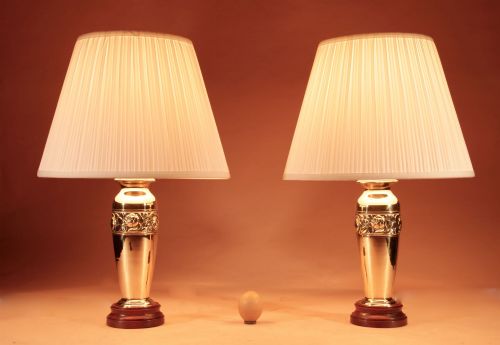
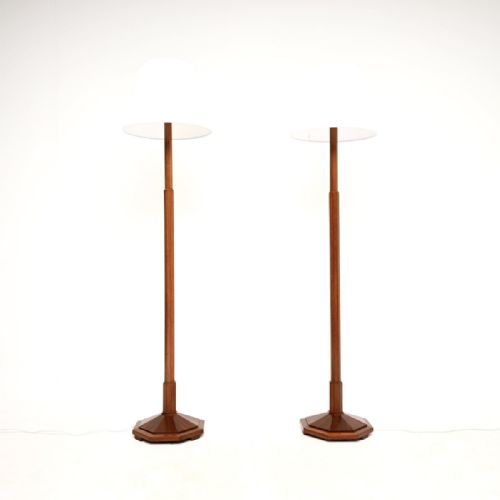


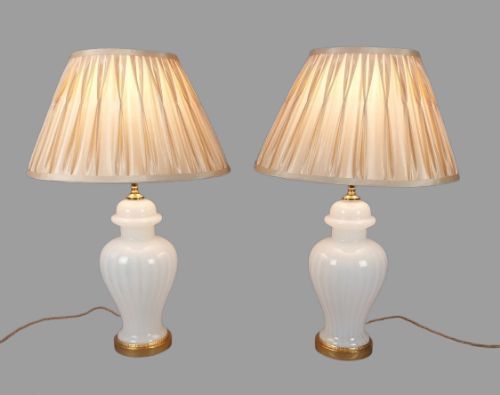


Pair Art Deco Lamps
Pair art deco lamps bring geometric symmetry and period elegance to an interior, offering matching illumination through striking thirty-era design.
Understanding pair art deco lamps
These matched light fittings span table, floor, desk and wall forms from the nineteen thirties, designed to balance a room with symmetrical illumination. Buyers encounter numerous variants, from simple glass standards to elaborate models incorporating sculptural figures and specialised shades.
The materials recorded in the archive and current listings include walnut, chrome, silver plate, nickel, bronze, steel, copper, gilt brass, crystal and bakelite. Frosted glass and clear glass feature heavily, often taking clam shell, dish uplighter or standard forms.
Origin and attribution occasionally span French workshops and specific designers, alongside standard commercial productions of the period. Forms range from compact smokers table lamps and candlesticks to grand scale floor standards and desk models.
Materials and construction
Makers utilised cast metals such as bronze, steel, copper and silver plate alongside structural timbers like walnut to build robust bases and standards. Chrome and nickel finishes provided the reflective sheen characteristic of the style.
Glass elements were moulded into frosted shades, clam shell wall mounts and large dish uplighters, sometimes paired with original shades. Bakelite was employed for switchgear and body components, reflecting early plastics manufacturing techniques of the era.
Retail Price Guide 2026
Typical UK retail prices for pair art deco lamps, calculated from the Sellingantiques database of over a million retail prices indexed since 2003. This retail price guide relies exclusively on Sellingantiques data; no external sources or auction records are used, so the figures do not describe the wider market.
A bronze panther occasionally guards the clock while the lamps provide the illumination.
Distinctions in quality
The top of the range is defined by substantial metal casting, superior glass weight, and attribution to known designers or prominent glass houses. Lesser pieces rely on simpler pressed components and standard commercial casting without distinct attribution.
Material combinations create divergence in quality, where mixed metals like copper and steel or fine walnut veneers outclass basic plated substitutes. The presence of original frosted glass shades and intact period switches elevates a pair above standard replacements.
Decoux·Hettier and Vincent·Walthe and Sohne·Salvado·ESC Elektrosvit
The Pair Art Deco Lamps Glossary
- Bakelite
- An early form of thermosetting plastic used for lamp bodies and electrical components during the period. It offers a dense, durable finish often found in dark brown or black shades.
- Clam shell
- A moulded glass shade shape resembling a bivalve shell, frequently utilised in wall sconces. This form diffuses light softly across vertical surfaces.
- Silver plate
- A thin layer of silver applied over a base metal foundation to give a bright reflective appearance. It appears on numerous table and desk models in the archive.
- Uplighter
- A lighting configuration designed to throw illumination upwards toward the ceiling rather than down. Large dish versions are recorded among floor and table lamps.
Frequently Asked Questions
What rooms suit pair art deco lamps?
These matched lights fit naturally on sideboards, desks and bedside tables where symmetrical balance matters.
Larger floor standing variants suit corners of reception rooms, providing upward illumination that complements period interior schemes.
How do I identify nineteen thirties lighting?
Look for characteristic geometric lines, stepped bases, and the combination of chrome, frosted glass and walnut.
Named makers and specific glass moulding techniques also help confirm the era of production.
Were these lights originally wired differently?
Period fittings often required rewiring to meet modern safety standards while retaining their original sockets and switches.
Many examples have been updated with contemporary wiring and tested to ensure safe domestic use.
What is the difference between desk and table lamps?
Desk models often incorporate adjustable arms, functional switches or materials like bakelite suited for task work.
Table versions generally prioritise decorative symmetry and ambient output for living spaces.