






Painted Neoclassical Footstools
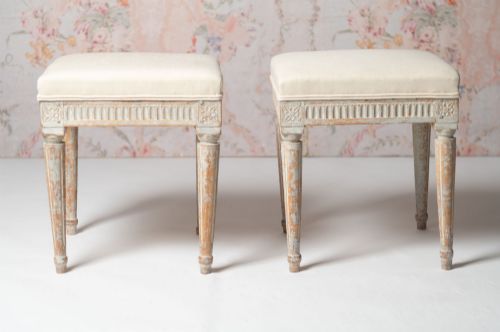
These painted neoclassical footstools bring restraint and carved elegance to a room, offering classic seating derived from 18th-century and 19th-century traditions.
Painted Neoclassical Footstools
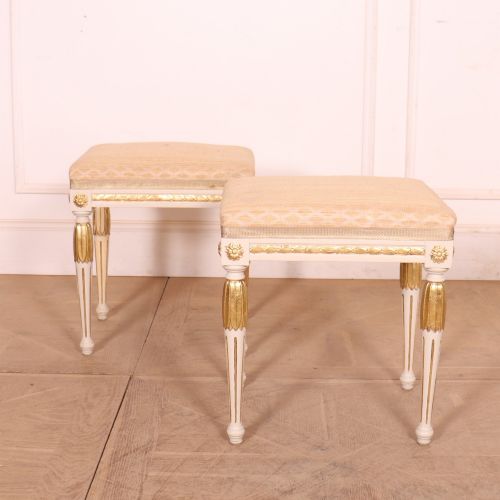
Painted neoclassical footstools combine classical forms with muted painted finishes, following designs established in the eighteenth century and nineteenth century. These pieces appear frequently as Swedish Gustavian works or Italian neoclassical examples, often offered as pairs.
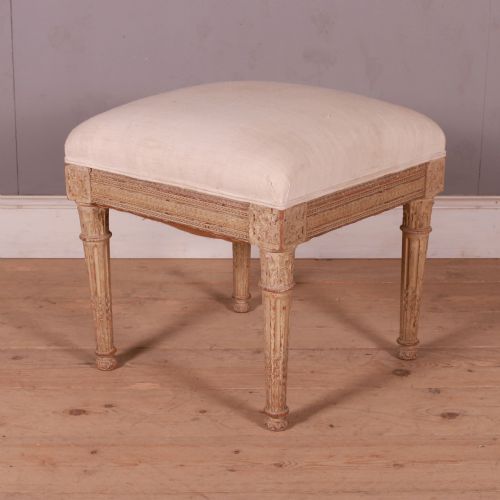
The primary forms include compact stools and footstools, built with painted timber or carved wood frames. Many examples feature textile coverings such as linen, fabric, or wool needlework.
Buyers seeking these footstools encounter items originating from continental Europe, predominantly Sweden and Italy. The inventory ranges across distinct periods including the eighteenth century, the nineteenth century, and specific decades such as 1880 and 1890.
How they were made
Makers constructed these frames from timber and wood, applying carved details to legs and rails before finishing the surfaces with paint and sometimes gold leaf. The underlying woodwork relies on traditional joinery methods suited to domestic seating.
Upholstered elements utilise linen, standard fabric, or hand-worked wool needlework secured to the frame. The painted surfaces often show layers of historic pigment over primed wood.
Painted Neoclassical Footstools Retail Price Guide 2026
Typical asking prices for painted neoclassical footstools among the pieces listed under this phrase on Sellingantiques today, from the lower quarter to the upper quarter. They describe what is for sale here now, not the wider market.
Several pairs have survived centuries together, enduring countless changing fashions while keeping their matching painted coats intact.
What varies in quality
The sophistication of the carved wooden ornament dictates much of the distinction between standard pieces and finer examples. Crisp lines in carved timber and well-proportioned neoclassical motifs elevate the work.
The integrity of the painted finish and the quality of the textile upholstery, whether original wool needlework or later linen, shape the overall character of the stool.
The Painted Neoclassical Footstools Glossary
- Gustavian
- The Swedish interpretation of neoclassical style, defined by clean lines, restrained carving, and pale painted finishes. This aesthetic dominates Scandinavian seating from the period.
- Needlework
- Stitched textile decoration, often executed in wool on canvas. Such panels form the historic upholstery surfaces on select nineteenth-century stools.
- Gold leaf
- Extremely thin beaten gold applied to wooden frames to highlight carved details. It provides a contrast to the painted timber body.
- Neoclassical
- A style reviving classical antiquity through symmetry, straight lines, and architectural motifs. It informs the form and decoration of these European stools.
Painted Neoclassical Footstools: Frequently Asked Questions
Are these footstools sold as pairs?
Many of the listed pieces appear as matched pairs, particularly the Swedish Gustavian and carved wooden examples.
Single stools also occur within the selection, originating from both eighteenth-century and nineteenth-century workshops.
What materials cover the seats?
The upholstery consists of various textiles including simple linen, standard fabric, and detailed wool needlework.
These coverings sit atop traditional wooden frames finished with paint and occasional gold leaf.
Where do these pieces originate?
The available inventory originates primarily from Sweden and Italy, reflecting northern European and Mediterranean interpretations of neoclassical design.
Swedish pieces frequently display Gustavian characteristics, while Italian items show distinct regional carving styles.
How do I date a painted stool?
Dating relies on the construction techniques, the style of the wood carving, and the characteristics of the layered paint finishes.
Pieces span the eighteenth century and the nineteenth century, including specific dates like 1880 and 1890 recorded in the listings.