
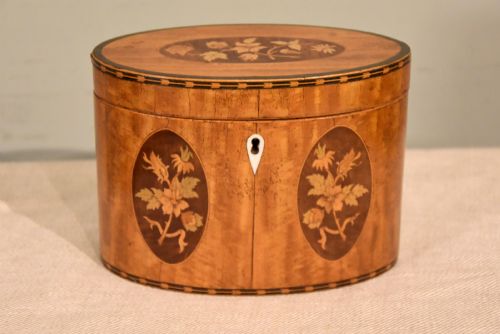


Oval Wooden Caddy
An oval wooden caddy brings a smooth Georgian silhouette to the room, holding tea or small treasures with quiet poise.
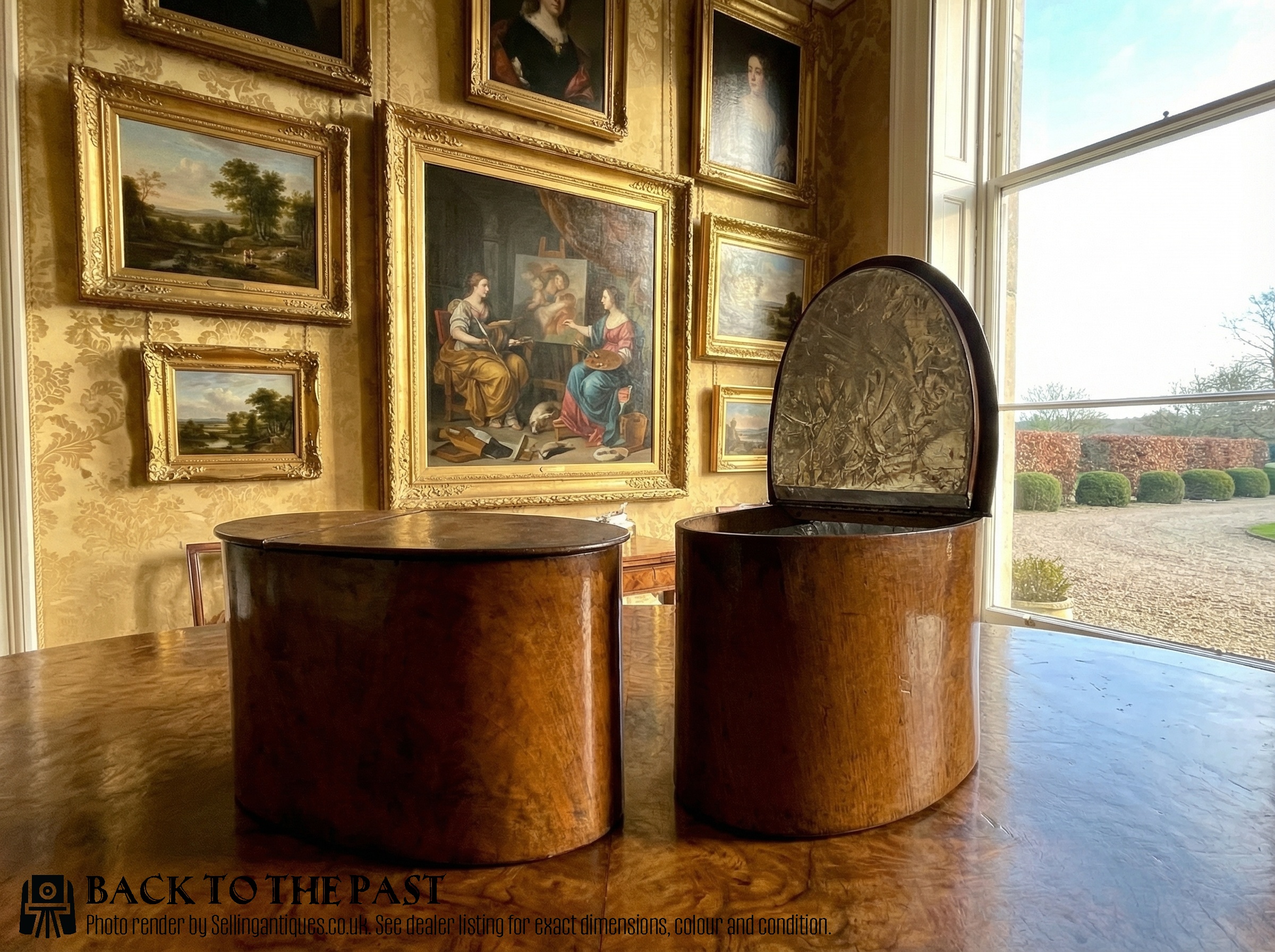
Oval Wooden Caddy
An oval wooden caddy is a compact vessel designed originally for storing leaf tea securely, shaped with curved ends rather than rigid right angles. The examples gathered under this search phrase span from the eighteenth century into the nineteenth, taking the form of tea caddies alongside related oak and elm storage vessels.
You are most likely to meet mahogany, satinwood, and harewood versions on this page, often featuring inlaid banding characteristic of the Georgian and Sheraton Revival styles. These pieces combine functional storage with fine cabinet work, making them adaptable decorative objects for modern interiors.
Beyond standard tea caddies, the selection includes related timber vessels such as butter tubs and wine coolers sharing the distinctive oval footprint. Each piece reflects the eighteenth and nineteenth-century preference for curved wooden forms over stark geometric boxes.
How these pieces were constructed
Cabinetmakers built these caddies using dense timbers like mahogany, walnut, and elm as a structural base, frequently applying veneers of exotic satinwood and harewood to the exterior surfaces. Boxwood and ebony stringing often outlines the oval lids and panels, requiring precise hand-cutting to follow the tight curves of the grain.
Many examples incorporate brass escutcheons and hinges fitted by hand into the timber. The wood was then polished to a smooth finish that highlights the natural figuring of the elm, mahogany, or walnut without masking the material.
Listings under this phrase span from the eighteenth century through to the late nineteenth century, incorporating both mahogany and satinwood.
Judging the quality of an oval wooden caddy
Quality rests primarily on the crispness of the timber inlay and the symmetry of the oval shape, which demands precise carpentry to prevent warping along the curves. Finer pieces display carefully matched veneer grains across the lid and sides, whereas simpler versions rely on plain mahogany or oak boards.
The choice of secondary woods and the delicacy of stringing distinguish standard workshop output from higher-tier cabinet work. Well-executed stringing follows the precise geometry of the oval without chipping the surrounding satinwood or harewood veneer.
The Oval Wooden Caddy Glossary
- Satinwood
- A lustrous tropical timber with a golden yellow sheen, frequently utilised for decorative veneers on late eighteenth-century pieces. It provides a bright contrast to darker bandings.
- Harewood
- Sycamore wood treated to take on a distinctive greenish-grey tone, popular in Sheraton Revival and Georgian decorative work. It is often employed for specialised stringing and panels.
- Stringing
- Thin strips of contrasting wood inlaid into channels cut into the surface of the caddy. This technique creates delicate linear borders around the oval panels.
- Escutcheon
- A small protective plate surrounding the keyhole, usually fashioned from brass. It adds both a functional guard and a metallic accent to the wooden front.
Oval Wooden Caddy: Frequently Asked Questions
What is an oval wooden caddy?
An oval wooden caddy is a lidded container originally used for keeping dry tea leaves fresh and secure under lock and key. The curved perimeter differentiates it from standard rectangular storage boxes.
Craftsmen built these vessels from solid timbers and fine veneers during the eighteenth and nineteenth centuries. Today they function as decorative objects on sideboards or mantelpieces.
How do I date a Georgian caddy?
Dating relies on observing the timber choices, construction techniques, and decorative vocabularies visible on the piece. Eighteenth-century examples often feature satinwood veneers with delicate boxwood stringing.
Later nineteenth-century revivals tend to employ heavier proportions or different internal configurations. Comparing the secondary woods inside the box helps confirm the period of manufacture.
Where were these caddies kept?
Tea caddies rested in principal reception rooms such as the dining room or drawing room during the Georgian period. Because tea was an expensive commodity, the container stayed locked until the mistress of the house dispensed the leaves.
Their decorative quality ensured they remained visible on tables rather than stored away in pantries. This prominence encouraged cabinetmakers to use fine veneers and brass fittings.
How do I care for antique wood?
Antique wood requires stable indoor humidity levels away from direct sunlight and strong heat sources. Excessive dryness can cause old veneers to lift from their timber bases.
Light dusting with a dry, soft cloth maintains the surface without stripping the aged polish. Wax polishes formulated for antiques can be applied sparingly when the wood appears dry.