


Oval Swing Toilet Mirror
An oval swing toilet mirror sits upon a chest or table, tilting to catch the morning light while concealing small valuables in its base.
Oval Swing Toilet Mirror
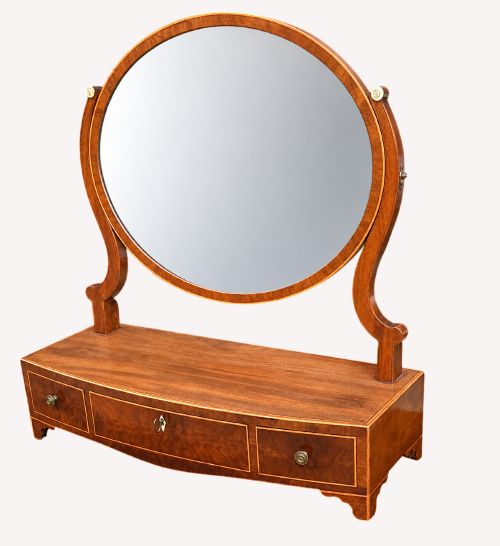
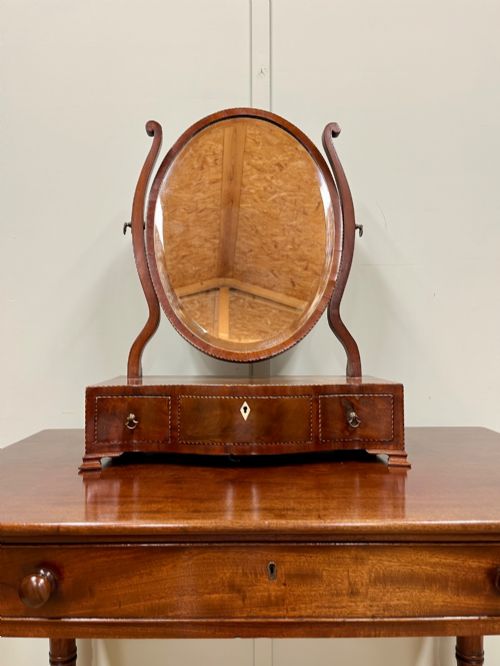
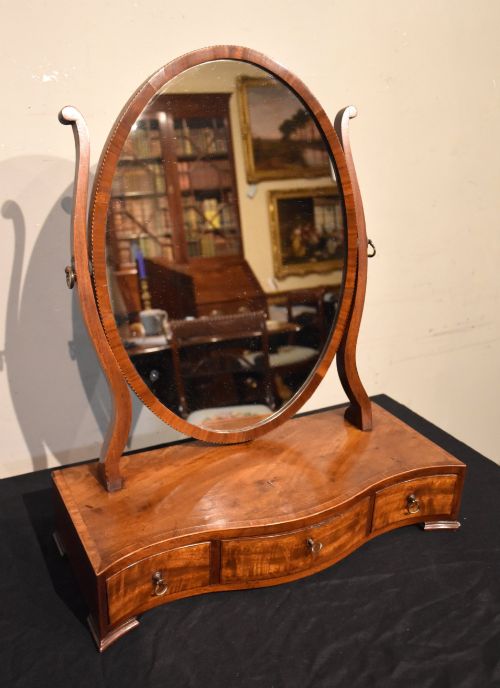
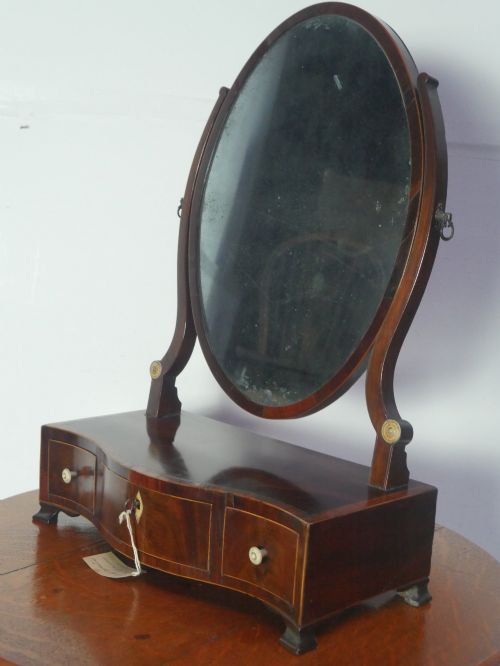
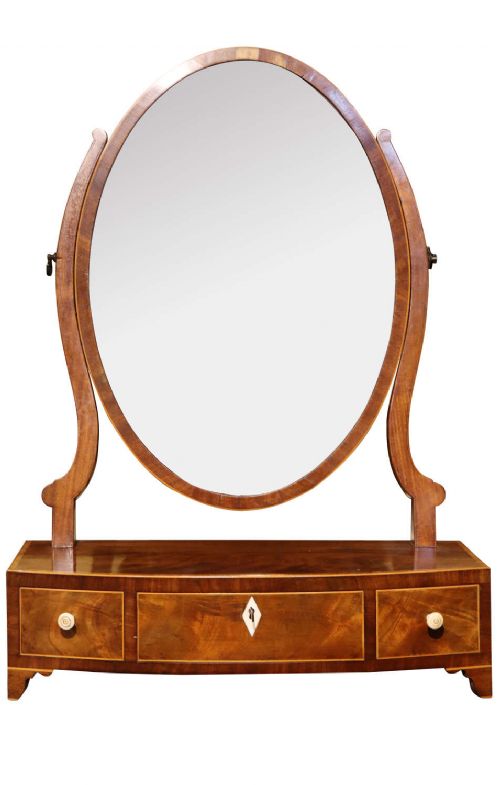
The oval swing toilet mirror appears most frequently in mahogany, constructed as a tabletop dressing glass designed for the bedroom or boudoir. These pieces date across the eighteenth, nineteenth and early twentieth centuries, spanning Georgian, Victorian and Edwardian periods.
The typical survivor pairs an upright frame pivoting on brass screw pins with a box base containing one, two or three small drawers. Examples range from plain George III designs to serpentine fronts set upon squashed bun feet.
Materials and technique
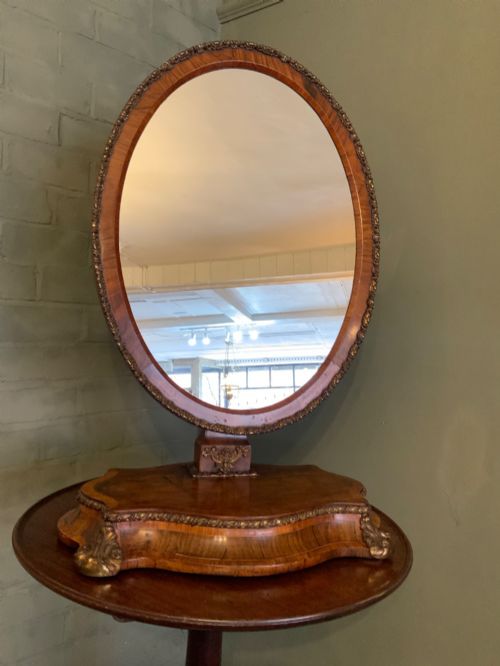
Cabinetmakers built the primary structures in solid mahogany, frequently selecting flame mahogany veneers and applying boxwood inlay or crossbanding to the drawer fronts. Brass fittings secure the pivoting arms, while giltwood and gesso appear on continental and revival pieces.
The glass plate rests within a moulded oval frame supported by shaped upright arms. Bases often incorporate small storage compartments or triple drawers constructed with traditional joinery.
Mahogany is the dominant timber across these listings, accompanied by occasional walnut, satinwood, giltwood and gesso.
Quality differences
Finer examples distinguish themselves through the choice of timber figure, such as richly marked flame mahogany, and the crisp execution of boxwood inlay. The proportion between the oval glass frame and the drawer base determines visual balance.
Subtle details separate standard production from superior work, including the shaping of the serpentine fronts, the turning of the support arms and the retention of original brass hardware and glass plates.
The Oval Swing Toilet Mirror Glossary
- Serpentine front
- A convex central section flanked by two concave curves, creating a gentle undulating shape on the drawer base. This profile requires skilled woodworking.
- Crossbanding
- A narrow strip of veneer applied to the border of a panel or drawer front with the grain running perpendicular to the main surface. It frames the central timber figure.
- Giltwood
- Wood carved and coated with gold leaf or a gold-coloured finish. It appears on decorative eighteenth-century Italian frames.
- Boxwood inlay
- Contrasting pale wood inserted into recesses cut into darker timber to form geometric lines or decorative motifs. It highlights the edges of drawers and frames.
- Cheval mirror
- A full-length dressing glass supported on a standing frame rather than a tabletop base. Some period variants share similar pivoting mechanisms.
Oval Swing Toilet Mirror: Frequently Asked Questions
How do I date an oval swing toilet mirror?
Look to the timber selection, drawer configuration and construction methods to establish an approximate period. Georgian pieces often display slender proportions and mahogany crossbanding, while Victorian examples tend to be heavier with carved supports.
Hardware also offers clues. Hand-turned wooden knobs, original brass screw pins and secondary woods inside the drawers help distinguish eighteenth-century work from later nineteenth-century manufacturing.
Where should I place a toilet mirror?
These mirrors suit dressing tables, sideboards or chest tops where their pivoting frames can be adjusted for height and angle. Their compact footprints make them practical for everyday use.
Ensure the supporting surface is stable and level to protect the antique base and brass pivot pins from undue strain during adjustment.
Are the mirror plates usually original?
Many surviving pieces retain later replacement glass because early mirrors deteriorated over decades of exposure to moisture and light. Original plates sometimes exhibit minor foxing or light silver loss.
A replacement plate does not diminish the decorative utility of the frame, though collectors prefer surviving antique glass where present.
What is the difference between a toilet mirror and a dressing mirror?
The terms are largely interchangeable in antique descriptions, referring to smaller mirrors designed to sit upon furniture rather than hang on a wall. Both types incorporate swing mechanisms.
Some variations include small drawers or storage compartments beneath the glass, functioning as miniature table chests as well as reflectors.