




Oval Carriage Clock
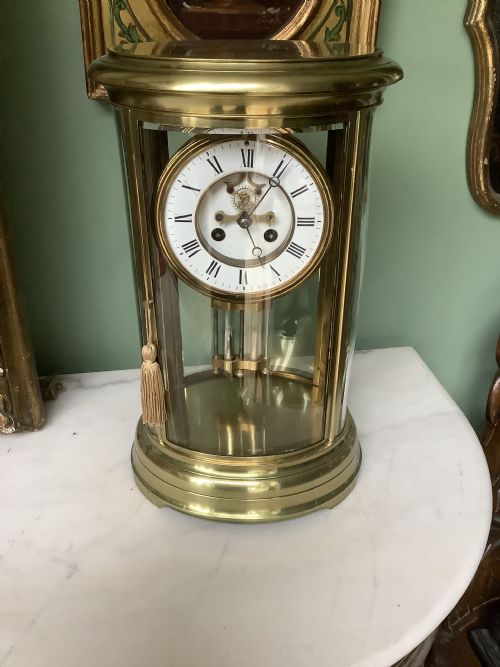
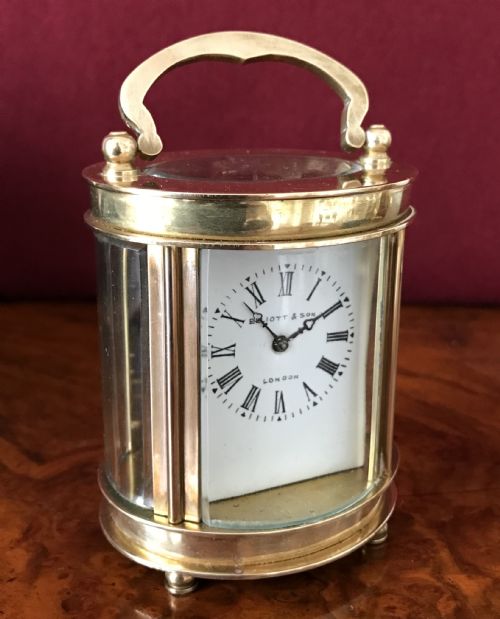
An oval carriage clock brings portable timekeeping to the mantel, offering bevelled glass panels and brass housing shaped for the traveller.
Oval Carriage Clock
An oval carriage clock represents a specific departure from standard rectangular brass cases, adopting curved or elliptical sides that alter how light catches the glass and metal. Buyers searching for an oval carriage clock typically encounter French examples spanning the Victorian period through to the nineteen-twenties, alongside occasional English interpretations.
These pieces function primarily as mantel clocks or portable timekeepers, appearing in sizes that range from diminutive miniatures to striking models with repeaters and alarms. The form accommodates bevelled glass panels, enamel dials, and sometimes travel cases, making them prominent desk or shelf ornaments.
Materials and construction
Makers constructed these clocks predominantly using brass casings and glass panels, often employing gilt finishes or gilding over the metal substrate. Enamel appears extensively on the dials, while leather and fabric frequently line the original travel cases accompanying the pieces.
The mechanical assemblies combine brass gears, escapements, and striking trains housed compactly within the curved frames. Engraving and precision metalworking define the exterior decoration, particularly on models featuring decorated bezels or cases.
Oval Carriage Clock Retail Price Guide 2026
Typical asking prices for oval carriage clock among the pieces listed under this phrase on Sellingantiques today, from the lower quarter to the upper quarter. They describe what is for sale here now, not the wider market.
Listings feature periods spanning the Victorian era, Edwardian years, and nineteen-thirties, constructed from brass, glass, enamel, and gilt brass.
Understanding quality differences
Quality in these clocks rests upon the complexity of the movement and the crispness of the case execution. Examples featuring striking trains, repeater mechanisms, or alarms command attention over simple timepieces, while miniature and giant scales introduce their own distinct manufacturing challenges.
The degree of hand engraving on the brass panels and the presence of original components, such as leather travel cases and signed movements, separate standard production pieces from higher echelon works.
Drocourt·AD Mougin·Richard & Co Paris·Henri Jacot
The Oval Carriage Clock Glossary
- Carriage clock
- A small, portable spring-driven clock designed for travellers in the nineteenth century. They typically feature glass sides to display the movement.
- Repeater
- A mechanism that chimes the hours and quarters on demand when a push-button is pressed. This complication indicates higher craftsmanship.
- Escapement
- The internal mechanism that controls the release of gear train energy to maintain pendulum or balance wheel motion. Platform escapements are standard in these portable pieces.
- Dial
- The face of the clock where time is indicated, frequently rendered in white enamel with Roman or Arabic numerals. It sits behind the bevelled glass front door.
- Striking train
- The secondary gear train within a clock that controls the audible ringing of the hours or half-hours. It operates independently from the timekeeping train.
Oval Carriage Clock: Frequently Asked Questions
What is an oval carriage clock?
An oval carriage clock is a portable mechanical timepiece housed in a curved brass and glass case, developed for transport and mantel display during the nineteenth and early twentieth centuries.
Unlike standard rectangular designs, the curved profile softens the silhouette while retaining the structural layout of bevelled glass panels and visible movements.
How do I wind an oval carriage clock?
Winding requires a dedicated key inserted into the arbours located on the backplate of the movement. Care must be taken not to overwind the mainspring.
Most examples run for approximately eight days on a full wind, requiring gentle handling of the delicate gear trains and escapements.
Are these clocks French or English?
The vast majority of surviving examples originate from French workshops, particularly in Paris, though occasional pieces emerge from English makers.
French pieces often incorporate complex movements featuring strikes, repeats, and alarms within their brass frameworks.
What does a repeater function do?
A repeater mechanism allows the clock to chime the last hour and quarter-hour upon pressing a button on the top of the case.
This added complication enabled users to check the time in darkness without striking matches or lighting candles.
How do I care for my clock?
Living with these clocks involves placing them on stable, level surfaces away from direct sunlight and temperature fluctuations that affect brass and glass.
Professional servicing every few years ensures the internal brass gears and escapements remain free of dried oils and dust.