

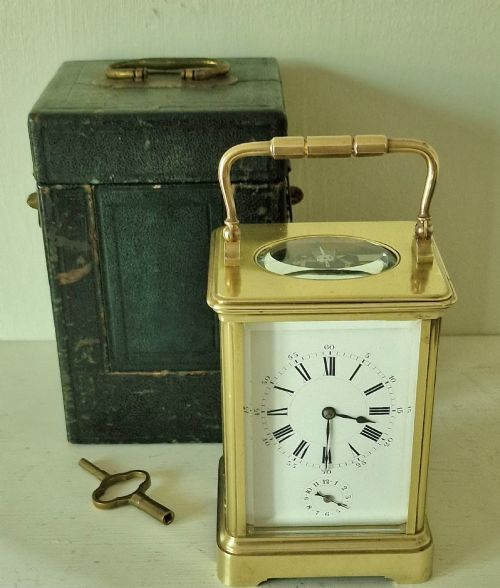
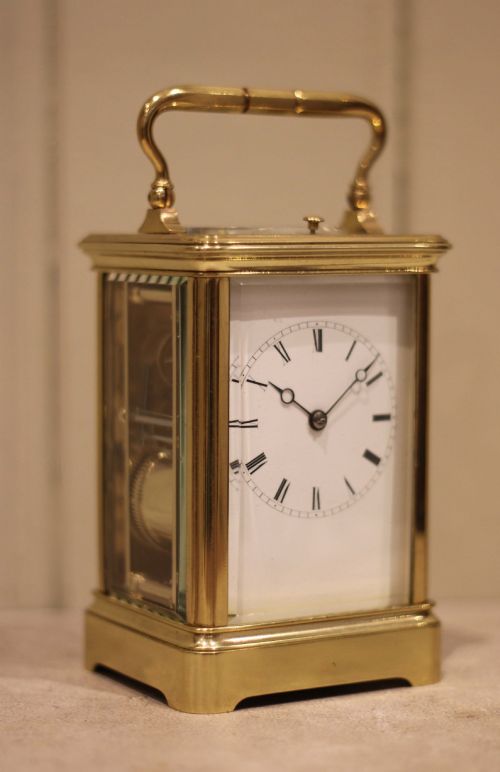
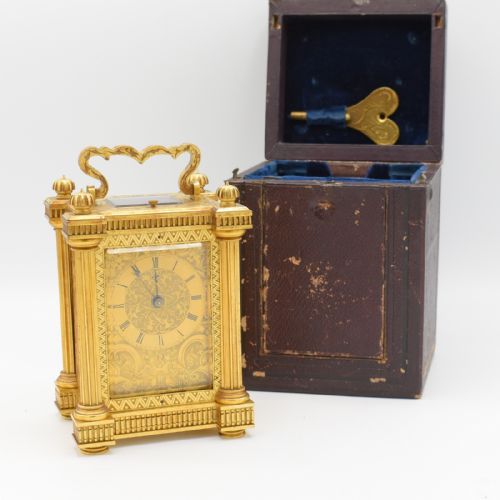


French Repeating Clock
When you handle a french repeating clock, you hold a piece of portable 19th-century horology that strikes the hours on demand.
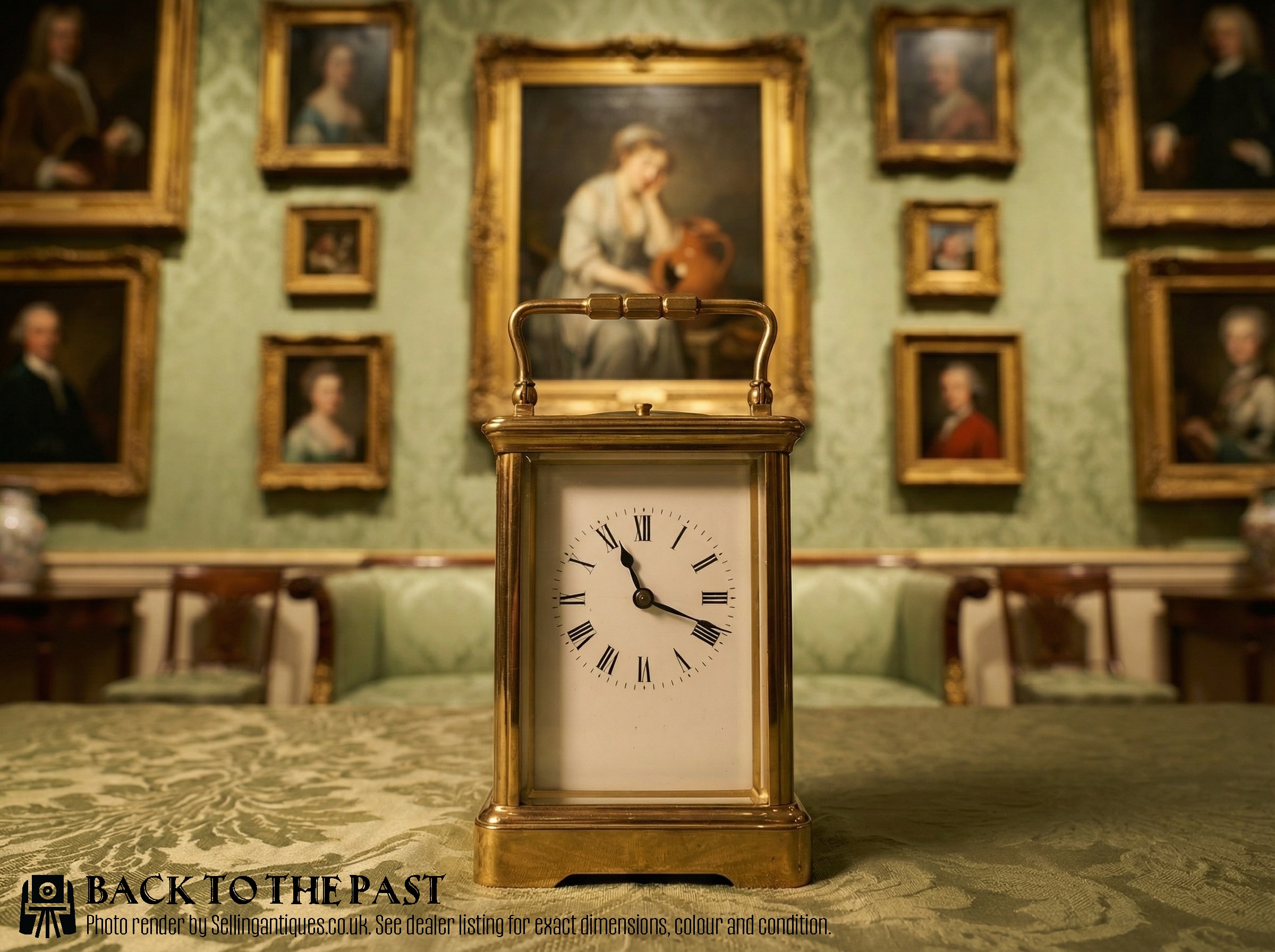
French Repeating Clock
A french repeating clock is a portable timepiece designed for travel, housing an intricate mechanical movement that sounds the last hour and quarters when a button or pendant is depressed. The pieces encountered most frequently on this page originate from the second half of the 19th century and into the Edwardian period.
Makers housed these movements in sturdy rectangular brass or gilt-brass frames, often with bevelled glass panels that reveal the escapement and gear train within. Variations include gorge cases, doucine shapes, and designs embellished with hand-painted enamel panels or detailed floral bandings.
Horologists built these clocks for convenience, allowing travellers to check the time in darkness by touch or sound without peering at a dial. Many examples combine the repeating mechanism with striking trains, alarms, or grand sonnerie capabilities.
How They Were Made
Workshops constructed the structural frames primarily from brass and gilt brass, casting heavy components and machining plates to house the complex gear trains. Cases frequently received supplementary surface treatments including gilding, silver plating, or hand engraving across the brass surfaces.
Glaziers fitted thick bevelled glass panels into the top, sides, and back doors, protecting the delicate balance wheel and escapement while offering visibility into the movement. Dials were typically formed of white enamel with painted Roman or Arabic numerals, sometimes surrounded by subsidiary enamel sub-dials or floral paintings.
Movement makers utilised steel for springs, arbors, and pinions, pairing them with brass wheels and lever escapements. Skilled artisans finished the components by hand, ensuring the striking, repeating, and alarm mechanisms interacted reliably within restricted portable dimensions.
French Repeating Clock Retail Price Guide 2026
Typical asking prices for french repeating clock among the pieces listed under this phrase on Sellingantiques today, from the lower quarter to the upper quarter. They describe what is for sale here now, not the wider market.
Listings feature carriage clocks spanning the Victorian era, the 1850s, 1860s, 1870s, 1880s, 1890s, and 1900, constructed in brass, gilt brass, silver gilt, and glass.
What Varies in Quality
The sophistication of the internal movement dictates much of the standing, moving from simple hour repeaters up to grand sonnerie, quarter-repeating, or alarm complications. The presence of documented maker signatures on the backplate or dial elevates a piece significantly.
Case execution and decorative depth distinguish standard production from finer output, seen in deeply hand-engraved gilt brass, silver-gilt finishes, or panels decorated with miniature enamel paintings. The thickness of the brass casting and the crispness of the mouldings also separate workshop grades.
The survival of original gilding and undamaged white enamel dials preserves the integrity of the piece. Clocks retaining their matching numbered keys or retaining original numbered leather travelling cases command stronger attention from collectors.
DROCOURT·Henri Jacot·Francois Arsene Margaine·Pons·Dwerrihouse & Bell·Howell & James
The French Repeating Clock Glossary
- Repeater
- A mechanical complication that strikes the last elapsed hour and quarters when a button on the top of the case is pressed. This function allowed owners to ascertain the time in the dark.
- Gorge case
- A distinct rectangular carriage clock case style characterised by a stepped cornice and base with reeded pillars at the corners. It is one of the most classic housings for 19th-century french timepieces.
- Grand Sonnerie
- A striking train that sounds both the hours and the quarters automatically as each quarter passes, alongside the repeating button function. It represents a more complex movement architecture than standard hour striking.
- Escapement
- The internal mechanism that controls the release of power from the gear train to the balance wheel, translating tension into regulated ticking. Platform escapements are standard in these portable clocks.
- Doucine case
- A carriage clock housing featuring concave curved mouldings along the top or sides of the brass frame. This profile softens the rectilinear geometry typical of travel clocks.
French Repeating Clock: Frequently Asked Questions
How do I operate the repeater?
Depress the button or plunger located on the top of the case firmly downwards. The mechanism will sound the last hour and any preceding quarters on the internal gongs or bell.
Release the button fully and allow the train to complete its cycle before pressing it again. Avoid forcing the plunger if the striking sequence feels jammed or hesitant.
What is a gorge case?
A gorge case is a heavy brass carriage clock housing defined by stepped mouldings on the top and bottom plates and fluted or reeded corner pillars. It provides a robust architectural frame for the movement.
This style became popular among leading french makers during the mid to late 19th century. Many fine examples feature hand engraving across these brass surfaces.
How do I wind the clock?
Insert the matching key into the appropriate winding square on the underside or backplate of the movement. Turn the key gently in the direction specified by the arrows until resistance indicates the mainspring is fully tensioned.
Take care not to overwind the springs, as this can cause breakage. Most travel clocks require winding every eight days.
Why does it strike twice?
Repeating mechanisms are designed to recount the hours and quarters sequentially when activated. If the clock sounds an incorrect hour or skips a quarter, the rack and snail components may require adjustment by a horologist.
Regular servicing ensures the synchronisation between the time-keeping train and the striking train remains accurate.