

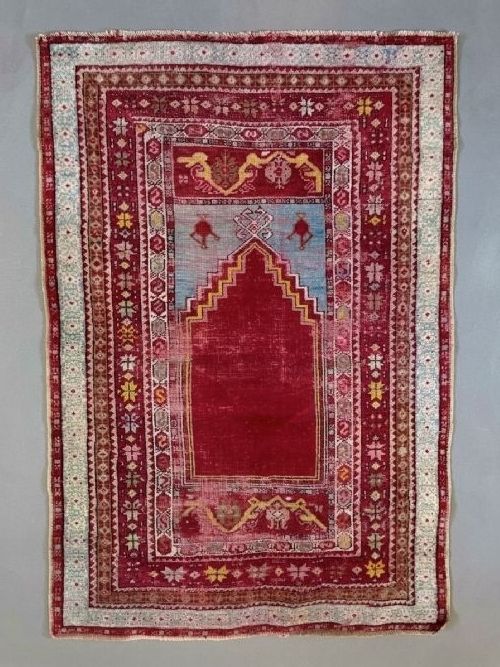


Ottoman Prayer Carpet
An ottoman prayer carpet brings centuries of Anatolian weaving tradition into a room through distinct architectural niches and rich wool pile.
Ottoman Prayer Carpet
An ottoman prayer carpet is a portable textile designed for daily devotion, featuring a central mihrab or architectural arch that indicates the direction of prayer. These pieces originate primarily from Turkish centres such as Ghiordes, Ladik, Konya, and Milas, spanning periods from the eighteenth century to the early twentieth century.
Buyers on this page encounter rugs and carpets categorised under Ottoman, Anatolian, and tribal traditions. The selection includes single niche designs alongside multi-niche safs, woven in regional village workshops and larger urban looms.
Materials and construction
Weavers constructed these rugs using wool, hand-spun wool, cotton foundations, and occasionally silk for finer urban commissions. Natural dyes provided the palette, producing durable tones across blues, greens, reds, and pistachios.
The pile is knotted onto warp and weft threads, creating dense surfaces designed to withstand regular use while retaining intricate border patterns and central motifs.
Ottoman Prayer Carpet Retail Price Guide 2026
Typical asking prices for ottoman prayer carpet among the pieces listed under this phrase on Sellingantiques today, from the lower quarter to the upper quarter. They describe what is for sale here now, not the wider market.
Early twentieth-century Romanian workshops occasionally produced faithful copies of seventeenth-century Transylvanian rugs, complete with simulated age.
Judging quality in woven textiles
Quality rests upon the precision of the knotting, the handling of natural dyes, and the clarity of the design structure within the niche. Examples executed with hand-spun wool and balanced colour palettes demonstrate superior material integrity.
The distinction between standard village production and master weaver output shows in the crispness of geometric borders, column details, and inscriptions woven into the field.
Tuduc
The Ottoman Prayer Carpet Glossary
- Mihrab
- The arched design at one end of a carpet representing the prayer niche found in mosques, oriented toward Mecca during use.
- Saf
- A multiple niche prayer rug designed to accommodate more than one person praying side by side.
- Ghiordes
- A historic weaving centre in western Anatolia known for knotted rugs featuring distinctive floral borders and architectural mihrabs.
- Warp
- The vertical threads stretched lengthwise on a loom that form the structural foundation of the carpet.
- Natural Dyes
- Colouring agents derived from plants, insects, and minerals rather than synthetic chemicals, yielding softer patinas over time.
Ottoman Prayer Carpet: Frequently Asked Questions
What is an ottoman prayer carpet used for?
These carpets served as clean, portable spaces for daily ritual prayer, providing a designated surface that could be rolled up and transported.
Their distinctive architectural designs also allowed wealthy households to display them as wall hangings or decorative floor coverings.
How do I identify a Ghiordes prayer rug?
Ghiordes rugs typically feature a pronounced central mihrab flanked by columns, accompanied by elaborate floral borders and soft wool pile.
Weavers in this western Anatolian town favoured specific palettes including pastel grounds and contrasting borders that separate them from other regional types.
What does a multi-niche saf rug look like?
A saf displays a sequence of several prayer arches repeating across a single long carpet field, allowing multiple individuals to pray simultaneously.
These pieces are exceptionally large and were often commissioned for communal spaces or larger household gatherings.
How should I care for an antique wool carpet?
Protect the textile from direct sunlight to prevent natural dye fading, and vacuum gently using suction without a rotating brush bar.
Professional cleaning should be undertaken sparingly by specialists experienced in antique hand-knotted pile carpets.