
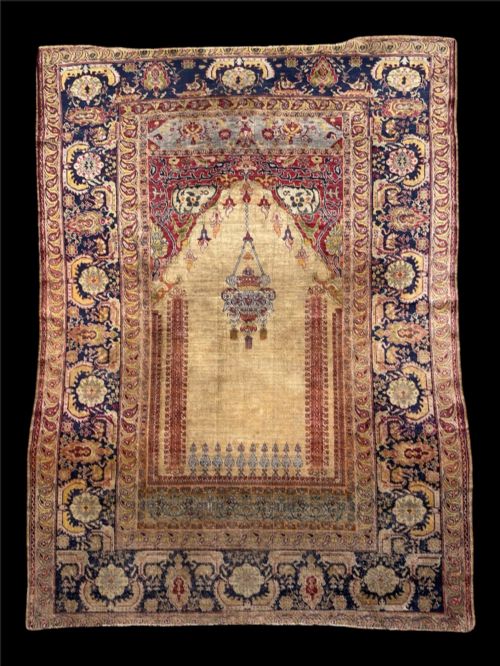


Antique Islamic Prayer Rug
An antique islamic prayer rug brings centuries of woven devotion and architectural mihrab designs straight onto your floor.
Antique Islamic Prayer Rug
An antique islamic prayer rug is a portable place of worship characterised by its distinctive niche design, known as the mihrab, which points the worshipper toward Mecca. These textiles encompass regional styles from Anatolian, Ottoman, Caucasian, Turkmen tribal, and Persian traditions spanning the eighteenth and nineteenth centuries.
The pieces available here include specific village and tribal formats such as Ghiordes, Ladik, Kizil Ayak, Bordjalou Kazak, Kirsehir, Shirvan, and Monastir types. Most examples survive from the nineteenth and early twentieth centuries, alongside older eighteenth-century workshop and nomadic weaving traditions.
Buyers encounter formats ranging from single niche prayer rugs to double lantern compositions and multi-column architectural designs. These floor coverings and area rugs reflect both the solemn requirements of daily prayer and the decorative aesthetics of their specific weaving cultures.
Materials and construction
These textiles rely on natural fibres, primarily utilising wool for the dense pile and foundation yarns, alongside cotton foundations in certain regional workshops. Finer city and workshop pieces incorporate silk to achieve intricate detail and luminosity in the design.
Weavers knotted the pile by hand onto warp and weft foundations, employing traditional wool and silk materials that allowed for complex geometric medallions, floral lattices, and architectural columns. The choice of fibre directly influences the weight, drape, and structural rigidity of each rug.
Some nineteenth-century weavers carefully inscribed dates in Islamic script right into the pile, leaving a permanent signature for future generations to puzzle over.
What separates the best from the rest
Quality rests on the precision of the knotting, the saturation and balance of the natural dyes, and the clarity of the drawing within the mihrab and borders. Finer examples display meticulous attention to detail in secondary motifs, such as floral lattices and inscription bands.
The integrity of the wool or silk pile and the survival of the original outer borders dictate the visual impact of the piece. Superior specimens maintain crisp architectural lines and harmonious colour palettes that remain legible across the entire field.
The Antique Islamic Prayer Rug Glossary
- Mihrab
- The arched niche at one end of a prayer rug that symbolises the direction of Mecca. This architectural feature directs the focus of the person kneeling in prayer.
- Ghiordes
- A historic town in Western Turkey renowned for distinctive classical prayer rug designs. Weavings from this centre often feature prominent pillars and stepped arches.
- Kazak
- A style of Caucasian tribal rug known for bold geometric patterns and strong primary colours. These pieces originate from the southern Caucasus region.
- Ladik
- A Turkish weaving centre famous for eighteenth-century prayer rugs with distinctive tiered mihrabs and tulip motifs. These rugs hold a prominent place in Anatolian textile history.
- Shirvan
- A Caucasian weaving region producing rugs with fine ivory grounds and precise floral lattice work. These textiles are celebrated for their balanced composition and delicate detailing.
Antique Islamic Prayer Rug: Frequently Asked Questions
How do I identify a prayer rug?
A prayer rug is instantly recognised by its single or double mihrab arch, which frames the upper section of the field to direct the user toward Mecca during devotions.
Unlike standard area rugs, the composition focuses the eye toward this directional niche rather than presenting an all-over repeating medallion.
Where were these rugs made?
These textiles originate from weaving traditions across Turkey, the Caucasus, and Central Asia, encompassing Ottoman workshops and nomadic tribal groups.
Specific provenances include Anatolian centres like Ghiordes and Ladik, Caucasian regions like Shirvan and Kazak, and Turkmen tribal areas.
How do I care for an antique rug?
Protect your rug by placing it in a low-traffic area out of direct sunlight to preserve the natural wool and silk pile. Vacuum gently using suction only without a rotating brush bar.
Consult a specialist textile conservator for professional cleaning rather than attempting wet washing at home.
What distinguishes eighteenth-century pieces?
Earlier eighteenth-century examples often display greater purity in regional drawing styles, deeply saturated natural dyes, and specific structural characteristics in the wool foundation.
These older weavings reflect classical Ottoman court designs or early village interpretations that became rarer in subsequent centuries.