


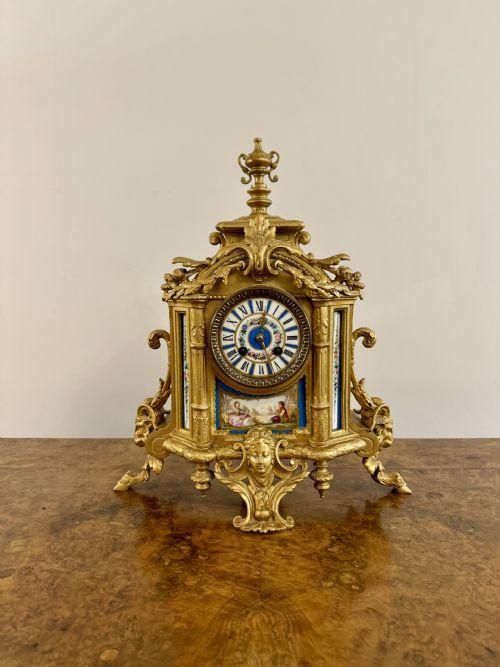


Ornate Gilt Table Clock
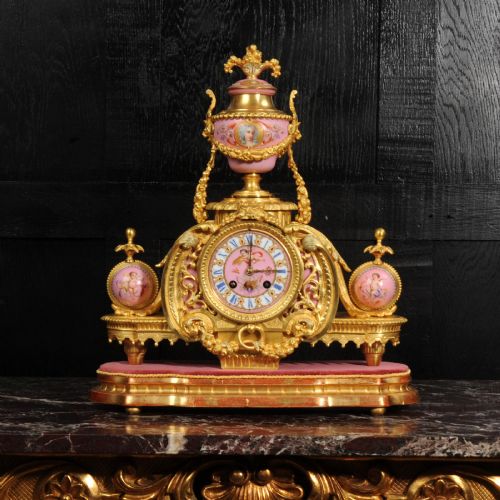
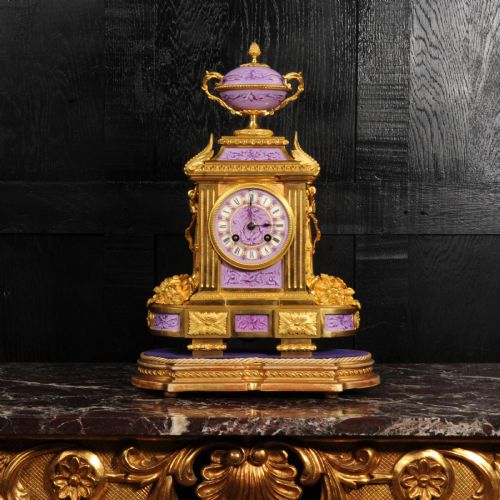
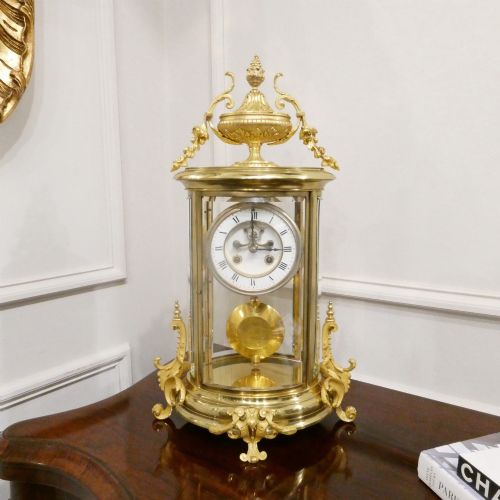
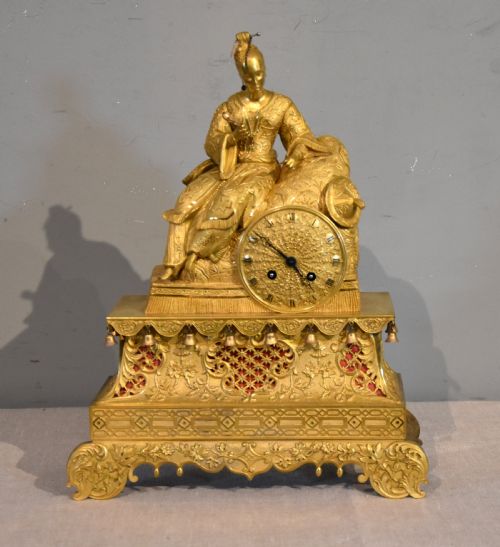
An ornate gilt table clock brings striking nineteenth-century presence to a mantelpiece through gilded metalwork and intricate dial surrounds.
Ornate Gilt Table Clock
An ornate gilt table clock covers a range of nineteenth-century decorative timepieces designed for mantelpieces, desks, and brackets. Buyers encounter mantel clocks, carriage clocks, portico timepieces, and larger clock garniture sets featuring flanking ornaments.
The selection on this page is dominated by French manufacture from the Victorian era, spanning the decades between eighteen fifty and nineteen hundred. Pieces frequently reflect revived historical tastes such as Rococo, Louis XVI, and Second Empire styles.
Common formats include four-glass mantel designs, figural subjects, and architectural marble cases mounted with gilt bronze or brass. Smaller carriage clocks in engraved cases also appear alongside elaborate champlevé enamel examples.
Materials and construction
Cases combine base metals like brass and bronze finished with ormolu or fire-gilding, paired with natural materials such as marble, porcelain, and glass. Dial faces often incorporate hand-painted enamel panels or porcelain plaques, sometimes attributed to Sèvres workshops.
Internal movements rely on brass wheel trains, escapements, and spring or weight power, often housing eight-day striking mechanisms produced by prominent French factories. Decorative enrichment is achieved through champlevé enamel work, cast figural mounts, and fine metal engraving.
Ornate Gilt Table Clock Retail Price Guide 2026
Typical asking prices for ornate gilt table clock among the pieces listed under this phrase on Sellingantiques today, from the lower quarter to the upper quarter. They describe what is for sale here now, not the wider market.
Listings feature nineteenth-century French and English horology, incorporating materials like Sèvres porcelain, champlevé enamel, white marble, and fire-gilded ormolu.
Craftsmanship and finish
The distinction between tiers of work rests on the crispness of the bronze casting and the depth of the gilding. Superior examples display sharply chiselled mounts, hand-painted porcelain with intact detail, and robust movements signed by established makers.
Lesser pieces feature softer cast definition, mechanical replacements, or worn surface finishes where the underlying base metal shows through. The integration of auxiliary elements like matching side urns in a garniture set also influences the integrity of an object.
Achille Brocot·Samuel Marti·Japy Freres·William Payne·John Barwise
The Ornate Gilt Table Clock Glossary
- Ormolu
- A technique of applying finely ground high-carat gold to a bronze base using a mercury amalgam. It produces a warm, durable metallic lustre typical of luxury French horology.
- Champlevé
- An enamelling process where troughs are hollowed out of a metal surface and filled with vitreous paste before firing. This technique decorates clock cases with colourful geometric or floral patterns.
- Garniture
- A set consisting of a central clock flanked by matching decorative objects such as urns or candelabra. These sets were designed to create a balanced display across a mantelpiece.
- Fusee
- A conical pulley used in clock movements to maintain even tension on the gear train as the mainspring unwinds. It represents a mark of mechanical precision in better timepieces.
- Portico timepiece
- A clock housed within an architectural frame supported by columns. This neoclassical form often incorporates marble and gilt bronze elements.
Ornate Gilt Table Clock: Frequently Asked Questions
How do I wind an antique gilt table clock?
Most mechanical clocks use a specific winding key inserted into holes on the dial face to tension the springs. Care must be taken not to overwind the mechanism.
Striking clocks should be allowed to complete their sequence before adjusting the hands to avoid damaging the internal count wheel.
What is the difference between ormolu and gilt brass?
Ormolu involves a thick layer of gold applied to a bronze casting through traditional fire-gilding methods, creating a rich golden tone. Gilt brass uses a lighter surface application over a simpler yellow metal alloy.
High-grade nineteenth-century French pieces generally employ ormolu on bronze for sharper sculptural detail.
Where should I place a heavy marble clock?
Marble and bronze clock sets require a sturdy, level surface capable of supporting considerable weight without shifting. A solid mantelpiece or heavy sideboard provides the necessary stability.
Keeping the clock away from direct sunlight and damp walls protects both the delicate enamel dials and the internal steel components.
How do I identify a French Rococo revival clock?
Rococo revival pieces feature asymmetrical scrolls, C-scrolls, acanthus leaf motifs, and often incorporate naturalistic rockwork or cherubs. The gilt bronze or brass cases curve fluidly without strict geometric symmetry.
Many of these examples date from the mid to late nineteenth century and draw inspiration from eighteenth-century court styles.
Are clock garnitures complete sets?
Clock garnitures typically include a central timepiece accompanied by two matching side pieces, such as urns or vases. These items were manufactured together to form a unified decorative arrangement.
Checking that the mounts, marble types, and gilding match across all components confirms the set remains together.