
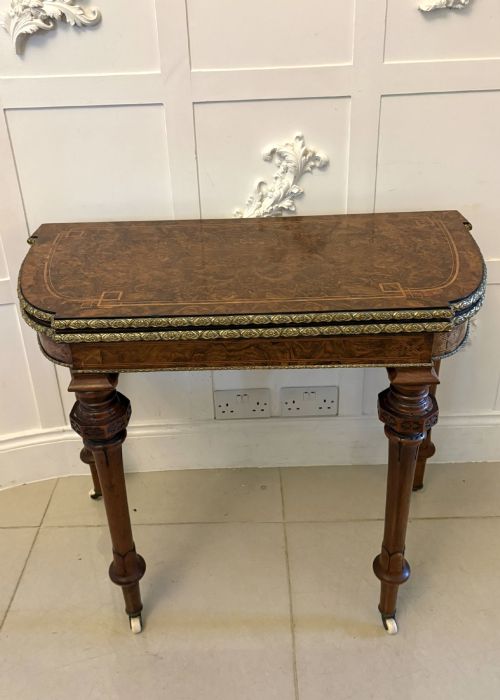
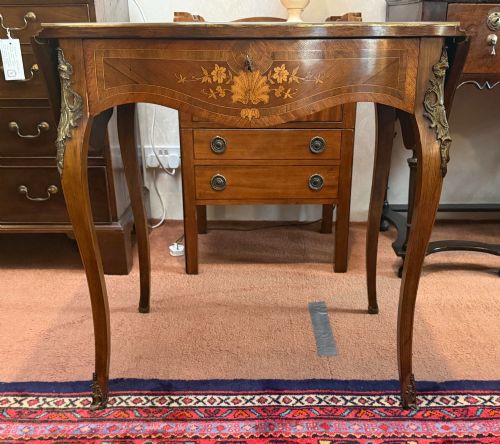
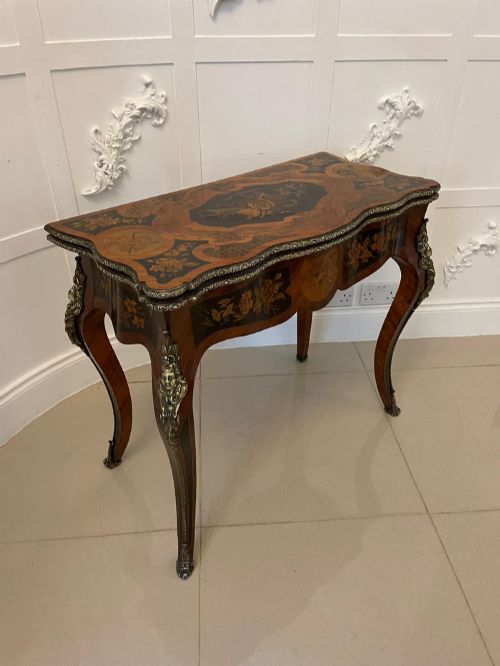
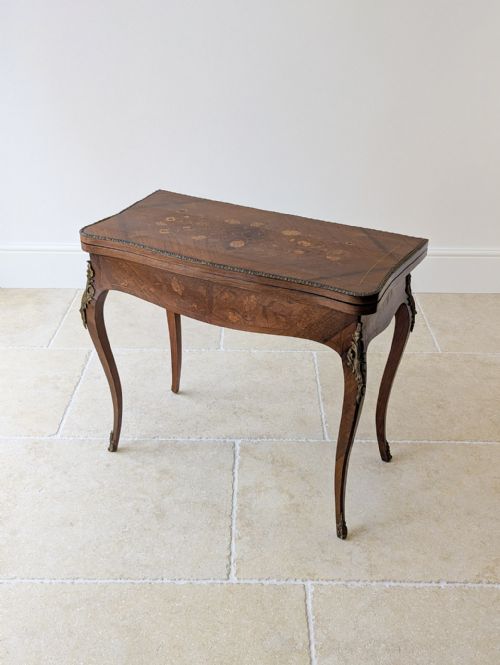
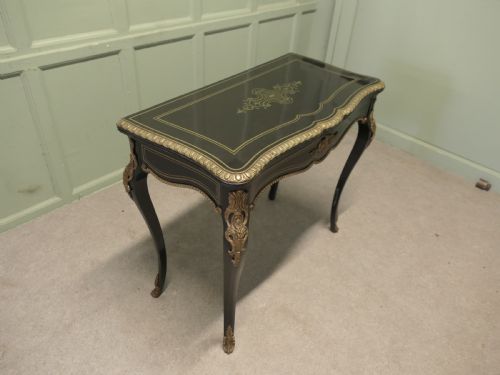
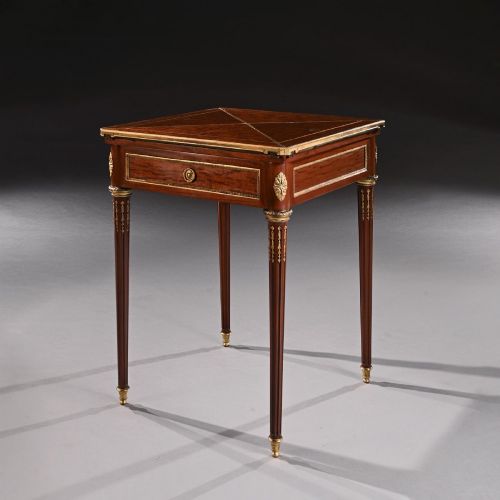
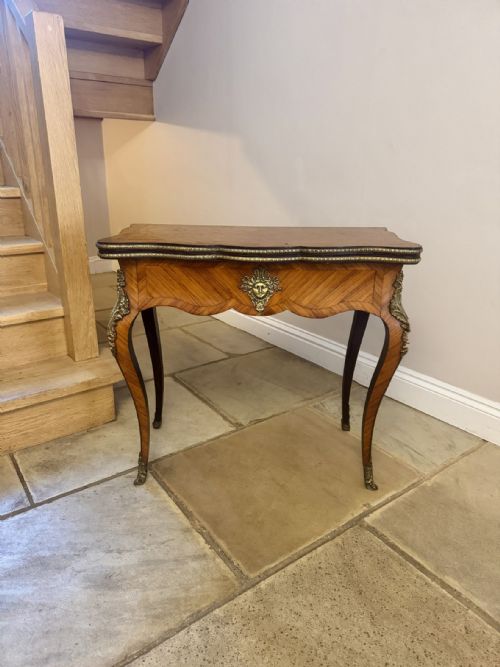
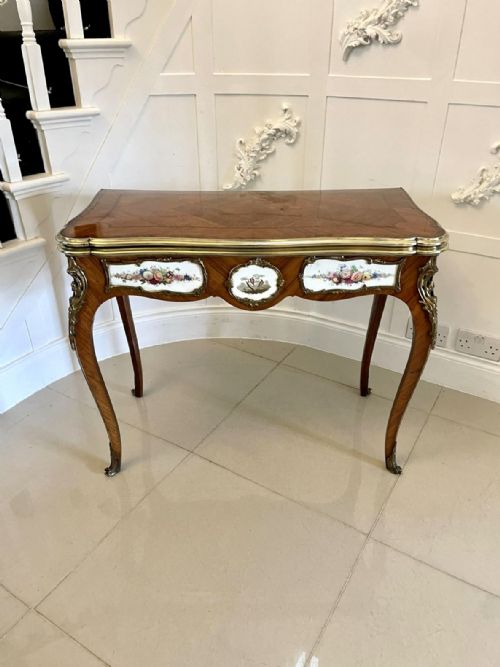
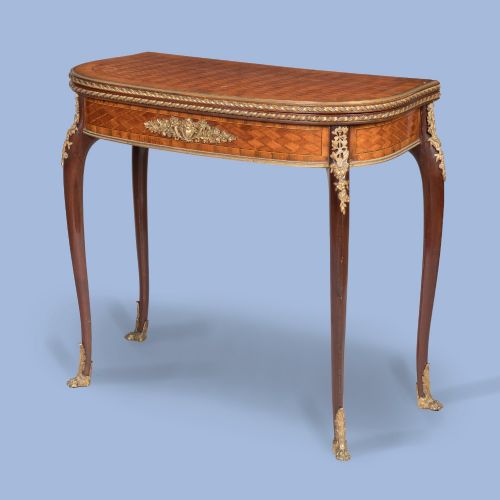
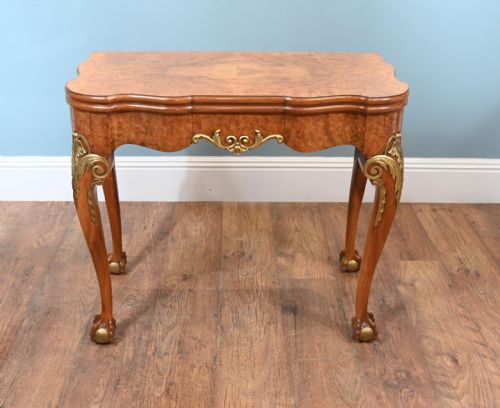
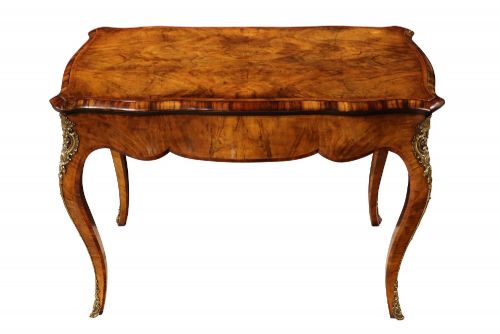
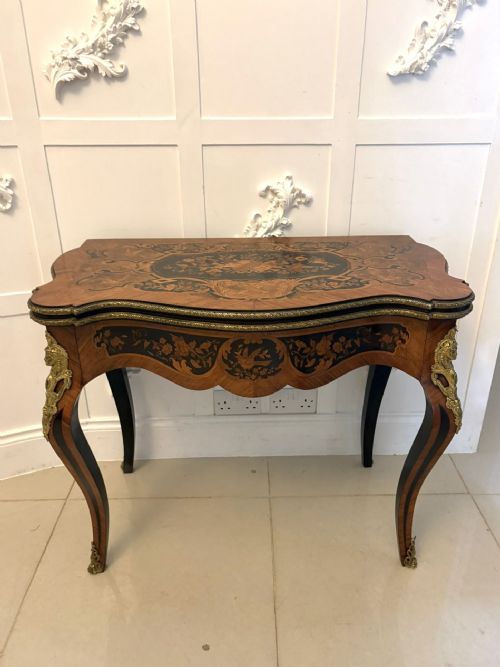
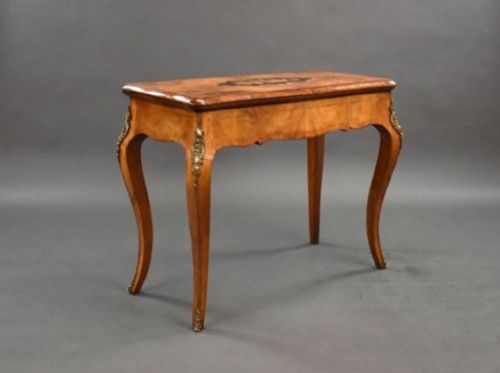


Ormolu Card Table
When you handle an ormolu card table, you hold a piece of nineteenth-century craftsmanship designed for evening entertainment and display.
How they were made
Cabinet-makers built the carcasses of these tables using solid foundational timbers like mahogany or walnut, subsequently applying decorative veneers of kingwood, rosewood, burr walnut and exotic woods in parquetry and floral marquetry patterns. Brass and porcelain elements occasionally supplemented the timber surfaces.
Gilt bronze or ormolu mounts were cast, chased and fire-gilded before being screwed or pegged to the corners, apron centres and cabriole legs of the table. These metal garnitures protected vulnerable edges while framing the wood grain and marquetry panels.
What varies in quality
Quality separates ordinary production furniture from exhibition pieces through the crispness of the ormolu chasing and the complexity of the wood veneers. Superior tables display finely detailed bronze mounts that retain their original fire gilding alongside intricate, tight marquetry.
Construction standards also determine value, visible in the precision of the fold-over hinges, the stability of the leg joints and the thickness of the timber used for the carcase and cross-banding.
Listings for ormolu card tables heavily feature walnut, burr walnut and kingwood veneers combined with Louis XV and Louis XVI revival styles.
Antoine Lampre·G T Morant·François Linke·Epstein and Co·Maple and Co·Maison Mottheau·Joseph-Emmanuel Zwiener·Maison Millet·Edwards and Roberts·Henry Dasson
The Ormolu Card Table Glossary
- Ormolu
- Gilded bronze mounts applied as decoration to furniture surfaces. The technique involves applying a mercury and gold amalgam to cast bronze before heating.
- Marquetry
- Decorative patterns formed by fitting together thin slices of veneer in floral or geometric designs. This work requires precise hand-cutting of diverse exotic timbers.
- Parquetry
- Geometric wood inlay forming repetitive patterns such as cubes or chessboards across the table top. It differs from marquetry by using angular, repeating shapes.
- Envelope table
- A square card table with four triangular flaps that swivel and fold open to reveal the playing surface. The mechanism resembles a folded envelope.
Ormolu Card Table: Frequently Asked Questions
How did people use an ormolu card table?
These tables served a dual purpose in nineteenth-century drawing rooms, functioning as console or side tables against a wall when closed. In the evening, the top folded or swiveled open to create a stable surface for card games and social gatherings.
Beneath the folding top, many models incorporated a hidden compartment or well designed for storing playing cards, counters and gaming accessories.
How can I tell a French table from an English one?
French tables from this era frequently employ extensive kingwood veneers, elaborate floral marquetry, and heavier cast ormolu mounts influenced by Louis XV and Louis XVI revivals. English versions often showcase figured walnut, burr walnut or mahogany with more restrained brass or gilt mountings.
Maker stamps or retailer labels, when present inside drawers or on the carcase edge, provide definitive proof of origin from London firms or Parisian ateliers.
How should I care for ormolu mounts?
Ormolu mounts require gentle dusting with a dry, soft cloth to prevent the accumulation of dirt in the recessed chased details. Avoid abrasive cleaners, polishes and chemical solvents, which can strip the historic gilt surface from the bronze.
Maintaining stable room humidity protects both the delicate gilt bronze and the underlying wood veneers from cracking or warping.